

Use this telecom BPO RFP template to ask vendors 75 telecom-specific questions on CPNI, porting, fallout, and FCC onshoring. Compare answers with a weighted scorecard.
Most RFP templates ask a BPO partner about headcount, hours, and price. Few ask what happens when a port request fails at 9 p.m. For a telecom operator, those gaps show up later as order fallout, fraud, or a compliance finding. This telecom BPO RFP template closes them. It gives Tier 1 and Tier 2 operators 75 questions in 10 areas, plus a weighted scorecard to compare vendors.
What Makes a Telecom BPO RFP Different?
A telecom BPO RFP asks outsourcing partners how they would run your care, support, and back-office work. A generic call center outsourcing RFP template covers staffing, quality, and price. However, telecom work carries risks those templates skip.
For example, agents handle customer proprietary network information (CPNI), which federal rules protect. They also work number ports and provisioning orders, where one error can cut off service. In addition, the FCC proposed limits on offshore call centers in March 2026. So a telecom outsourcing RFP must ask where agents sit, too. Our guide to FCC offshore call center rules explains that proposal.
How to Use This Telecom BPO RFP Template
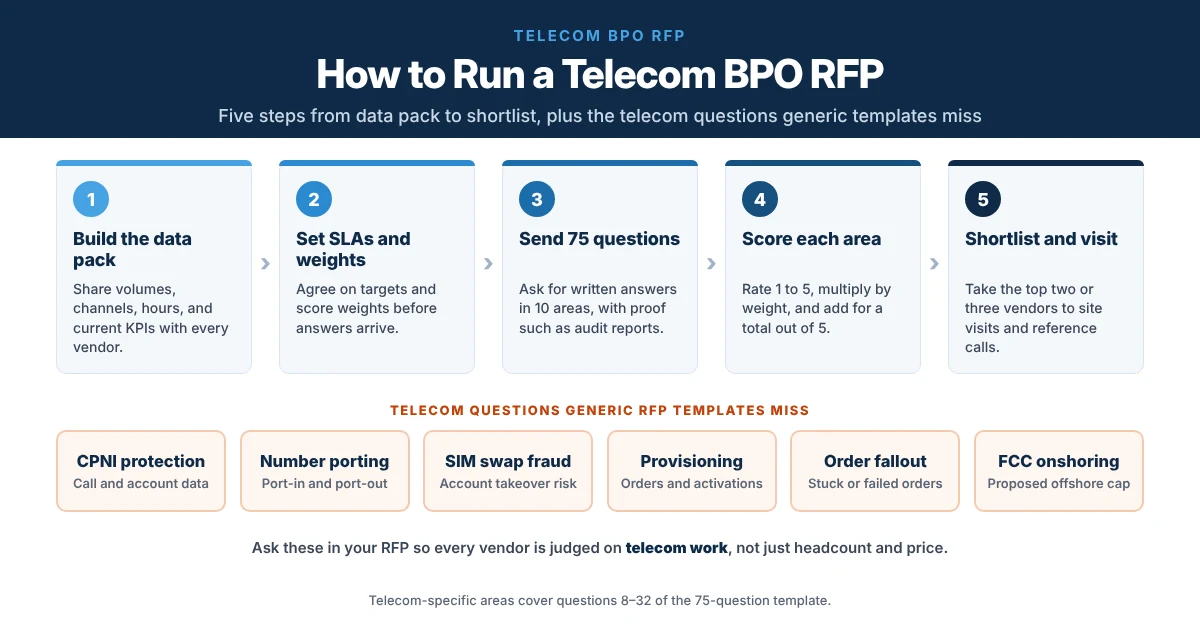
First, send every vendor the same questions and data pack. Include volumes, channels, hours, and current KPIs. Otherwise, vendors guess, and prices will not compare. Many teams also request an early budget quote to set a realistic range.
Next, set your target service levels. Our guide to telecom BPO SLAs shows which metrics to include. Then ask for written answers and proof, such as audit reports. Finally, score each answer with the scorecard below.
75 Telecom BPO RFP Questions to Ask
The contact center RFP questions below fall into 10 areas. Copy them as written, or trim them to fit your scope.
1. Company and Telecom Experience
- How many years have you supported telecom clients?
- Which telecom clients do you serve today?
- What share of your revenue comes from telecom?
- Which lines do you support, such as wireless, fiber, or VoIP?
- Can you share two telecom references?
- What was your client retention rate over the past three years?
- Who would be our executive sponsor?
2. Provisioning, Porting, and Order Fallout
This is where telecom work differs most from general support.
- Which order types do agents handle, such as installs and disconnects?
- How do you process port-in and port-out requests?
- What controls stop port-out fraud and unauthorized SIM swaps?
- How do you work order fallout, and how fast do you clear it?
- What alerts flag at-risk orders before they miss a due date?
- Which OSS and BSS platforms have your agents used?
- How do you fix orders that fail between billing and provisioning?
- Do you also schedule field technicians?
- How do you report fallout root causes to our teams?
3. CPNI, Data Security, and Compliance
Security answers need proof. Since March 31, 2025, the future-dated PCI DSS v4.x requirements have been mandatory, so ask for current reports.
- How often do you train agents on CPNI rules?
- What steps verify callers before agents share account details?
- How do you log and report a CPNI breach?
- Can you share your latest PCI DSS v4.x report on compliance?
- Which other audits do you hold, such as SOC 2 Type II?
- How do you keep card numbers out of call recordings?
- Do agents work on-site, from home, or both?
- How do you limit agent access to customer data?
- How do you meet state privacy laws, such as California’s?
4. Delivery Locations and FCC Onshoring
The FCC proposal uses 30% as an example cap on offshore calls. It is not final, but vendors should be ready.
- Which countries and cities would serve our account?
- What share of our volume could U.S. sites handle?
- How fast could you move volume onshore when rules require it?
- Can you route password and payment calls to U.S. agents only?
- How would you report the share of calls handled offshore?
- Can customers reach a U.S.-based agent when they ask?
- Which backup sites protect service during outages?
5. Hiring, Training, and Agent Retention
- How do you recruit and screen telecom agents?
- Which training does each queue get, and for how long?
- How long is nesting before agents work alone?
- What was your agent attrition rate over the past 12 months?
- How many agents report to each team lead?
- How do you retrain agents when plans or prices change?
- Can you staff bilingual English and Spanish queues?
- How do you keep trained agents during slow periods?
6. Quality, KPIs, and SLAs
- Which KPIs do you report, and how often?
- What service level and first contact resolution do similar clients see?
- What share of contacts does your QA team review?
- How do you calibrate quality scores with our team?
- Which credits do you accept for missed SLAs?
- How do you reduce repeat calls?
- How do you track customer satisfaction?
- What happens when a program misses targets for two months?
7. Technology, AI, and Integration
- Which contact center platforms do you support, and can you use ours?
- How do you use AI for agent assist, QA, or self-service?
- What stops AI tools from exposing customer data?
- How quickly can you connect to our CRM and billing tools?
- Which real-time dashboards will we see?
- Which channels do you support, such as chat, email, and text?
- Who owns recordings and data when the contract ends?
8. Workforce Management and Scaling
Telecom volume jumps during outages, launches, and billing changes.
- How do you forecast and schedule staff for our queues?
- Within 30 days, how many agents could you add?
- How do you staff for network outages and storms?
- How do you cover nights, weekends, and holidays?
- What happens when volume falls below forecast?
- Can agents also cross-skill across care, tech support, and billing?
9. Transition and Launch
A weak handoff can undo months of planning. Our 90-day BPO transition plan shows what a strong one includes.
- What does your transition plan look like, week by week?
- Who leads the transition?
- How do you capture knowledge from our current team?
- Which go-live criteria must you meet before launch?
- How do you protect service levels during the ramp?
- What exit support do you provide when the contract ends?
10. Pricing and Commercial Terms
Ask for pricing you can compare line by line. Our guide to telecom call center outsourcing pricing explains the common models.
- Do you price per hour, per agent, per minute, or per transaction?
- What does the rate include, and what costs extra?
- What are your setup and technology fees?
- Which volume minimums do you require?
- How do rates differ by location, such as U.S. or offshore?
- Do you offer outcome-based pricing?
- How often can rates rise, and by how much?
- Which notice period and exit terms do you propose?
Free BPO Vendor Evaluation Scorecard
This BPO vendor evaluation scorecard turns answers into one number per vendor. Score each area from 1 (weak) to 5 (strong). Then multiply each score by its weight and add the results.
| Area | Questions | Weight | What a 5 looks like |
|---|---|---|---|
| Telecom experience | 1–7 | 10% | Years of telecom work, live references |
| Provisioning, porting, fallout | 8–16 | 15% | Written fallout process with tracked times |
| CPNI and security | 17–25 | 15% | Current PCI DSS and SOC 2 reports |
| Locations and onshoring | 26–32 | 10% | U.S. capacity and an onshore plan |
| Hiring and retention | 33–40 | 10% | Low attrition, telecom training |
| Quality and SLAs | 41–48 | 15% | Proven results and SLA credits |
| Technology and AI | 49–55 | 5% | Works on your platforms securely |
| Scaling | 56–61 | 5% | Tested surge plan |
| Transition | 62–67 | 5% | Weekly plan with go-live criteria |
| Pricing and terms | 68–75 | 10% | Clear rates, fair exit terms |
For example, a vendor that scores 4 on security earns 0.6 points, because 4 × 15% = 0.6. Add all 10 areas for a total out of 5.
Next, adjust the weights to fit your needs. A Tier 1 operator might raise security and locations to 20% each. A Tier 2 operator, by contrast, might weight pricing higher. In the end, shortlist the top two or three vendors for site visits. Use this as your BPO RFP checklist at every stage.
Talk to a Telecom BPO Expert Before You Send Your RFP
The right questions now save months of rework later. Sequential Tech supports telecom operators, MVNOs, and broadband providers with care, technical support, billing, and retention teams across U.S., Canadian, nearshore, and offshore sites. Our telecom-trained agents already work within the CPNI and service rules this template covers.
Have questions about your RFP or scorecard? Talk to our telecom BPO experts and choose your next partner with confidence.
Frequently Asked Questions About Telecom BPO RFPs
What should a telecom BPO RFP include?
A telecom BPO RFP should include your volumes, channels, hours, and target KPIs. It should also ask about telecom experience, security, locations, staffing, quality, technology, transition, and pricing. Most importantly, it should cover CPNI, number porting, provisioning, and order fallout, which generic templates often miss.
How do you score BPO vendors in an RFP?
Score each area from 1 to 5, then multiply each score by its weight and add the results. For example, a score of 4 in an area weighted at 15% earns 0.6 points. Set the weights before answers arrive, so every vendor is judged the same way.
What compliance questions should you ask a telecom BPO?
Ask how the vendor trains agents on CPNI rules, verifies callers, and reports breaches. Then request a current PCI DSS v4.x report and a SOC 2 Type II report. Also ask how it stops port-out fraud and SIM swaps, and how it would meet proposed FCC offshore limits.
What is the difference between an RFI and an RFP for BPO services?
An RFI, or request for information, gathers basic facts from many vendors to build a shortlist. An RFP, or request for proposal, asks shortlisted vendors for detailed answers, pricing, and a delivery plan. Many operators send an RFI first and then the RFP.
How many vendors should receive a telecom BPO RFP?
Three to five vendors is a practical range for most telecom operators. Fewer vendors limit your choice and pricing leverage. More vendors add review time without better results. After scoring, shortlist the top two or three for site visits and reference calls.