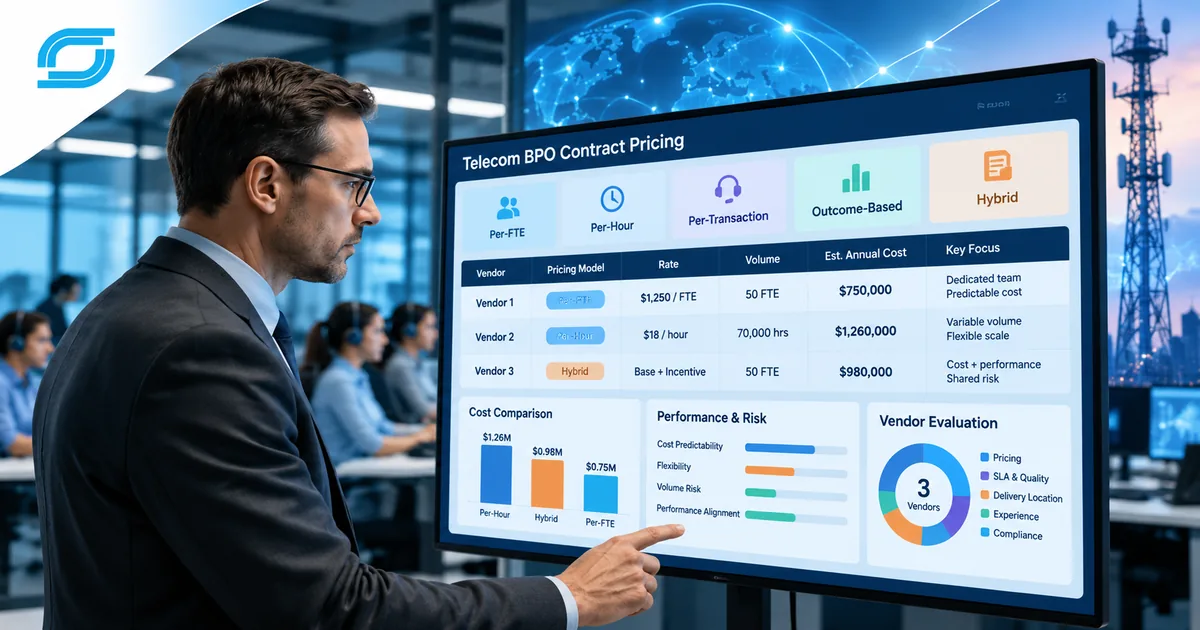

A nearshore call center sits close to home, in your time zone, with bilingual agents on the line. This guide shows why US telecom operators now choose nearshore support for real-time, high-quality CX.
It is 4 p.m. on a Tuesday. A subscriber calls about a billing error, and she wants to switch to Spanish. Your offshore team is half a world away, and the shift just ended. So the call waits. Now picture the same call going to an agent in Bogotá or Mexico City. Same time zone. Fluent in English and Spanish. The fix takes three minutes, not three days. That gap is the nearshore difference. And for US telecom operators, it is quietly changing where support lives.
What is a nearshore call center?
A nearshore call center handles your support from a nearby country, not a distant one. For US operators, that means Latin America and the Caribbean. Think Mexico, Colombia, Costa Rica, and Jamaica. It sits between two familiar choices.
On one side is onshore, with agents inside the US. It gives the best cultural fit, but the highest cost. On the other side is offshore, in far hubs like India or the Philippines. It gives the lowest cost, but the widest gaps in time and language. Nearshore lands in the middle. And for telecom, that middle is a sweet spot. That blend of cost and quality is why many telecom customer care leaders now look south. For the full picture, see our onshore, nearshore, and offshore comparison guide.
Why nearshore fits telecom support so well
Telecom support is rarely simple. Calls are often technical, urgent, and personal. So the where of support really matters. Nearshore fits telecom for four clear reasons, and they build on each other.
First, time zones line up. A nearshore team shares six to eight hours of the US business day. So when a subscriber calls at 2 p.m. Eastern, an agent is already on the clock. And a supervisor can jump on a hard case in real time, not overnight.
Second, the bilingual pool runs deep. Spanish is a first language across the region. And English is strong in hubs like Colombia, Costa Rica, and Mexico. So one agent can move between English and Spanish on the same call. For operators chasing Hispanic market growth, that is a real edge.
Third, quality holds steadier. Nearshore teams follow US culture, sports, and brands closely, so conversations feel natural. Turnover also runs lower than in many offshore voice centers. And lower turnover means more experienced agents on the phone, which subscribers feel right away.
Fourth, the price is right. Nearshore rates sit around $10 to $20 per agent hour. That is well below US onshore, where customer service wages run about $21 an hour before overhead. So you trim cost without shipping the work to the other side of the planet.
Onshore vs. nearshore vs. offshore at a glance
Put the three models side by side, and the trade-offs get clear. The table below compares them on the things telecom operators care about most.
| Factor | Onshore (US) | Nearshore (LATAM) | Offshore (Asia) |
|---|---|---|---|
| Cost per agent hour | $25–$50 | $10–$20 | $6–$16 |
| US business-hours overlap | Full | 6–8 hours | 8–12 hour gap |
| Bilingual English/Spanish | Small pool | Strong, US-tuned | Limited |
| Real-time escalation | Easy | Easy | Hard |
| Best-fit telecom work | Sensitive, governance | Daytime care, complex voice, retention | High-volume, scripted |
The pattern is easy to read. Offshore wins on raw cost. Onshore wins on proximity. But nearshore wins on balance, and balance is what real-time telecom support needs. For operators spreading risk across regions, nearshore also anchors a strong multi-shore delivery footprint.
Why nearshore wins for US telecom
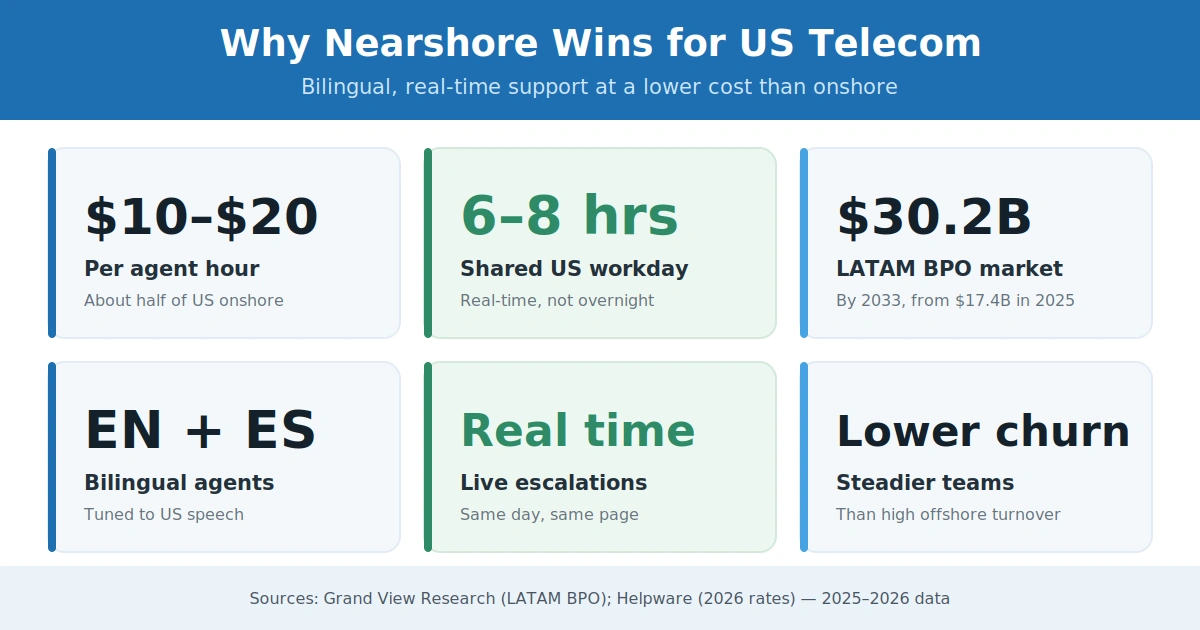 Nearshore telecom support combines lower costs, bilingual agents, real-time escalation, and better customer experience.
The telecom work that belongs nearshore
Nearshore is not the right home for every task. But it shines where timing and language matter most. These are the jobs that fit it best:
- Daytime customer care: Billing questions, plan changes, and account help during US business hours.
- Complex voice and tech support: Troubleshooting that needs a real conversation, not a script, often through a telecom inbound call center team.
- Save-desk and retention: Win-back calls where tone and timing decide whether you keep the subscriber.
- Bilingual Spanish support: Calls that switch between English and Spanish without a clumsy handoff.
High-volume, scripted work can still go offshore, where cost rules. So many operators split the two. They keep the real-time, bilingual work nearshore, and send simple overflow offshore. As a result, they get the best of both worlds.
Where offshore falls short and nearshore steps up
Offshore still has its place. It offers the lowest cost and easy 24/7 scale. But it struggles where telecom hurts most. The time gap is the first problem. When your team sleeps through the US day, real-time escalation breaks down. Second, distance can dull the conversation, through accents and cultural gaps. And third, voice attrition often runs high, so quality wobbles. Nearshore closes those gaps for a small step up in cost. That is one reason more US operators are shifting to blended delivery.
The timing is good, too. Because the Latin America outsourcing market keeps growing, the nearshore talent pool keeps deepening. New hubs open each year, and agent skills keep rising. So the quality gap with onshore keeps shrinking, while the cost gap stays wide.
Top nearshore locations for US telecom
A few countries lead the nearshore map for US telecom. Mexico offers scale, strong Spanish, and a short flight for site visits. Colombia brings excellent English and a neutral accent. Costa Rica is known for quality and stability. And the Caribbean, from Jamaica to the Dominican Republic, adds strong English voice talent. Each one shares most of the US business day. So the right pick depends on your own mix of language, cost, and call volume.
How to choose a nearshore telecom partner
Not every nearshore partner fits telecom. So weigh a few things before you sign. Look for real telecom experience, because activations and outages then need little ramp time. Check that agents are truly bilingual, not just conversational. Confirm US-timezone coverage, so escalations stay live. And review compliance closely, since telecom support carries strict rules. A partner that clears all four is rare, and worth the search. For a wider view of every model, see our full onshore, nearshore, and offshore BPO guide.
Bring your telecom support closer to home
Here is the bottom line. Your subscribers want fast, fluent help, in their time zone and their language. Nearshore delivers exactly that, at a price that makes sense. This is the work Sequential Tech does for US telecom operators. Our customer care teams run bilingual, US-aligned support across Latin America, built for real-time escalation and complex telecom calls. We also tune every telecom inbound call center queue to your plans, systems, and subscribers.
So if offshore has stretched your CX too thin, let’s bring it closer to home. Book a free consultation today, and we will map a nearshore plan around your busiest queues.
Frequently Asked Questions
What is a nearshore call center?
A nearshore call center handles your support from a nearby country in a similar time zone. For US operators, that means Latin America and the Caribbean, like Mexico, Colombia, and Costa Rica. So it sits between costly onshore and distant offshore.
Why do telecom operators choose nearshore over offshore?
Nearshore shares the US business day, so agents escalate in real time, not overnight. Agents are also bilingual in English and Spanish, and tuned to US speech. And quality stays steadier, for only a small step up in cost.
How much does a nearshore call center cost?
Nearshore rates run about $10 to $20 per agent hour. That is roughly half of US onshore, which sits near $25 to $50. It is a step above offshore, near $6 to $16. So you pay a little more than offshore for real-time, bilingual support.
What telecom work is best for nearshore?
Daytime customer care, complex voice and tech support, save-desk and retention, and bilingual Spanish support all fit nearshore well. High-volume, scripted work can still go offshore. So many operators run a blend of both.
Which countries are top nearshore locations for US telecom?
Jamaica, Colombia, El Salvador and Belize lead for bilingual voice. The Caribbean, from Jamaica to the Dominican Republic, adds strong English support. And each one shares most of the US business day.