
One non-compliant campaign can cost millions. This guide breaks down the TCPA, DNC, and consent rules behind telecom outbound calling compliance, with a checklist to vet any partner.
One wrong call can cost you a lawsuit. In US telecom, outbound calling is one of the most regulated activities there is. Call the wrong number, skip a consent record, or ignore an opt-out, and the penalties stack up fast, at $500 to $1,500 per call. Multiply that by a campaign of thousands, and a small mistake becomes a class-action headline. So before you outsource outbound, compliance is the first thing to check. Here is what every B2B buyer should confirm.
Why compliance is the gating requirement for outbound
Outbound is powerful, but it carries real legal risk. The Telephone Consumer Protection Act (TCPA), sets strict rules on who you can call and how. Break them, and the cost is steep. Penalties run $500 to $1,500 per call, with a four-year window to sue. And because the law allows class actions, one bad campaign can trigger thousands of claims at once. So compliance is not paperwork. Instead, it is the gate you must clear before a single dial, whether you run calls in-house or through outbound sales outsourcing.
The damage is not only financial, either. Non-compliant calls get flagged and blocked by carriers. So your legitimate calls stop connecting, and your brand starts to look like a spammer. In telecom, where trust is everything, that reputation hit can last long after a fine is paid.
Consider the math for a moment. A single violation can cost up to $1,500. A large campaign might place tens of thousands of calls. So even a small error rate, spread across a big list, adds up to a serious number. And a class action rolls many claims into one case. That is how a routine campaign becomes a headline.
The rules that govern US telecom outbound
A few core rules shape every compliant campaign. First, consent. Marketing calls usually need prior express written consent, and you must keep the records. Second, the Do Not Call lists. You must scrub against the national registry and your own internal list before each campaign, per the FTC and FCC rules. Third, opt-outs. Since April 2025, consumers can revoke consent by any reasonable means, and you must honor it within ten business days. Fourth, caller ID. STIR/SHAKEN rules require calls to be signed and attested, so your numbers are not flagged as spam. And fifth, payment security. If agents take payments by phone, PCI DSS controls apply.
State rules add another layer, as well. Several states run their own mini-TCPA laws, with tighter limits and extra penalties. And courts still debate what counts as an autodialer. So a national campaign must clear federal rules and every state it touches. This is why list hygiene and legal review are not optional.
Payment handling needs its own care, too. If agents take a card over the phone, PCI DSS rules shape how that data is captured and stored. Many programs also record calls for quality and proof. So the opening disclosure must tell the customer that the call is recorded. Small steps, but they matter in an audit.
The outbound compliance checklist
A good partner can prove compliance on every front. Use the checklist below to vet them before you sign.
| Compliance area | What to verify |
|---|---|
| Consent (TCPA) | Prior express written consent, with records kept |
| DNC lists | National and internal lists scrubbed before every campaign |
| Opt-out handling | Revocation honored within 10 business days, by any reasonable means |
| Caller ID (STIR/SHAKEN) | Calls signed and attested; numbers watched for spam flags |
| Payment data (PCI DSS) | Secure handling for any payments taken by phone |
| Recording & disclosures | Required disclosures, call recordings, and audit trails |
| Vendor governance | QA scoring, compliance audits, and documented policies |
Treat this list as a scorecard. A strong partner clears every row and can show the proof. So score each vendor against it before you shortlist, not after a problem appears.
Outbound compliance at a glance
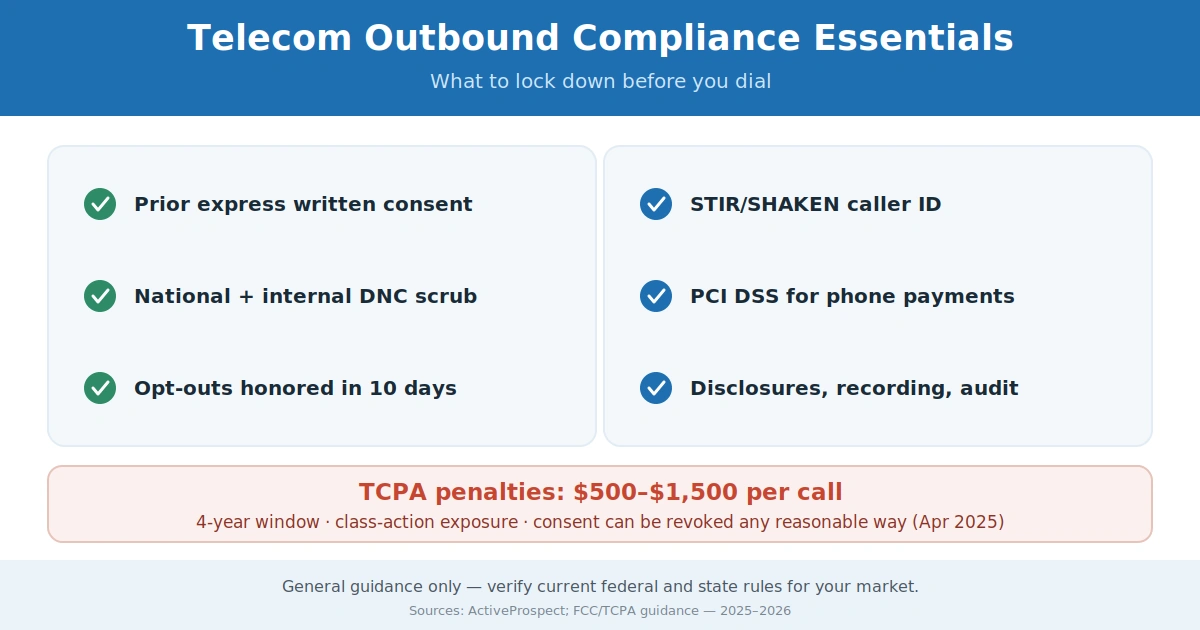 Key compliance controls to verify before launching a telecom outbound calling campaign.
What changed in 2025 and 2026
The rules keep moving, so stay current. The biggest recent change took effect in April 2025. Now consumers can opt out in any reasonable way, not just by replying STOP, and you have ten business days to act, per current TCPA guidance. A separate federal rule that would have tightened consent for lead sellers was scrapped before it began. So the landscape shifts often. This is why your partner should track changes for you. One caution, though. This article is general guidance, not legal advice. Always confirm current federal and state rules for your market.
How a compliant outbound partner protects you
The right partner builds compliance into every call. A good team scrubs DNC lists before each campaign. The team also keeps consent records and honors opt-outs on time. Agents sign each call with proper caller ID attestation. And the platform records every call, with required disclosures and audit-ready trails. On top of that, AI tools score calls for risk, often with TCPA-aware quality monitoring. So a strong telecom outbound call center gives you the revenue of outbound without carrying the legal risk alone.
Documentation ties it all together, too. In a dispute, your records are your defense. So keep proof of consent, opt-out timing, disclosures, and call recordings. A partner that logs each step gives you a clear audit trail. And that trail can be the difference between a quick dismissal and a costly settlement.
Compliance also builds customer goodwill. People notice when a brand respects their time and their choices. So honoring opt-outs and calling at reasonable hours protects more than your legal standing. It protects the relationship, too.
Technology helps here, as well. AI quality tools can score every call for compliance risk, not just a sample. So issues surface early, before they become claims. Paired with human review, that gives you a safety net across the whole campaign.
It is easy to see compliance as a brake on growth. But the opposite is true. Clean, consented calls connect more often, because carriers trust them. Respectful opt-out handling protects your brand. And strong records shield you in a dispute. So a compliant outbound program is not just safer. It also performs better.
Questions to ask before you sign
A short set of questions reveals a lot. So put every potential partner to the test before you commit.
- How do you capture and store consent?
- How often do you scrub national and internal DNC lists?
- How do you handle and document opt-outs?
- How do you manage caller ID reputation and attestation?
- What compliance audits and QA do you run?
If a partner hesitates on any of these, treat it as a warning sign. The strong ones answer each with confidence and proof.
Dial with confidence, not legal worry
Here is the takeaway. Outbound drives real revenue, but only when every call clears the rules. Get compliance wrong, and one campaign can erase a year of gains. This is why telecom brands lean on Sequential Tech. Our customer care and outbound teams run compliant programs by design, with list scrubbing, consent management, caller ID attestation, and audit-ready records. So you can dial with confidence, not worry. Book a free consultation today, and we will walk your outbound program through every compliance checkpoint, step by step.