

Choosing the right telecom BPO provider has become one of the most important decisions for telecom operators looking to improve customer experience, reduce costs, and scale efficiently. This guide covers seven key selection factors: telecom expertise, AI maturity, compliance, scalability, agent retention, transparent pricing, and real-time reporting, plus a green-flag or red-flag scorecard and questions to ask before signing.
A similar vendor checklist applies when deciding how to choose a data annotation partner for telecom AI.
Your subscribers will forgive a weak signal once. However, they will not forgive a 40-minute hold time or an agent who cannot fix a billing error. In 2026, support quality decides who keeps customers and who loses them. That is why choosing the right telecom service provider is no longer a back-office decision. Instead, it is a strategic growth decision that directly impacts customer loyalty, operational efficiency, and long-term profitability. Whether you are evaluating a new outsourcing partner or replacing an underperforming one, knowing what separates an industry specialist from a generic contact center can save significant time, cost, and customer frustration. This guide breaks down exactly what to check before you sign, so you can compare vendors with confidence and select a partner that supports your business as it grows.Why This Decision Matters More in 2026
The outsourcing industry is growing fast. Grand View Research values the global BPO market at $328.4 billion in 2025, rising to $358.6 billion in 2026. Moreover, IT and telecom remain the largest segment of that spend. Technology raises the stakes even further. Gartner projects that 70% of customer interactions will be AI-assisted by 2028. As a result, the gap between a modern telecom BPO company and an outdated one has never been wider. Pick well, and you gain speed, scale, and savings. Pick poorly, and you inherit churn.The Pain Points Pushing Operators to Switch Vendors
Most operators do not evaluate telecom outsourcing services from scratch. In fact, many are replacing a partner who failed them. These are the problems we hear most often:- Generalist agents who don’t understand telecom. This is the biggest pain point. Agents without telecom training misdiagnose network issues, botch porting requests, and escalate tickets that should close on the first call.
- Rising churn from slow resolutions. Every unresolved billing or connectivity issue pushes subscribers toward a competitor.
- High agent attrition. Offshore attrition averages around 32% per year, which drains quality and raises training costs.
- No real-time visibility. Monthly PDF reports hide problems for weeks.
- Hidden costs. Low hourly rates often mask charges for training, tools, and reporting.
- Weak data security. One breach can trigger regulatory fines and lasting brand damage.
7 Key Factors for Selecting a Telecom BPO Provider
Use the seven factors below as your evaluation framework. Each one separates a true telecom partner from a generic call center.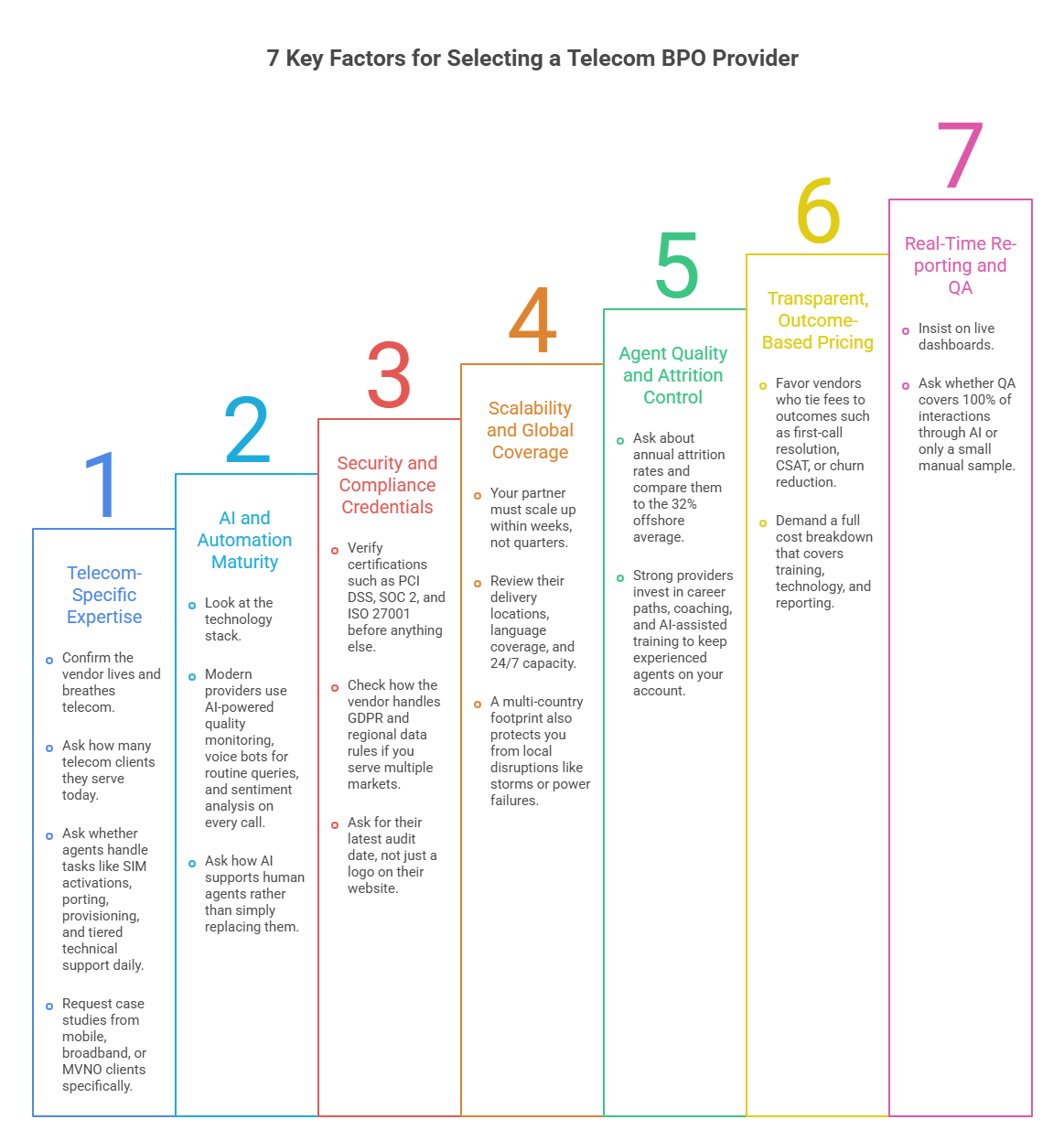
1. Telecom-Specific Expertise
First, confirm the vendor lives and breathes telecom. Ask how many telecom clients they serve today. Also, ask whether agents handle tasks such as SIM activations, porting, provisioning, and tiered technical support on a daily basis. A telecom call center outsourcing partner should speak your language on day one. Therefore, request case studies specifically from mobile, broadband, or MVNO clients.2. AI and Automation Maturity
Next, look at the technology stack. Modern providers use AI-powered quality monitoring, voice bots for routine queries, and sentiment analysis on every call. McKinsey research shows automation can cut process costs by 30–60% in some functions. However, tools alone are not enough. Ask how AI supports human agents rather than simply replacing them.3. Security and Compliance Credentials
Telecom data is sensitive, so compliance cannot be optional. Verify certifications such as PCI DSS, SOC 2, and ISO 27001 before anything else. Additionally, check how the vendor handles GDPR and regional data rules if you serve multiple markets. Ask for their latest audit date, not just a logo on their website.4. Scalability and Global Coverage
Your call volumes will spike during launches, outages, and promotions. Consequently, your partner must scale up within weeks, not quarters. Review their delivery locations, language coverage, and 24/7 capacity. A multi-country footprint also protects you from local disruptions such as storms or power outages.5. Agent Quality and Attrition Control
Great CX depends on people who stay. So, ask about annual attrition rates and compare them to the 32% offshore average. Strong providers invest in career paths, coaching, and AI-assisted training to keep experienced agents on your account. Lower attrition means faster resolutions and steadier CSAT.6. Transparent, Outcome-Based Pricing
Cheap hourly rates can hide expensive surprises. Instead, favor vendors who tie fees to outcomes such as first-call resolution, CSAT, or churn reduction. Also, demand a full cost breakdown that covers training, technology, and reporting. Clear pricing signals a confident partner.7. Real-Time Reporting and QA
Finally, insist on live dashboards. You should be able to see queue times, resolution rates, and quality scores at any time. In addition, ask whether QA covers 100% of interactions through AI or only a small manual sample. Full coverage catches problems before customers feel them.Quick Evaluation Table: Green Flags vs. Red Flags
Use this table during vendor demos and RFP reviews. It turns the seven factors into a simple scorecard.| Evaluation Area | Green Flag | Red Flag |
|---|---|---|
| Telecom expertise | Active telecom clients and telecom-trained agents | Generalist teams across many industries |
| AI and automation | AI QA, voice bots, and sentiment analysis in use | Manual QA on 2–5% of calls |
| Compliance | Current PCI DSS, SOC 2, and ISO 27001 audits | Certifications listed but not verifiable |
| Scalability | Multi-country sites, ramp-up in weeks | Single site, rigid headcount |
| Attrition | Below-industry attrition with retention programs | No attrition data shared |
| Pricing | Outcome-based, fully itemized costs | Low rates with vague add-on fees |
| Reporting | Real-time dashboards, 100% QA coverage | Monthly static reports only |
Questions to Ask Before You Sign
You have shortlisted two or three vendors. Now, pressure-test them with direct questions:- Which telecom KPIs will you commit to in the contract?
- How quickly can you add 100 trained agents during a product launch?
- What happened with your last client escalation, and how did you fix it?
- Can we speak with a current telecom client as a reference?
- What does your transition plan look like for the first 90 days?
0 downtime through a BPO failure — see how Sequential Tech did it →