
Some support surges are a surprise. Most are not. This guide shows how telecom call volume spike support scaling prepares operators for launches, storms, and promo season, before the phones light up.
Mark it on the calendar. A new flagship phone drops in the fall. Then a hurricane forms in the Gulf. And a Black Friday promo goes live at midnight. Each event is different, but they share one thing. Your phone lines are about to explode. For telecom operators, these spikes are not random bad luck. Instead, they are predictable events, hiding in plain sight. So the real question is not whether the surge will come. It is whether your support will be ready when it does.
The three spikes every telecom operator can see coming
Most telecom spikes fall into three buckets. Each one hits a different part of the business, at a different time of year. But all three can be seen coming months ahead. So the smart move is to plan for them, not react to them.
The good news is simple. Because these spikes repeat, you can forecast them. Last year’s launch week predicts this year’s. A region’s storm season is already on the map. And the holiday calendar never moves. So the data you need is mostly in hand before the surge even starts.
First, the device launch. When a new flagship phone drops, demand surges, and so do support calls. The iPhone 17 launch in 2025 outpaced the year before in its first week. For MNOs and MVNOs, that means a wave of activations and onboarding, setup questions, trade-ins, and pre-order issues, all at once.
Second, the storm and outage. When a hurricane or winter storm knocks out service, broadband and fixed-line support feels it first. Calls flood the lines within minutes. People want outage reports, status updates, and a restoration ETA. And they want them now, because losing connection during a storm is scary, not just annoying.
Third, promo and holiday season. From Black Friday to New Year, every segment feels the rush. Shoppers buy new plans, gift devices, and ask billing questions. In the 2024 holidays, Salesforce logged tens of billions of service interactions across its platform. So the holiday wave is real, and it is huge. The table below sums up all three.
| Spike event | Who feels it most | What drives the calls | When it hits |
|---|---|---|---|
| Device launch | MNOs & MVNOs | Activations, setup, trade-ins, pre-orders | Fall |
| Storm & outage | Broadband & fixed-line | Outage reports, status, restoration ETAs | Storm season |
| Promo & holiday | All segments | New plans, gifting, billing, returns | Nov–Dec |
Why spikes break a fixed support team
A spike is not just more of the same. It is a flood. During a surge, call volume can jump to three times the normal level. And handle times often rise 10% to 20%, because the issues are new and urgent. So each call takes longer, right when there are far more of them.
Here is the trap. Your in-house team is a fixed cost. You staff for the average day, not the peak. So when the spike hits, the team drowns. Hold times climb, and callers give up. Hire for the peak instead, and you pay for idle agents the rest of the year. Either way, a fixed team and a variable surge do not match. This mismatch is the heart of telecom call volume spike support scaling, and it is why customer care leaders plan ahead.
The in-house fixes carry hidden costs, too. Overtime pay runs time-and-a-half, and tired agents make more mistakes. Seasonal hires need weeks of training before they help. And when the spike passes, you are left with a team you no longer need. So the usual quick fixes are slow, costly, or both.
The real cost of being caught short
When support cannot keep up, subscribers pay first. Hold times stretch past ten minutes. Calls get abandoned. And simple problems turn into angry ones. In a storm, the stakes are even higher, because people need to reach their provider for safety. So a missed call is not a small thing. It can cost you a subscriber, and it can bruise your brand right when everyone is watching. These are also the clearest signs your support is stretched too thin.
The damage also spreads fast online. During a big outage or a botched launch, frustrated subscribers post in real time. So one bad day can fill social feeds and review sites for weeks. And new customers see all of it. In telecom, where switching is easy, that public record can cost far more than the spike itself.
Three spikes to plan for
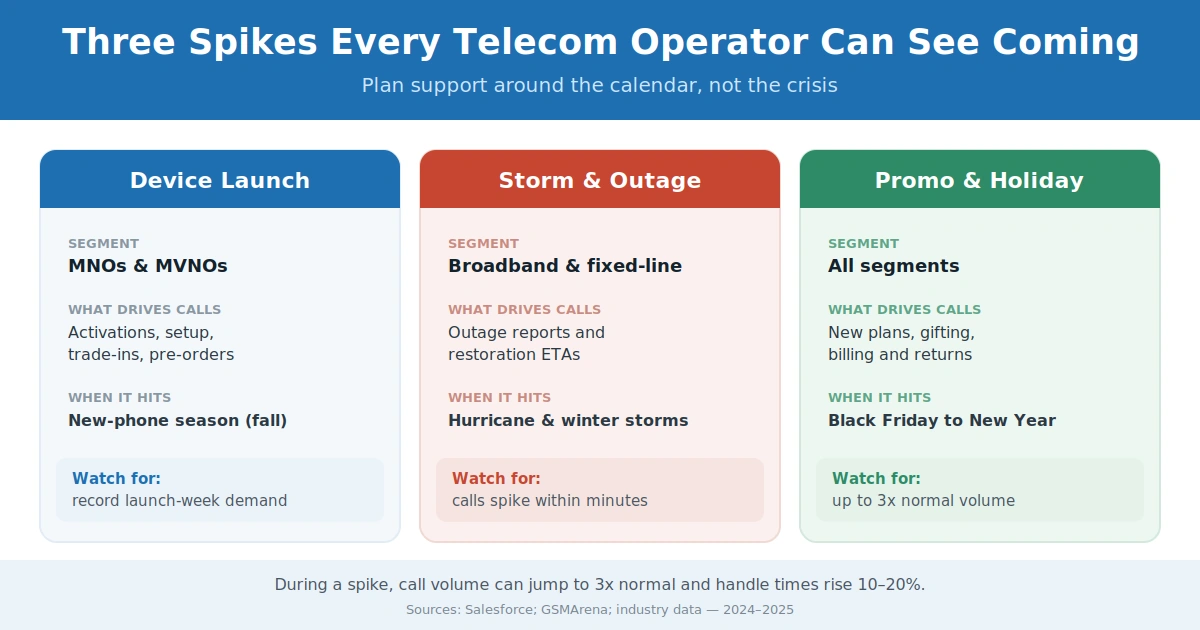 Launches, storms, and promo season each arrive on a schedule you can prepare for.
How to scale before the spike hits
A plan beats panic every time. So the goal is to add capacity fast, without carrying it all year. A few moves make that possible, and they work together.
- Forecast with history: Use past spikes to predict the next one. One year of data is a start; three years is better.
- Add flexible capacity: Line up overflow or a partner that can scale agents up in days, then back down after.
- Lean on self-service: A smart phone menu and chat can deflect many simple calls before an agent picks up.
- Cover around the clock: Storms and launches do not keep office hours, so your support cannot either.
- Prep scripts in advance: A handful of topics drive most spike calls, so ready answers speed every one up.
Technology carries part of the load, as well. A bot or a voice assistant can handle simple, repeat questions, like a balance check or an outage status. So your live agents stay free for the hard calls. During a spike, that split matters more than ever, because it stretches every agent further.
Done together, these steps turn a scary surge into a busy but manageable day. So the phones still ring hard. But your team, and your partner, are ready for every one.
Build the playbook before the calendar does
Timing is everything with spikes. Hiring and training a seasonal team in-house takes weeks, often six to eight before the peak. And by the time a storm forms, that window is gone. A specialist telecom inbound call center partner shortcuts all of it. They already have trained agents, proven tools, and ready capacity. So you can flex up in days, not months. You can also choose how much to hand over, from overflow to a fully outsourced queue. That flexibility is what lets you meet each spike without overspending the rest of the year.
Not every partner fits a telecom spike, though. The best ones know your world. They understand activations, billing, and outages, so they need little ramp time. They also flex both ways, up for the peak and back down after. So when you pick a partner, look for real telecom experience and a track record with surges, not just spare seats.
Turn the next surge into a non-event
Here is the goal. The next launch, storm, or holiday should feel like just another day to your subscribers. No long waits. No busy tones. Just fast, calm help when they need it. This is the work Sequential Tech does for telecom operators. Our telecom inbound call center teams flex with your calendar, absorb overflow, and add 24/7 cover, so every spike stays smooth. So before the next surge lands, let’s get you ready. Book a free consultation today, and we will build a spike plan around your busiest days.