
Two teams can run the same list and get very different results. This guide shows how telecom outbound campaign optimization uses data to lift connect rates, conversions, and ROI.
Two teams dial the same list, with the same agents, on the same day. One books twice as many sales as the other. What is the difference? Data. One team guesses when to call and who to call first. The other lets the numbers decide. In outbound telecom, small, data-driven choices add up fast. They turn a flat campaign into a performing one. Here is how to make that shift.
Why outbound performance rises or falls on data
Outbound results are not random. They follow patterns, and data reveals them. Start with the connect rate. On a fresh, consented list with a clean caller ID, teams connect on about 15% to 25% of dials. But let your numbers get flagged as spam, and that rate can fall into single digits. In fact, nearly 28% of unknown calls are now tagged as spam or fraud. So the same list can perform brilliantly or barely at all. Data is what separates the two.
Think about what a flagged number really costs. When carriers label your line as spam, most people never see your call as trustworthy. So your dials still cost money, but far fewer connect. In other words, a reputation problem quietly drains every campaign that follows. And fixing it takes weeks, not hours.
The levers of a data-driven campaign
A few levers drive most of the gains. Each one moves a specific metric. The table below maps them out, and a data-driven telecom outbound call center pulls each one in your favor.
| Lever | What it does | Metric it moves |
|---|---|---|
| List segmentation | Targets the right subscribers first | Contact rate |
| Call timing | Dials when people actually answer | Answer rate |
| Lead prioritization | Calls the hottest leads first | Conversion rate |
| Caller ID health | Keeps numbers off spam lists | Connect rate |
| Agent coaching | Sharpens scripts and objection handling | Talk time and conversion |
| Dialer & AMD tuning | Skips voicemails and paces calls | Agent efficiency |
Lead prioritization deserves special note. When you call the hottest leads first, using signals like recent activity or intent scoring, you convert more with the same effort. So the order you dial in matters as much as the list itself.
Timing is another quiet winner. People answer at some hours far more than others. So dialing a consumer list at the right window, often late morning or late afternoon, lifts the answer rate on its own. But the best window is not a guess. Instead, your own data shows it, campaign by campaign.
Segment before you dial
Not every subscriber is worth the same call. So smart campaigns sort the list first. Group by plan, tenure, usage, or churn risk, then tailor the offer to each group. A win-back list needs a different script than an upsell list. And a high-value account deserves a faster, more personal touch. So segmentation makes every dial land better.
Protect your connect rate
Your connect rate is fragile, so guard it. Carriers watch call patterns and flag numbers that look like spam. Once flagged, answer rates can drop 20% to 50% almost overnight. So spread calls across numbers, and keep each one to a safe pace, around 50 calls a day. Monitor your caller ID reputation, and register your numbers properly. Then sign calls with STIR/SHAKEN attestation. These steps keep your calls looking trustworthy, so more of them get answered.
Local presence can help as well. People are more likely to answer a number that looks local to them. So matching area codes to the region you are calling can raise answer rates. Still, use it carefully. Overused, the lift fades, and carriers may flag the pattern.
Dialer settings play a role, too. Pacing calls sensibly keeps your numbers healthy, while answering-machine detection skips dead calls so agents reach real people. So tuning the dialer is not a technical afterthought. Instead, it directly shapes how many live conversations each agent gets.
What moves outbound performance
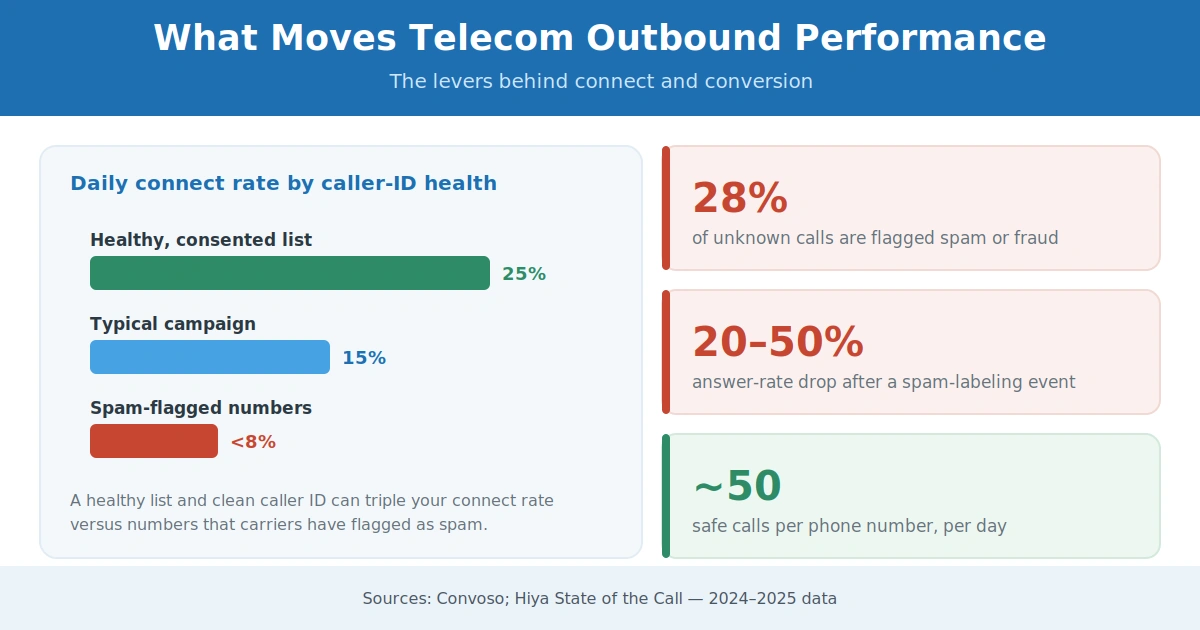 Caller ID health and clean contact lists influence telecom outbound connect rates.
Measure what actually matters
You cannot improve what you do not measure. So track the metrics that map to revenue. Contact rate shows how many people you reach. Connect rate shows live conversations. Right-party contact shows you reached the real decision-maker. And conversion rate ties it all to results. Watch these together, not alone. A high connect rate means little if conversions lag. Read as a set, with your customer care and sales data side by side, the weak link becomes clear.
Benchmarks help you read the numbers, too. A healthy connect rate often sits between 15% and 25%, so a rate below that signals a problem to fix. But do not chase a single number. Instead, compare this week to last, and this campaign to the last. Trends tell you more than any one figure.
Right-party contact is the metric many teams miss. Reaching a number is not the same as reaching the decision-maker. So track how often you actually speak to the right person. When that rate climbs, conversions usually follow close behind.
Turn data into a continuous loop
The best campaigns never sit still. Instead, they test, learn, and refine. Try two call windows, and keep the one that connects more. Test two scripts, and scale the winner. Re-segment your list as results come in. Small, steady tweaks compound over time. So feed the winners back into your outbound sales follow-up, and treat every campaign as an experiment, not a one-off.
Keep the loop short, as well. A campaign that waits a month to adjust wastes weeks of data. So review results often, even weekly. Then act on what you see. Small, fast changes beat big, slow ones every time.
The agent and script matter just as much as the data. So pair your best data with clear, tested scripts. Give agents the subscriber context before the call connects. And coach them on the objections that come up most. Because even a perfect list converts poorly with a weak conversation.
Finally, write down what works. A simple playbook of winning windows, scripts, and segments saves the next campaign from starting over. So each cycle builds on the last, instead of repeating it.
Costs matter in all of this, too. Every wasted dial burns agent time and money. So the same budget, aimed with data, simply buys more conversations. In other words, optimization is not only about performance. It is also about getting more from every dollar you spend.
Automation can speed the loop, as well. Dashboards that update in real time let you spot a sagging campaign within hours, not weeks. So you fix the weak spot while it still matters. And the faster you learn, the more each campaign earns.
Make every outbound call count
Here is the real lesson. Better outbound is not about dialing more. It is about dialing smarter, with data guiding every choice. This is how Sequential Tech runs outbound for telecom operators. Our telecom outbound call center teams tune segmentation, timing, caller ID health, and scripts, then measure and refine on a loop, so your connect and conversion rates keep climbing. So if your campaigns feel stuck, let’s put your data to work. Book a free consultation today, and we will turn your outbound numbers into a plan that performs.