

A practical 12 to 18 month plan for onshoring customer service. Learn how telecom operators move offshore volume to U.S. sites through smart site, hiring, training, and cost choices.
Eighteen months. That is how long Charter gave itself to bring Cox’s offshore sales and service work back to the U.S. after the deal closed in August 2026. Other telecom operators may soon face a similar clock. Moving thousands of daily calls home is not a switch you flip, though. It takes new seats, new people, new training, and a careful handoff. This guide lays out a 12 to 18 month plan for onshoring customer service without hurting the customer experience along the way.
What Does Onshoring Customer Service Mean?
Onshoring customer service means moving support work from overseas centers to sites in your home country. For U.S. telecom operators, it means shifting calls, chats, and back-office tasks to U.S. sites. Some teams call this reshoring call center work.
There are three main ways to do it. You can build your own sites, use onshore call center outsourcing, or combine both. Most large moves end up as a mix.
Why Telecom Operators Are Onshoring in 2026
Three recent events have pushed onshoring up the agenda.
First, deal terms. When Charter closed its Cox acquisition, it committed to move offshore Cox sales and service to the U.S. within 18 months.
Second, federal rules. On March 27, 2026, the FCC proposed new limits on offshore call centers for telecom, cable, satellite, and VoIP providers. The proposal uses 30% as an example cap on calls handled overseas. It would also let customers ask for a U.S.-based agent. In addition, calls involving passwords, Social Security numbers, or payment details would stay in the U.S. Our guide to FCC offshore call center rules explains what the proposal could mean for your BPO setup.
Third, Congress. The Keep Call Centers in America Act, introduced in July 2025, would require agents to share their location. It would also give customers the right to transfer to a U.S. agent.
Neither the FCC rule nor the bill is final. Still, both point the same way. In fact, many U.S. operators are already moving away from offshore-only BPO. As a result, onshoring customer service and securing domestic BPO capacity have become planning questions for many operators, not just cost questions.
Decide What to Move First
You do not need to move everything at once. In fact, a staged move is safer. Start by listing every queue, its monthly volume, and its current results. Note average handle time, first contact resolution, and quality scores for each one. These become the targets the U.S. team must match.
Then rank queues for the move. Most operators start with work that carries the most risk or value:
- Calls that touch passwords, payment details, or other sensitive data
- Retention and billing dispute queues, where churn risk is highest
- Complex technical support that drives repeat calls
- Routine account and order questions, which usually move last
This order protects your most valuable customers first. It also gives U.S. teams time to learn before the largest, simplest queues arrive.
The 12–18 Month Plan for Onshoring Customer Service
The plan below splits the offshore to onshore transition into six phases. Each phase covers sites, hiring, training, and cost.
| Phase | Months | Sites | Hiring | Training | Cost focus |
|---|---|---|---|---|---|
| 1. Plan and baseline | 0–3 | Map volume by queue and site; choose build, partner, or hybrid | Set hiring targets for each wave | Document offshore processes and knowledge | Build the full cost model |
| 2. Secure capacity | 3–6 | Sign partner contracts or lease sites; set up systems and security | Hire team leads and trainers first | Build the U.S. training program | Setup and technology costs |
| 3. Wave 1 | 6–9 | Move sensitive, retention, and billing dispute queues | Hire the first agent classes | Classroom training plus supervised live calls | Overlap costs while both teams run |
| 4. Wave 2 | 9–12 | Add technical support queues | Hire for wave 2 and replace attrition | Add technical and cross-skill training | Track cost per contact by queue |
| 5. Wave 3 | 12–15 | Move routine account and order volume | Steady hiring to match attrition | Refresher training and QA calibration | Reduce offshore contract volume |
| 6. Stabilize | 15–18 | Close or right-size offshore sites | Shift to steady-state hiring | Ongoing coaching | Compare final costs with the plan |
The timeline flexes with your volume. A move of a few hundred seats may finish in 12 months. A move of several thousand seats often needs the full 18.
Sites, Hiring, Training, and Cost
Choose Your Sites
Building your own sites gives you full control. However, leasing space, fitting it out, and hiring from zero takes many months. Onshore call center outsourcing is faster, because a partner already has U.S. delivery centers, systems, and recruiting teams in place.
Many operators use a hybrid. They keep a core in-house team and add a partner for each wave. Also, spread volume across at least two sites in different regions. That way, a storm or power outage in one city does not stop service. When you compare partners, check that each U.S.-based call center for telecom work has agents trained on plans and billing. Also confirm PCI DSS controls for payments and room to add seats for each wave. If you also serve Canadian customers, Canadian sites can add bilingual English and French support.
Hire Ahead of Each Wave
Hire team leads and trainers before agents. They set the culture and run the first classes. Then hire agent classes larger than your seat count, since some new hires will leave during training.
The U.S. labor pool is large but competitive. The Bureau of Labor Statistics counted about 2.67 million customer service jobs in 2025, with about 289,500 openings each year. So use local pay data and your own attrition rates when you set hiring targets.
Train for Telecom, Not Just Service
General customer service roles usually need two to four weeks of on-the-job training, according to the BLS. Telecom roles often need more. Agents must learn plans, billing, devices, and network troubleshooting.
Use your offshore team’s knowledge before the move. Ask experienced offshore agents to document common issues and fixes. Then add a supervised live-call period, often called nesting, before new agents work alone.
Budget for the Real Cost
Onshore labor costs more. The BLS reports a median wage of $21.53 per hour for customer service representatives in May 2025. That figure excludes benefits, payroll taxes, space, and technology.
You will also pay for both teams during each overlap period. Some of the gap may come back through fewer repeat calls and transfers. Even so, measure those gains rather than assuming them.
Manage the Offshore Wind-Down
The offshore side needs a plan too. Review your offshore contracts in phase 1. Look for minimum volume terms, notice periods, and exit fees. These often shape how fast you can move.
Next, agree on a step-down schedule with your offshore partner. Share it early and honestly. Otherwise, experienced offshore agents may leave before the U.S. team is ready, and service will drop during the overlap. Some operators also keep a small offshore team for after-hours or overflow work, as long as it stays within the proposed FCC limits on offshore call centers.
Cut Over Safely and Track Results
Move volume in steps, not all at once. For example, route a quarter of a queue to the U.S. team, then half, then all of it. Only take the next step when the U.S. team meets its targets. Keep the offshore team as a backup until each wave is stable. The chart below shows how the U.S. share of calls can rise in steps across the three waves.
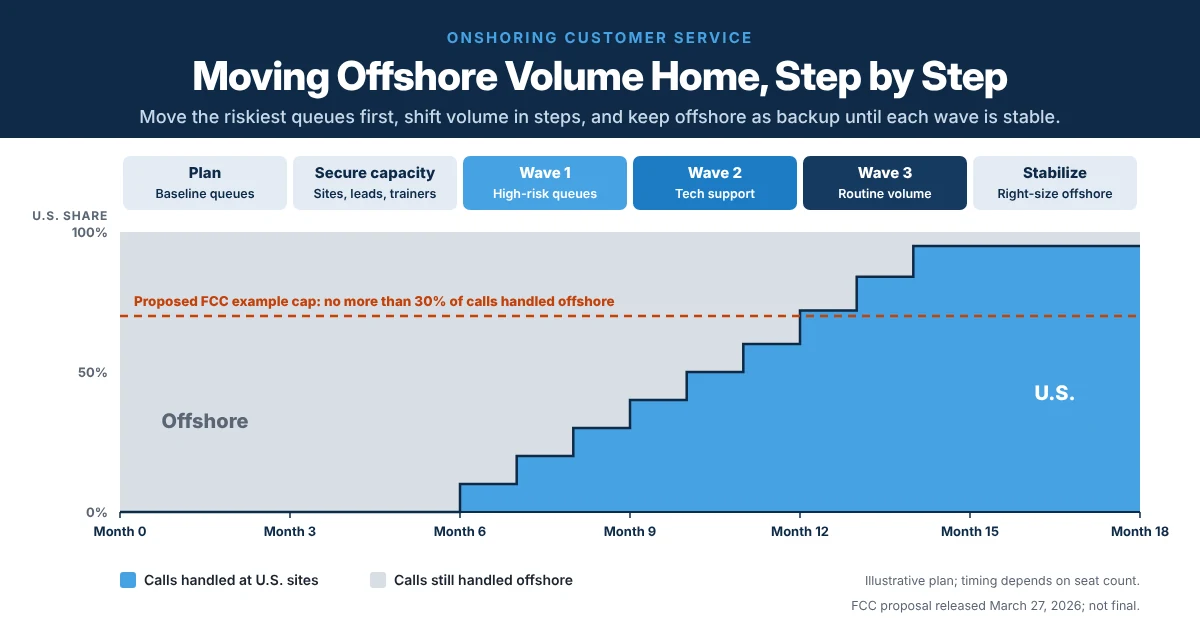 A 12–18 month roadmap for shifting telecom customer service from offshore to U.S. teams.
Track these metrics for every queue during the move:
- Service level and abandon rate
- First contact resolution and repeat calls
- Quality scores and customer satisfaction
- New-hire attrition in the first 90 days
- Cost per contact, compared with your plan
- Share of volume handled in the U.S., checked against any future FCC limit
If one metric slips, pause that queue and fix the cause before moving more volume. For more on handing off work safely, see our 90-day BPO transition plan.
Start Your Onshoring Plan With the Right Partner
A well-planned onshoring move protects customers, supports regulatory compliance, and keeps costs under control. Sequential Tech helps telecom operators, MVNOs, and broadband providers transition offshore operations through onshore telecom BPO teams across U.S. and Canadian delivery centers. Our telecom-trained agents scale in phases to match your migration timeline. Discuss Your Onshoring Requirements to plan a phased transition that aligns with your operational needs.
Frequently Asked Questions
How long does onshoring customer service take?
Onshoring customer service usually takes 12 to 18 months for a telecom operator. A move of a few hundred seats can finish in about a year. Larger moves need more time to secure sites, hire leaders, train agents, and shift volume in waves. Charter, for example, set an 18-month target for Cox.
What is the difference between onshore and offshore call center outsourcing?
Onshore call center outsourcing uses a partner whose agents work in your own country. Offshore outsourcing uses agents in another country, usually to lower labor costs. For U.S. telecom operators, onshore means U.S.-based agents. Proposed FCC rules would also give customers the right to reach a U.S. agent on request.
Is onshore customer service more expensive than offshore?
Yes, onshore labor usually costs more per hour. The BLS reports a median wage of $21.53 per hour for U.S. customer service representatives in May 2025. That excludes benefits, taxes, space, and technology. Some of the gap may come back through fewer repeat calls and transfers, so measure it carefully.
Which call center work should move onshore first?
Move the highest-risk and highest-value work first. That usually means calls involving passwords or payment details, then retention and billing dispute queues, then complex technical support. Routine account and order questions often move last. This order protects key customers while U.S. teams build their skills.
Will the FCC require telecom companies to use U.S. call centers?
Not yet. In March 2026, the FCC proposed rules that would limit how many customer service calls telecom providers route overseas, using 30% as an example cap. The proposal would also let customers request a U.S.-based agent. These rules are not final, and the details may change.