

A step-by-step support playbook for telecom merger customer migration. Learn how to handle billing cutovers, brand changes, staffing spikes, and retention so acquired subscribers stay.
The deal closed months ago. The press release is old news. Then, one Tuesday morning, thousands of acquired customers open a bill with a new logo, a new account number, and a total they do not recognize. By noon, your queues are full. For subscribers, this is the day the merger actually happens.
That is the core challenge of telecom merger customer migration. Executives plan the network and the systems. Customers, however, judge the deal by one thing: whether their service, bill, and support still work. This playbook shows integration teams and care leaders how to move acquired subscribers without losing them.
What Is Telecom Merger Customer Migration?
Telecom merger customer migration is the process of moving an acquired company’s subscribers onto the buyer’s brand, billing system, plans, and support channels. It usually happens in waves, market by market. Done well, customers barely notice. Done poorly, it drives call spikes, billing errors, and churn.
Subscriber migration support is the customer care side of that work. It covers the notices customers receive, the agents who answer their questions, and the fixes that follow each cutover.
Why Migration Support Matters in 2026
Several large U.S. deals closed recently. As a result, millions of subscribers are moving to new brands and systems through 2026
| Deal | Closed | Customers affected | What is changing |
|---|---|---|---|
| Charter and Cox | August 20, 2026 | Cox broadband, TV, and mobile customers | Spectrum brand, pricing, and packaging by mid-September 2026; offshore Cox service moves to the U.S. within 18 months |
| Verizon and Frontier | January 20, 2026 | Frontier fiber customers | Separate bills and accounts for now; plans to standardize over time |
| AT&T and Lumen | February 2, 2026 | About 1.1 million fiber customers | Market-by-market move to AT&T Fiber branding, systems, and equipment |
| T-Mobile and UScellular | August 1, 2025 | More than 4 million customers | Phased brand change; customers keep current plans for now |
Each deal follows a different path. Still, they share one pattern. The legal close is a single day, but the customer migration runs for months or even years.
Where Migrations Break for Customers
Customers do not see integration plans. Instead, they see a bill, a login screen, and a phone number. Most migration calls start at one of these points.
The First Bill on the New System
The first bill after a billing cutover is the biggest call driver. Account numbers, due dates, and bill layouts may all change at once. Also, autopay and saved payment methods can fail to carry over. When Cox customers received their first Spectrum bills in October 2026, Spectrum told customers that billing cycles and prices would carry over. Even so, the company was still working through account transition issues.
Mixed Brands and “Who Do I Call?”
Brand changes rarely happen all at once. For example, some former Lumen fiber customers still received CenturyLink bills, while others received Quantum Fiber bills, during AT&T’s conversion. As a result, many customers may not know whom to contact. Every mixed message creates a call.
Logins, Apps, and Linked Services
New portals and apps often mean new passwords. Customers also lose access to services tied to old credentials. In the Cox move, for instance, some customers had trouble signing in to streaming apps with their Cox logins.
Plan and Price Changes
Plan mapping is where trust breaks fastest. In the 2025 Consumer Trust Survey from Reviews.org, 67% of internet customers said they switched or considered switching over hidden fees or surprise charges. A merger price change that feels like a surprise carries the same risk.
The Telecom Merger Customer Migration Playbook
The six phases below follow a typical integration from announcement to stable service. Each phase has a clear support goal and one metric to track.
| Phase | When | Support goal | Metric to track |
|---|---|---|---|
| 1. Map the change | Announcement to close | Know exactly what changes for each customer group | Customer groups mapped |
| 2. Prepare agents | 60–90 days before cutover | Give agents one source of truth for both companies | Agent readiness score |
| 3. Communicate in waves | 30–60 days before each wave | Tell customers what changes and what to do | Notice open and action rates |
| 4. Staff for the spike | Cutover week to day 30 | Answer migration calls fast | Service level and abandon rate |
| 5. Protect at-risk revenue | Day 1 to day 90 | Save customers who want to leave | Migration-period churn |
| 6. Stabilize and hand off | Day 30 to day 90 | Fix root causes and close legacy queues | Migration contacts per account |
Phase 1: Map What Changes for Each Customer
Start with a change map, not a launch date. List every item that will change for customers. This includes brand, account number, billing date, payment method, login, app, email, plan, price, equipment, and support number.
Next, group customers by how much changes for them. A customer whose plan, price, and equipment all change needs more help than one who only sees a new logo. These groups then drive notices, staffing, and agent training.
Phase 2: Prepare Agents to Serve Both Companies
During migration, agents serve two sets of customers at once. So they need access to both legacy and target systems. They also need one knowledge base that explains old plans, new plans, and how each one maps.
Build short scripts for the top 10 expected questions. Common examples include “Why did my account number change?” and “Is my price going up?” Then test them with real agents before the first wave goes live.
Phase 3: Plan Brand Transition Customer Communication in Waves
Good brand transition customer communication answers three questions: what is changing, what stays the same, and what the customer must do by when. Send notices about 60 days and 30 days before each cutover. Then send a reminder in the final week.
In addition, send a first-bill guide to every migrated customer. Show a sample of the new bill with each section labeled. Point out new account numbers, new due dates, and any steps needed to restart autopay.
Phase 4: Staff Your Billing System Migration Call Center for the Spike
Call volume rises sharply in the weeks after each cutover. The first bill on the new system usually brings the largest wave. Therefore, forecast volume by migration wave, not by calendar month. The timeline below shows how contacts typically rise and fall, and when each phase should be running.
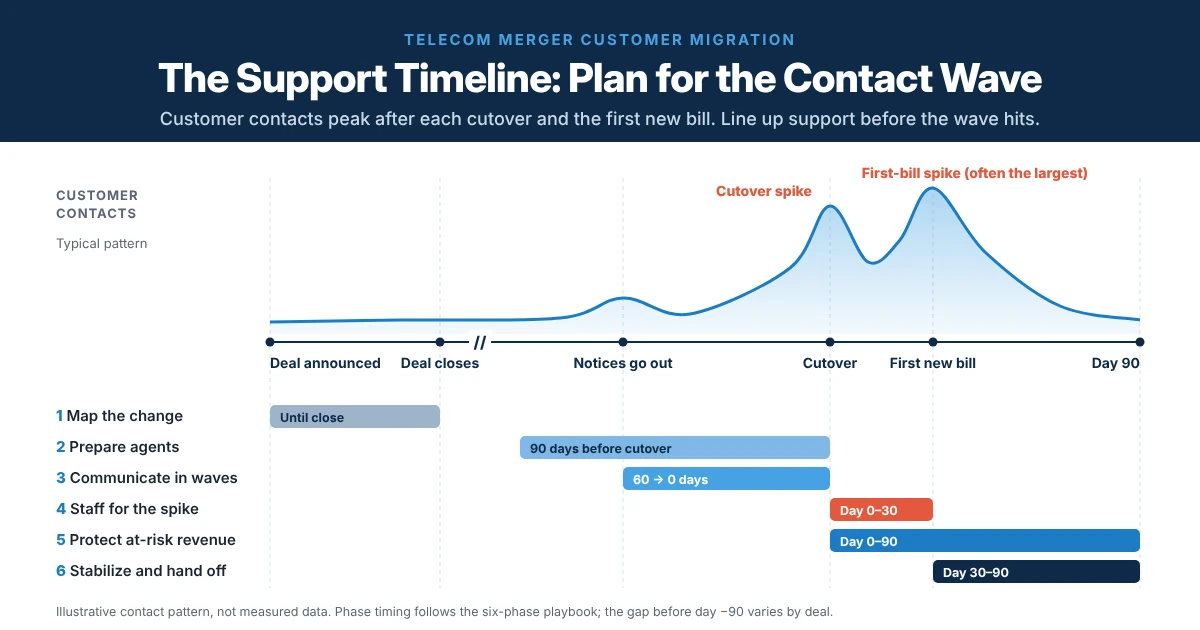 Contacts usually peak twice: at cutover and again when the first new bill arrives.
Set up a dedicated migration queue with its own phone number or menu option. Staff it with agents trained on telecom billing support, since billing questions lead most migration calls. Add extended hours during the first two bill cycles. Also, plan surge capacity before you need it, because hiring after the spike is too late. Our guide to scaling support for call volume spikes covers surge planning in more detail.
Phase 5: Protect Revenue at Risk
Migration gives customers a natural moment to shop around. A forced plan change, a new contract, or a new brand can all trigger a cancellation call. For this reason, route migration-related cancellation requests to a trained save team.
Give that team clear options, such as honoring old pricing for a set time or offering a matching plan. A focused retention and win-back program also helps you recover customers who leave during the move. To compare the cost of each save option, see our telecom churn reduction ROI guide.
Phase 6: Stabilize the Post-Merger Customer Experience
After each wave, run a 60 to 90 day “hypercare” period. During this time, review migration contacts every day. Tag each one with a root cause, such as a billing defect, a broken login, or an unclear notice.
Then fix the source, not just the call. When contacts per migrated account fall back to normal, close the legacy queue. Finally, move those customers into standard telecom customer care with full account history.
How to Measure Subscriber Migration Support
Track a small set of metrics for each migration wave. Compare each one against the same customers’ levels before migration.
- Migration contact rate: calls and chats per migrated account in the first 60 days
- First-bill contact rate: share of customers who contact you about their first new bill
- Autopay failure rate: share of autopay customers whose payment did not carry over
- Repeat contact rate: customers who contact you again about the same issue within 30 days
- Migration-period churn: cancellations in the 90 days after cutover, compared with the baseline
Together, these numbers show whether customers understand the change. They also show which defects to fix before the next wave.
When an Acquisition Integration BPO Makes Sense
Most migration work is temporary. Volume peaks for a few months per wave and then falls. Hiring permanent staff for that peak is costly and slow. This is where an acquisition integration BPO can help.
A partner can add trained agents in weeks, cover extended hours, and absorb overflow during each cutover. It also matters where agents sit. Some deals include service commitments. For example, Charter committed to move offshore Cox sales and service to the U.S. within 18 months. So check that a partner’s delivery locations fit your deal terms. Proposed FCC rules on offshore call centers make this check even more important.
When you compare partners, look for:
- Telecom billing and plan expertise across both legacy and target systems
- Proven ramp plans for fast, wave-based staffing
- Onshore and nearshore options that match your service commitments
- Quality checks across all calls and chats, not just a small sample
- Reporting by migration wave, customer group, and root cause
Once you choose a partner, set clear service level agreements for each migration wave. Then use a phased 90-day BPO transition plan to hand over work without service gaps.
Make Your Next Migration Wave the Smoothest One Yet
Every migration wave is a chance to win the acquired customer’s trust or lose it. Sequential Tech helps telecom operators, MVNOs, and broadband providers move acquired subscribers with trained billing, care, and retention teams that ramp in time for each cutover. Before your next wave goes live, Talk to our telecom support experts and see where your support plan has gaps.
Frequently Asked Questions
How long does telecom merger customer migration take?
Telecom merger customer migration usually takes months, and large deals can run for years. Operators move customers in waves, often market by market. For example, AT&T was near the end of converting former Lumen fiber customers about six months after its February 2026 close. Each wave then needs a 60 to 90 day stabilization period.
What causes call spikes during subscriber migration?
Most migration calls come from the first bill on the new system. New account numbers, due dates, and bill layouts confuse customers. Autopay may also fail to carry over. Other common drivers include new logins, mixed brand messages, and plan or price changes that customers did not expect.
How should telecom companies tell customers about a brand change?
Tell customers what is changing, what stays the same, and what they must do by when. Send notices about 60 and 30 days before each cutover, followed by a reminder in the final week. Then send a first-bill guide that labels the new bill and explains any autopay steps.
How can operators reduce churn during a telecom merger?
Operators reduce churn during a merger by avoiding surprises. Map plan and price changes early, and explain them before they reach the bill. Route migration-related cancellation requests to a trained save team with clear options, such as honoring old pricing for a set time. Then track cancellations against a pre-migration baseline.
When does an acquisition integration BPO make sense?
An acquisition integration BPO makes sense when migration volume spikes for a few months per wave. A partner can add trained agents in weeks and cover extended hours without permanent hiring. Choose one with telecom billing expertise, wave-based ramp plans, and delivery locations that fit your deal’s service commitments.