
Learn six telecom billing support best practices that cut surprise charges. See how operators, MVNOs, and broadband providers use clear bills to keep customers loyal.
A customer opens their monthly bill. The total is $18 higher than last month, and nothing explains why. Within minutes, they call support. Or worse, they start shopping for a new provider.
Here is the part many providers miss. A lot of billing calls do not start with an error. They start with a change. A promotion ends, a plan changes, or a first bill includes partial-month charges. The bill is correct, yet the customer still feels tricked.
That is why telecom billing support has to do more than fix mistakes. It has to explain change before the customer notices it. This guide shows telecom operators, MVNOs, and broadband providers how to do that.
What Are Telecom Billing Support Best Practices?
Telecom billing support best practices are the steps that keep bills accurate, clear, and easy to pay. They also cover how agents settle disputes and how providers warn customers before a bill changes. The goal is simple: fewer surprise charges, fewer repeat calls, and lower churn. Strong telecom billing support also links billing, care, and network teams, so one fix reaches every customer.
Why Billing Now Decides Customer Loyalty
Customers have little patience for surprise charges. In the 2025 Consumer Trust Survey from Reviews.org, 67% of internet customers said they switched or thought about switching over hidden fees or surprise charges. That is up from 56% a year earlier. Also, 88% want every fee included in the advertised price.
At the same time, good service is getting harder to deliver. J.D. Power’s 2025 U.S. Wireless Customer Care Study found that care satisfaction fell for the first time in two years. The study pointed to frequent offer changes as a strain on agents. It also noted that simpler offers could cut wait times and effort.
Rules are shifting, too. The FCC all-in pricing rule requires cable and satellite providers to show the full video price as one line on the bill. Bills must also warn customers 60 and 30 days before a promotion ends. Meanwhile, the FCC eased some broadband label rules in 2026. However, customer expectations did not ease. So the smartest providers treat clear pricing as a choice, not just a legal duty.
The Five Bill-Shock Moments to Plan For
Billing calls tend to cluster around a few predictable moments. When you plan for each one, telecom billing support shifts from reacting to preventing.
| Bill-shock moment | Why customers call | What to do before the bill | Metric to watch |
|---|---|---|---|
| First bill | Partial-month charges and one-time fees look like errors | Send a short first-bill guide with a line-by-line example | First-bill contact rate |
| Promotion ends | The price jumps with no warning | Alert customers 60 and 30 days ahead, and show the new price | Calls in the 30 days after the promotion ends |
| Plan or device change | Mid-cycle changes create odd credits and charges | Show a before-and-after estimate when the customer makes the change | Repeat billing contacts within 30 days |
| Price or fee increase | The total goes up with no clear reason | Explain the change in a message before the bill posts | Bill-related churn rate |
| Failed payment | AutoPay fails, and late fees follow | Send a same-day alert with a simple way to pay | Payments recovered within 7 days |
The mix varies by business. Broadband providers often field first-bill calls about installation and equipment fees. MVNOs tend to see more payment and top-up questions. Mobile operators face plan and device changes most often. So start with the moment that drives the most calls in your own data.
Six Telecom Billing Support Best Practices
Each practice below supports one or more of the five moments. Together, they cover accuracy, clarity, disputes, payments, automation, and communication.
1. Check Billing Accuracy Before Every Bill Run
Billing errors may be rare, but each one costs a lot of trust. First, compare orders, rate plans, and active promotions against what the system will charge. For example, confirm that expired discounts no longer apply and new ones show up. Next, review any bill that jumps sharply from the last cycle.
Then tag the root cause of every error you find. Over time, these tags show which systems or handoffs need fixing. This is the core of telecom billing process optimization.
2. Write Invoices for the Customer, Not the Billing System
Many invoices still use short codes that only staff understand. Instead, use plain words. Put the total due and the due date at the top. Add one line that explains what changed since the last bill.
List fees and taxes separately, each with a short note. Finally, test new layouts with real customers before launch. If they cannot explain their own bill, it is not clear enough. The FCC also offers a consumer guide to understanding your telephone bill. Reading it is a quick way to see bills through your customers’ eyes.
3. Give Agents Clear Rules for Telecom Billing Dispute Resolution
Disputes are where customers decide whether to stay. A strong telecom billing dispute resolution process lets agents act on the first call. It includes:
- Dollar limits for credits that agents can approve on their own
- Set time frames for complex cases, with updates to the customer
- Root-cause tags on every dispute
- Weekly reviews of credits, so goodwill does not turn into revenue leakage
The last point matters most. A credit fixes one call, but a root-cause fix stops the next hundred.
4. Make Payments Easy and Flexible
Customers now expect to pay digitally. According to InvoiceCloud’s State of Online Payments report, 70% of consumers pay phone bills digitally. Similarly, 67% pay internet bills digitally, and 64% use AutoPay for at least half of their bills.
So support every common option, including AutoPay, mobile wallets, and debit cards. Also, train agents to offer short payment plans when a customer falls behind. A plan often keeps an account out of collections and recovery.
Reminders matter, too. Send them a few days before the due date, through the channel each customer prefers.
5. Automate the Routine, Not the Judgment
Automation works best on simple, repeatable tasks. For example, it can check orders, apply standard credits, and send payment confirmations. Self-service tools, such as an AI chat assistant, can also answer questions about balances and due dates.
However, disputes and hardship cases still need a trained person. Make it easy to reach one. Otherwise, a chatbot that traps customers in a loop creates the very frustration you want to avoid.
6. Talk to Customers Before the Bill Does
Proactive messages are the most direct way to handle the five bill-shock moments. Send alerts before prices change, before promotions end, and when usage nears a limit. Confirm payments right away, and share outage credits before the next bill arrives. The infographic below recaps each moment and the early fix that prevents the call.
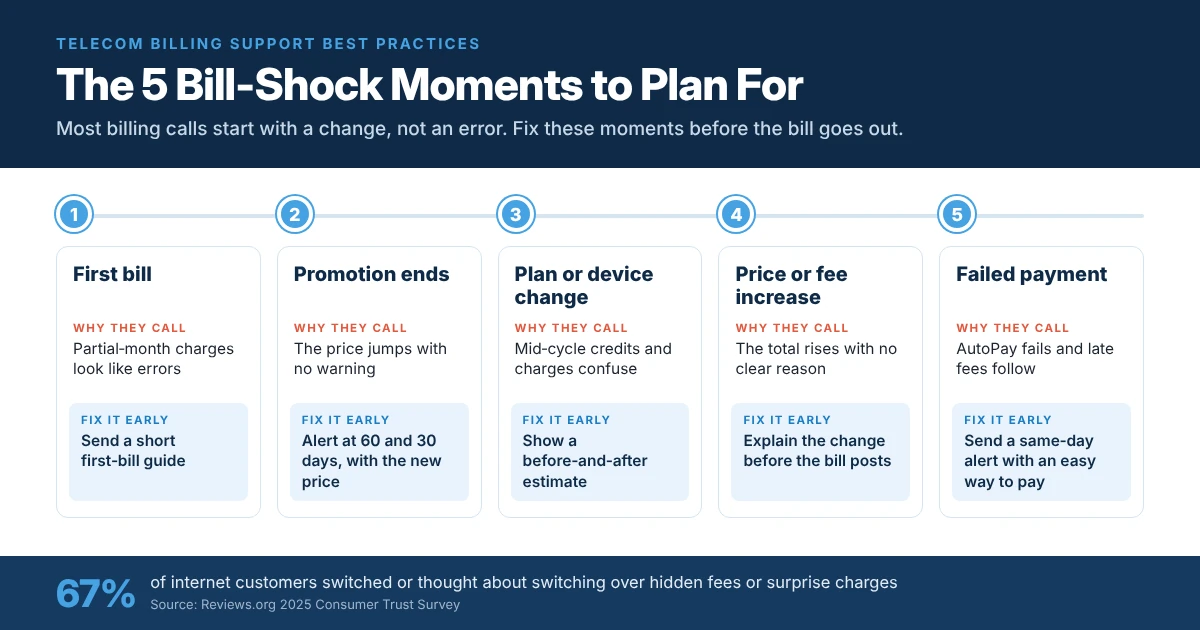 A quick recap: each bill-shock moment and the proactive fix that heads off the call.
Each message answers a question before it turns into a call. Clear usage views help, too, as our guide to transparent billing and usage visibility explains.
How to Measure Telecom Billing Process Optimization
Track three numbers every month. First, billing contact rate, which is billing calls and chats divided by bills issued. Second, repeat contacts, which counts customers who return about the same bill within 30 days. Third, bill-related churn, which counts customers who leave within 60 days of a billing contact.
Together, these show whether customers understand their bills. In contrast, handle time alone only shows how fast agents close tickets. Set a baseline first, and then review the trend by channel and customer type. If bill-related churn keeps rising, a focused retention and win-back program can help.
When Telecom Billing Outsourcing Makes Sense
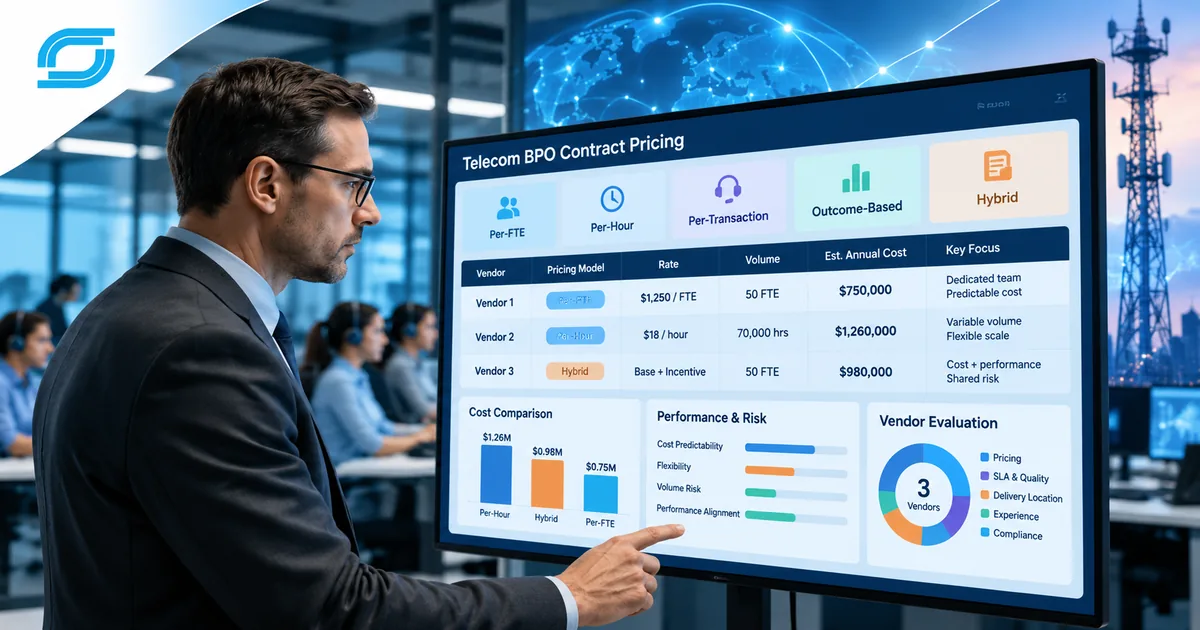
Telecom billing outsourcing can help when billing calls spike after a price change or a system migration. It also helps when you launch new plans, enter new markets, or need 24/7 coverage. Smaller MVNOs and broadband providers often lack the in-house staff to cover all of this well. Before you compare vendors, review the common telecom call center outsourcing pricing models.
When you compare telecom billing management services, look for:
- Agents trained on telecom plans, partial-month charges, and taxes
- Clear dispute rules backed by strong service level agreements (SLAs)
- PCI DSS compliance for card payments
- Quality checks across all calls and chats, such as AI quality monitoring, not just a small sample
- Reports that tie billing contacts to their root causes
The right telecom billing support partner does more than answer calls. It helps you cut the reasons customers call.
Make Every Bill Easier to Understand
Billing support works best when it prevents confusion, not just when it fixes it. Sequential Tech helps telecom operators, MVNOs, and broadband providers get there. Our telecom billing support teams handle bill explanations, payments, credits, adjustments, and disputes across voice, chat, and email.
Want to find out which bill-shock moments cost you the most calls? Book a free billing support consultation with Sequential Tech today.
Frequently Asked Questions
What is telecom billing support?
Telecom billing support is the service that helps customers understand, pay, and fix their phone, internet, or TV bills. It covers bill explanations, payment help, credits, and disputes. Good billing support also warns customers before charges change. As a result, it cuts repeat calls and lowers churn.
What causes most telecom billing complaints?
Most telecom billing complaints come from a change, not an error. Common triggers include the first bill, an expiring promotion, a mid-cycle plan change, a price increase, and a failed payment. Customers call when the total moves and the bill does not explain why. Clear invoices and early alerts prevent most of these calls.
How do telecom companies resolve billing disputes?
Telecom companies resolve billing disputes by reviewing the charge, explaining it, and issuing a credit when needed. A strong telecom billing dispute resolution process lets agents approve small credits on the first call. It also sets time frames for complex cases. Finally, each dispute gets a root-cause tag, so the same issue does not return.
When should telecom providers outsource billing support?
Telecom billing outsourcing makes sense when billing calls spike, new plans launch, or you need 24/7 coverage. It also helps smaller MVNOs and broadband providers without large in-house teams. Before choosing a partner, check its telecom training, dispute SLAs, PCI DSS compliance, and quality checks across all calls and chats.
How do you measure telecom billing support performance?
You can measure telecom billing support with three core metrics. Billing contact rate shows billing calls and chats per bill issued. Repeat contact rate shows customers who return about the same bill within 30 days. Bill-related churn shows customers who leave within 60 days of a billing contact. Track all three every month.