

A step-by-step telecom BPO transition plan that moves customer care, provisioning, and network operations to an outsourcing partner in 90 days — with zero service downtime.
Switching a telecom operation to a new BPO can feel like changing a plane’s engine mid-flight. On paper, the plan looks clean. In reality, one wrong move during cutover, and calls drop, tickets pile up, and SLAs break. That fear is real. In fact, it keeps many operators locked into vendors they have outgrown. It doesn’t have to be that way. With the right telecom BPO transition plan, you can move care, provisioning, and network operations in 90 days. Better still, you keep service running the whole time. This playbook is written for the people who own that risk: the COO, the NOC leader, and procurement. Here is how it works.
The Real Fear: A Botched Cutover
Ask any COO or NOC leader about outsourcing, and one worry comes up first: downtime. A messy handover doesn’t just cause a blip. Instead, it hurts trust and revenue at the same time. So let’s name the risk plainly. Here is what a botched telecom BPO transition looks like:
- Dropped or misrouted calls and tickets during the switch.
- SLA breaches that trigger penalties and hard conversations.
- Lost tribal knowledge when the outgoing team walks out the door.
- Provisioning and activation backlogs that stall new revenue.
- Agent attrition that thins the floor mid-transition.
- Customer churn from a single bad first impression.
Every item above is preventable. None of it is bad luck; each one traces back to a rushed, all-at-once handover. The fix is a phased plan, not a big-bang switch.
What Downtime Costs in 2025–2026
The stakes are higher than ever. According to ITIC’s 2025 survey, one hour of downtime now costs the median large enterprise about $540,000 — roughly $9,000 per minute. Moreover, over 90% of mid-size and large firms lose more than $300,000 per hour. For 41% of them, the loss runs between $1 million and $5 million.
Outages also last longer than people expect. The Uptime Institute’s 2025 data puts the median major outage at 53 minutes. Nearly one in five runs past four hours. In telecom, a cutover touches live calls and live orders. Therefore, removing that exposure is the whole point of a transition plan. Every stalled activation or dropped ticket during a switch adds to that bill. A phased plan keeps the meter at zero.
The 90-Day Telecom BPO Transition Plan
A safe move breaks into three 30-day phases. Each phase has one clear goal. Together, they keep service live from day one to cutover. Notably, no customer should ever notice the switch.
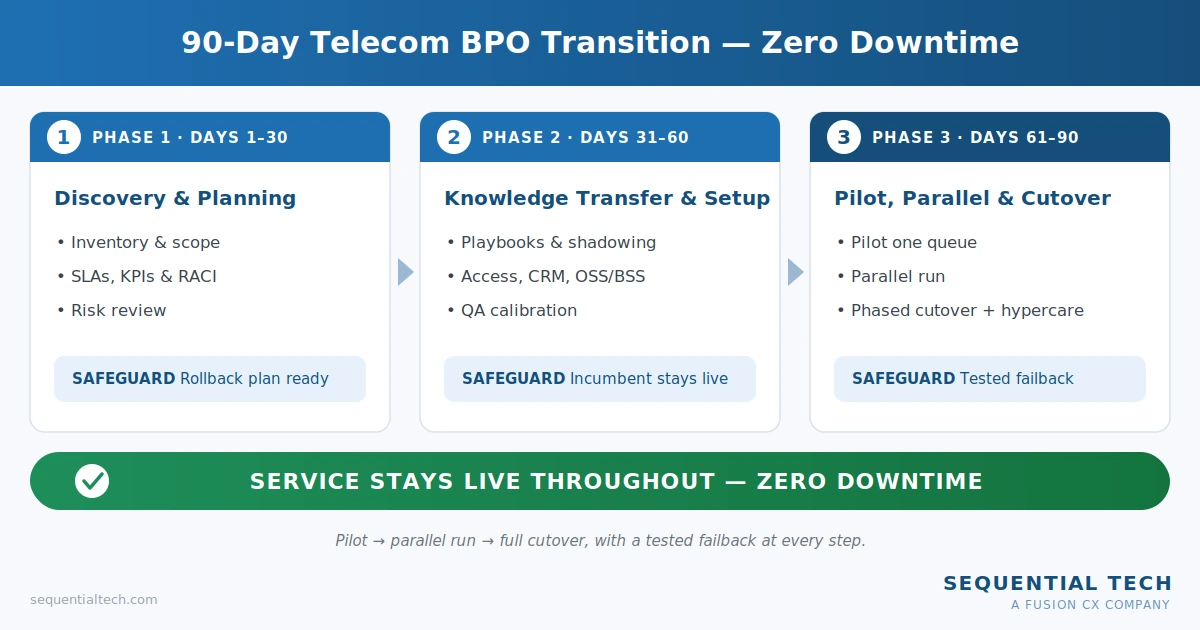 The 90-day telecom BPO transition plan: discovery, knowledge transfer, and a zero-downtime cutover.
Why three phases? Because risk drops when change is gradual. A big-bang switch flips everything at once. So a single error can hit every customer. A phased plan keeps each risk small and reversible.
Phase 1 (Days 1–30): Discovery and Planning
First, map everything before you touch anything. In this phase, you build a full picture of current operations. Skip it, and go-live becomes a guess.
- Inventory call flows, ticket queues, provisioning steps, and network runbooks.
- Lock scope: what the BPO owns (Tier 1) and what escalates (Tier 2).
- Set SLAs, KPIs, and a shared governance model with named owners (a RACI).
- Run a risk review, then write a rollback plan.
- Decide your operating mode: full coverage, after-hours, overflow, or a blend.
Much of discovery is simply listening. You interview team leads, pull reports, and watch how the work really flows. Because discovery is thorough, the go-live date becomes a decision, not a hope.
Phase 2 (Days 31–60): Knowledge Transfer and Setup
Next, move the knowledge and stand up the tools. This is where most transitions succeed or fail. So treat knowledge transfer for the telecom BPO as a formal project, not a hallway chat. Capture it in writing while the experts are still on the floor.
- Document tribal knowledge into clear playbooks and scripts.
- Run structured shadowing, then reverse shadowing, until scores match.
- Provision systems: SSO, least-privilege access, CRM, OSS/BSS, and telephony.
- Calibrate QA so “good” means the same thing on both teams.
- Set a weekly release rhythm for scripts and knowledge articles.
Meanwhile, keep the incumbent team fully live. You document and train in parallel with real operations. Importantly, no traffic moves yet.
Phase 3 (Days 61–90): Pilot, Parallel Run, and Cutover
Finally, shift traffic in controlled steps — never all at once. This is the stage that actually protects uptime.
- Start with a pilot: one queue, one region, or one order type.
- Run in parallel: the BPO takes a share while your team stays as a safety net.
- Watch live dashboards for coverage, speed, quality, and continuity.
- Cut over fully only after metrics hold, with a tested failback ready.
- Enter hypercare: daily reviews in week one, then twice-weekly.
- Test calls from several carriers and regionsbefore you widen traffic.
Between each step sits a simple go/no-go gate. If the numbers hold, you advance. If they slip, you pause and fix. As a result, downtime stays at zero, because you always keep a fallback.
| Phase | Timeline | Focus | Key Activities | Downtime Safeguard |
|---|---|---|---|---|
| 1. Discovery & Planning | Days 1–30 | Map and plan | Inventory, scope, SLAs, RACI, risk review | Rollback plan before any change |
| 2. Knowledge Transfer & Setup | Days 31–60 | Move knowledge, build tools | Playbooks, shadowing, access, QA calibration | Incumbent team stays fully live |
| 3. Pilot, Parallel & Cutover | Days 61–90 | Shift traffic safely | Pilot, parallel run, phased cutover, hypercare | Tested failback at every step |
Four Rules That Keep Downtime at Zero
Across every clean telecom BPO transition, the same four rules apply. They are simple. Still, skipping any one of them is how downtime creeps in.
I. Never big-bang. Always pilot, then parallel, then cut over.
II. Keep a rollback path tested and ready at each step.
III. Move knowledge before traffic. People and playbooks come first.
IV. Watch four signals live — coverage, speed, quality, and continuity.
Follow these, and “minimal downtime” becomes “zero downtime.”
The Four Signals That Prove Zero Downtime
How do you know the switch is safe? You watch four signals in real time. Together, they show whether service is holding.
- Coverage: The share of calls and tickets answered, in hours and after hours.
- Speed: Time to answer, plus time to resolve or route.
- Quality: QA scores, intake accuracy, and first-contact resolution.
- Continuity. The share of interactions with a correct record and disposition.
If all four hold steady through cutover, downtime is truly zero. If one dips, your go/no-go gate catches it early. So you fix the issue before customers ever feel it.
Mistakes That Quietly Cause Downtime
Even a strong BPO can stumble on avoidable errors. In fact, most outages during a switch trace back to a short list of mistakes. So watch for these:
- Big-bang cutover. Moving everything at once leaves no safety net.
- No rollback plan. Without a tested failback, small issues become outages.
- Weak knowledge transfer. Undocumented steps vanish when the old team leaves.
- No QA calibration. If “good” means different things, quality drifts fast.
- Untested routing. One wrong schedule can create silent downtime for hours.
- Loose access control. Late SSO and permissions stall agents on day one.
Avoid these six, and most transition risk disappears. Notably, each fix costs far less than a single hour of downtime.
Keep Everyone Aligned
A transition is a team sport. So governance matters as much as tools. First, name one owner for each workstream — operations, IT, CRM, and compliance. Then set a steady rhythm for updates and decisions:
- Daily stand-up during cutover week.
- Weekly review through hypercare.
- A war room for live decisions and fast fixes.
Because everyone sees the same status, small problems surface early. As a result, no issue festers into downtime. In short, clear ownership and steady communication keep the whole move calm.
Proof: Zero Downtime Is Achievable
This is not theory. When a prior BPO’s broadband support collapsed during COVID-19, critical SD-WAN orders were at risk. Sequential Tech cross-trained an existing team in just 24 hours and took full ownership — with zero downtime. In another case, an acquisition collided with a 25% workforce loss and a struggling offshore vendor. Disconnect errors had spiked to 15%. Sequential Tech absorbed the work and drove errors to zero within 30 days. The pattern is clear. With cross-training, parallel running, and tight governance, service holds. A disciplined transition protects uptime, even under real pressure.
Start Your Zero-Downtime Telecom Transition
Sequential Tech, runs telecom transitions like this every day. We manage customer care, technical support, order management and provisioning, activations, billing, collections, retention, and network operations. Behind that sits 20+ years of telecom experience across 12 countries. Moreover, every transition follows a phased, SLA-backed plan built to keep your service live. If you planning a move, and we’ll map your 90-day path to zero downtime.