
The FCC has proposed new rules on offshore telecom call centers. They are not final yet. But smart operators are checking their BPO readiness right now.
In March 2026, the FCC did something that got every telecom operator’s attention. It proposed new rules on how providers use foreign call centers. The plan is bold. It floats a cap on offshore call volume. It would force live location disclosure. And it would keep sensitive data onshore. For any operator using offshore support, this is a wake-up call. Here is the key point, though. These are FCC offshore call center rules in proposal form, not final law. So you have time to prepare, but not to ignore it. The best move now is simple. Check if your BPO partner is ready. Let us break down what the proposal says and what to ask.
The Real Problem: Your Delivery Model May No Longer Fit
Most telecom operators lean on offshore or blended support. It cuts cost and adds scale. But the FCC’s proposal puts that model under a spotlight. If the rules pass in any form, the risk is real. Here is what is at stake for operators:
- Compliance risk. New reporting and disclosure duties could apply fast.
- Volume limits. A cap on offshore calls could force a rework of your footprint.
- Data restrictions. Sensitive tasks may need to stay in the U.S.
- Customer trust. Callers could gain a right to a U.S. transfer.
- Vendor gaps. Your current BPO may not track any of this today.
- Cost pressure. A rushed onshore shift is far more expensive than a planned one.
The main danger is not the rule itself. It is being caught unready. Operators who wait may scramble later. They may face rushed onshore moves and higher bills. Operators who plan now stay in control. They can test their options calmly, well before any deadline.
What the FCC Actually Proposed
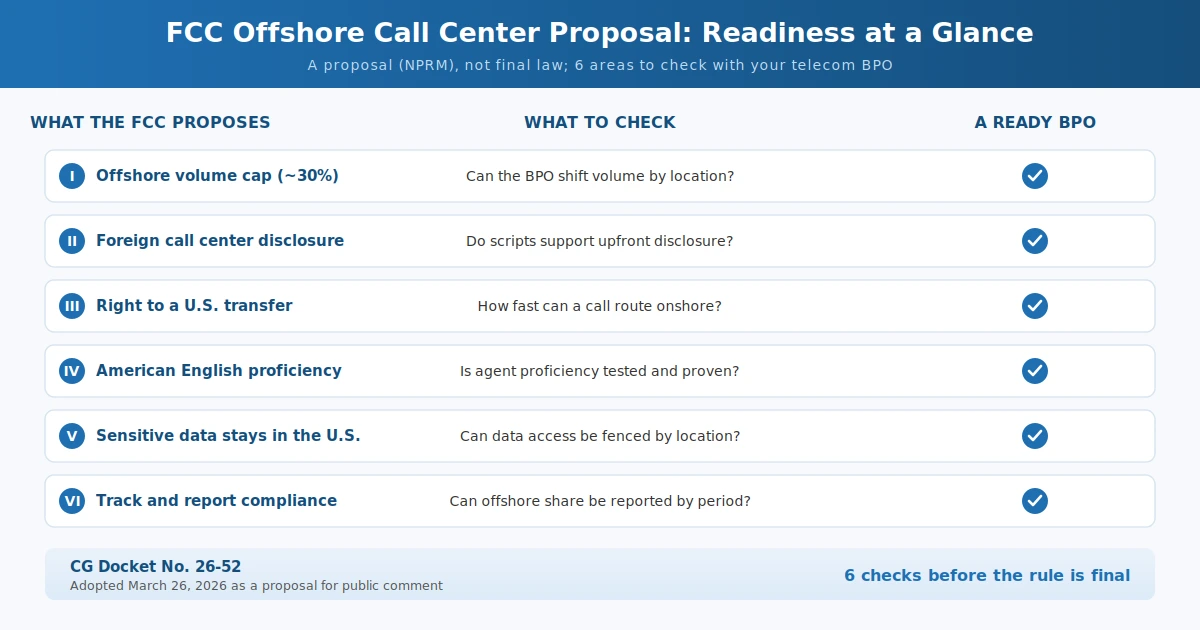
The FCC adopted this proposal, known as an NPRM, on March 26, 2026, under CG Docket No. 26-52. It asks for public input on several ideas. Remember, these are questions and proposals, not settled rules. Here is what it floats:
I. A cap on offshore calls: The FCC suggests limiting the share of customer calls handled abroad. A starting point of about 30% is under discussion.
II. Location disclosure: Providers may need to tell callers, up front, that a foreign call center is handling the call.
III. U.S. transfer rights: Customers could gain the right to move to a U.S. center on request. And they must be told about it.
IV. English proficiency: Offshore staff may need proven skill in written and spoken American Standard English.
V. Sensitive data stays onshore: Tasks with sensitive information may be limited to U.S. centers. This would span calls, chats, texts, and emails.
VI. Compliance reporting: Providers may need to track and report compliance on a set schedule.
The scope is wide. It covers telecom, wireless, VoIP, cable, and satellite providers, plus their affiliates.
 What the FCC’s proposed offshore call center rules mean for telecom operators in 2026
Your Operational Readiness Decision Tree
How do you turn a proposal into an action plan? Use a simple decision tree. For each workflow, map the proposed issue, the change it forces, and the question to ask your BPO. The table below shows how.
| Workflow area | What the NPRM proposes | What you may need to change | Question to ask your BPO |
|---|---|---|---|
| Call routing | Offshore volume cap near 30% | Balance offshore and U.S. queues | Can you shift volume by location on demand? |
| Caller disclosure | Announce a foreign call center | Add location messaging to scripts | Do your systems support upfront disclosure? |
| Escalation | Right to a U.S. transfer | Build a live U.S. transfer path | How fast can you route a call onshore? |
| Sensitive transactions | Keep sensitive data in the U.S. | Fence sensitive tasks to U.S. teams | Can you restrict data access by location? |
| Workforce | American English proficiency | Validate and certify language skill | How do you test and prove proficiency? |
| Reporting | Track and report compliance | Add location and volume reporting | Can you report offshore share by period? |
What the 2026 Status Tells You
The timeline matters as much as the content. Here is where things stand today:
- It is a proposal, not law. The NPRM only opens the question for comment.
- Comments come next. Comments are due 30 days after the rule posts in the Federal Register, with replies 60 days after.
- The scale is huge. The FCC chair noted that nearly 70% of U.S. businesses outsource at least one function, including customer service, abroad.
- The direction is clear. Even if the final rule softens, the push toward onshore options is real.
- Readiness is free. Checking your BPO now costs little and buys peace of mind.
So the smart play is to prepare, not panic. You can read the full proposal in the FCC’s March 2026 fact sheet and in legal analysis of the foreign call center rules.
How to Check Your BPO Readiness Now
You do not need to move everything onshore today. Instead, run a quick readiness check. This keeps you ready for any outcome. A simple path works best:
- Map your offshore share. Know what percentage of calls run abroad today.
- Flag sensitive workflows. List tasks that touch sensitive customer data.
- Test the transfer path. Confirm your BPO can route calls to the U.S. fast.
- Review disclosure and language. Check scripts and agent proficiency proof.
- Ask for location reporting. Make sure your partner can report by geography.
A telecom-ready partner will answer all five with ease. If yours cannot, that is your signal. This work also builds on the wider offshore-to-blended delivery shift many U.S. operators already began in 2025.
What This Means for Telecom Operators
For a telecom leader, the message is clear. You cannot control the final rule. But you can control your readiness. A flexible delivery model is now a real advantage. It lets you shift volume across U.S., nearshore, and offshore sites as needed. It also protects you if the cap or the data rule lands.
The key is a partner built for this. You need one who can flex your shore mix without a painful rebuild. You need clear location reporting and clean data controls. And you need it backed by strong SLA and compliance tracking. That mix turns a regulatory worry into a planned, calm response.
Stay Ready, Whatever the FCC Decides
The FCC’s proposal may change before it is final. Or it may not pass at all. Either way, the lesson is the same. Operators with a flexible, U.S.-capable partner will sleep easier. Those locked into a single offshore model may not. So the question is not whether to react. It is whether you are ready.
Do Not Wait The Final Rule to Get Ready
Sequential Tech, a Fusion CX company, runs telecom customer care, technical support, billing, and activations across U.S., nearshore, and offshore sites, with location-based reporting, strong data controls, and a delivery model you can flex as the rules evolve.
Request a U.S., Nearshore, and Offshore Readiness Assessment →