
Agent attrition is the single biggest hidden driver of inconsistent telecom CX, yet most buyers skip it during vendor reviews. This guide breaks down the 2025–2026 attrition benchmarks and shows you how to read the numbers before you sign a BPO partner.
A polished sales deck can hide a lot. One number usually cannot: agent attrition. It quietly shapes every call your subscribers make. Yet many buyers skip past it during vendor reviews. That is a costly miss. In telecom, high turnover shows up as long holds, repeat calls, and frustrated customers. So before you sign, look hard at the churn behind the smile. This guide explains what call center agent attrition in telecom really tells you and how to read it like a pro.
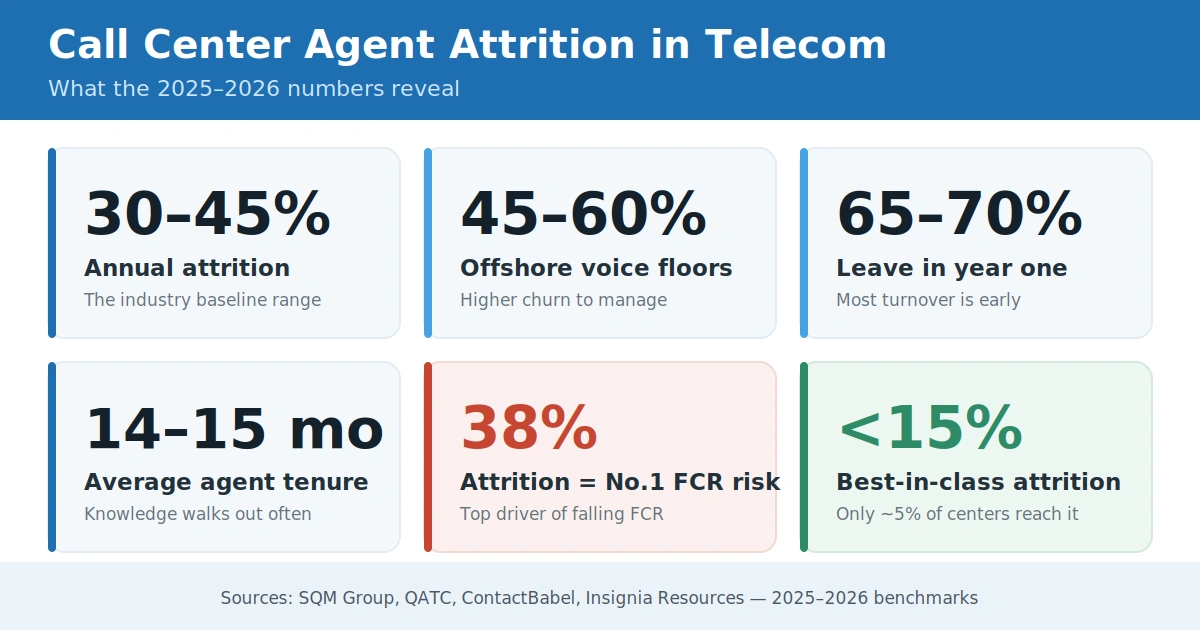 Telecom call center agent attrition benchmarks, 2025–2026.
Why attrition is the metric that predicts your CX
Attrition is the share of agents who leave a program over a year. It sounds like an HR stat. In practice, it is a customer experience stat. Here is why. New agents take months to get good. Meanwhile, they make more mistakes and escalate more often. As a result, a floor full of new hires delivers weaker service, no matter how strong the tools are.
Telecom makes this worse. Your agents handle billing disputes, SIM and eSIM issues, porting, and outage calls. These need product depth and calm judgment. Therefore, when tenure drops, quality drops with it. In short, attrition is the best early warning of inconsistent CX. That is exactly why it belongs near the top of your telecom BPO selection checklist.
What the 2025–2026 numbers actually say
You cannot judge a vendor’s attrition without a baseline. So let’s set one. The table below shows current industry benchmarks. The industry association QATC puts annual attrition in this same 30% to 45% band. Use it to pressure-test any number a partner gives you.
| Metric | 2025–2026 benchmark | What it signals |
|---|---|---|
| Industry annual attrition | 30% to 45% per year | The normal range; use as your baseline |
| Offshore voice floors | 45% to 60% | Higher churn risk; needs strong management |
| First-year attrition | 65% to 70% of new hires | Most turnover hits in the first 12 months |
| Average agent tenure | 14 to 15 months | Short careers; knowledge walks out often |
| “Best in class” attrition | Under 15% (only ~5% of centers) | Rare, and worth paying for |
| Cost to replace one agent | $10,000 to $20,000+ (up to ~$46,000 all-in) | Turnover is costly, and you help fund it |
| Ramp to full productivity | 4 to 6 months | New agents are slower for months |
Read the table as a spectrum, not a pass-fail line. A partner near the low end is healthy. One near the high end is not automatically bad, but it must prove strong controls. Also remember that these are vendor-reported ranges. So treat them as directional, and ask how each number was measured.
How attrition quietly damages FCR
First-call resolution is the metric telecom leaders watch most. Attrition attacks it directly. The link is not a guess. SQM Group’s research names roughly 38% agent attrition as the biggest driver behind falling FCR scores. In other words, churn and FCR move together.
The reason is simple. Experienced agents fix issues on the first try. New agents transfer, hold, and call back. So as tenure falls, repeat contacts rise. Your customers feel it fast. Meanwhile, the numbers back this up. The cross-industry FCR average sits near 70%, and only about 5% of centers reach world-class 80% or higher. Stable floors are how the best programs get there.
There is a satisfaction angle too. Centers with attrition under 15% post CSAT scores about 26% higher than high-turnover centers. That gap is huge. High churn also fuels subscriber churn on your side of the relationship. Therefore, when a partner brags about CSAT but hides attrition, be skeptical. The two are linked, and you deserve to see both.
The hidden costs behind agent turnover
Attrition drains money as well as quality. It is one of the biggest hidden operational costs of the wrong partner. Every departure restarts the clock on hiring and training. Then the new agent ramps slowly for months. During that window, you pay full rate for partial output.
The stress cycle keeps the churn going. Over 60% of departing agents point to stress and burnout as the top reason they quit. Workload plays a role too. When agent occupancy climbs above 85%, attrition tends to spike within 90 days; the healthy band is 75% to 82%. So a “fully utilized” floor can be a warning, not a win. Ask about occupancy targets, and you will learn a lot.
How to vet a telecom outsourcing partner on attrition
Vetting a telecom outsourcing partner is easier when you know what to ask. Do not accept a single glossy figure. Instead, dig into how the number is built. The table below sorts the answers you will hear into warning signs and healthier signs.
| Warning sign | Healthier sign |
|---|---|
| “We don’t really track that.” | Shares attrition by program and site, monthly |
| One blended annual number only | Breaks out first-90-day attrition too |
| Hides seat churn behind AI deflection | Reports tenure and FCR side by side |
| No plan for backfilling seats | Documented ramp and knowledge transfer |
| Occupancy pushed past 85% | Occupancy managed in the 75% to 82% band |
Use this as your interview script. Additionally, ask for numbers on a program like yours, not a company-wide average. Telecom work is complex, so a general figure can flatter the reality. Finally, request a trend line. One good quarter means little. A steady record over a year means a great deal.
What “good” looks like in practice
A strong telecom partner treats retention as an operating system, not a slogan. First, they hire for the role and train deeply, because telecom knowledge takes time. Next, they watch early attrition, since most churn happens inside the first year. Then they give agents modern tools and realistic workloads. As a result, agents stay longer and resolve more.
Delivery model matters here as well. A blended footprint spreads risk across onshore, nearshore, and offshore sites. So if one location tightens, another can flex. Well-run dedicated programs, especially with clear career paths, often beat the offshore averages. In short, good attrition is not luck. It is design. And you can see it in the numbers, if the partner is willing to share them.
Turn attrition into a partner you can trust
Attrition is not a vanity metric. It is a promise about the experience your subscribers will get next quarter. At Sequential Tech, we treat retention as a discipline, not a talking point. Our telecom teams handle customer care, technical support, billing, activations, and retention across onshore, nearshore, and offshore sites, with transparent attrition reporting and AI-assisted quality monitoring on every program. So if a past partner left you with inconsistent CX, we can walk you through the tenure and FCR numbers behind our floors. Book a free consultation, and see what stable, telecom-trained agents can do for your customers.