
Two vendors can quote the same telecom program and land far apart, because they price in different units. This 2027 guide breaks down the six pricing models, benchmarks them against 2026 market rates, and helps you compare offers before you sign.
You send the same scope to three telecom BPO vendors. The quotes come back wildly apart. One looks cheap per hour but balloons at scale. Another costs more up front but caps your risk. A third ties its fee to results you have not even defined yet. So which one is the real deal? You cannot tell from the headline price alone. You have to understand the pricing model underneath it. That is where most buyers get lost. It is also where the smart ones find real savings. Here is how telecom call center outsourcing pricing actually works as you head into 2027. One note on the numbers first. Every rate in this guide is a 2026 market benchmark. The contracting shift these rates point to is where 2027 is headed.
Why two quotes for the same work look so different
Price and pricing model are not the same thing. The price is a number. But the model is the logic that produces it. So two vendors can quote the same program and still land far apart, simply because they count cost in different units.
One charges for every agent seat. Another charges for every productive hour. A third charges for every ticket resolved. So a “cheap” quote can hide expensive terms, and a “pricey” one can protect you from overruns. The model matters more than the sticker. Learn the five main models, and you can compare any two quotes fairly, including the hidden costs most buyers miss.
The six pricing models you will actually see
Most telecom BPO contracts use one of six structures. And each one shifts risk and reward in a different direction. So the table below sums them up.
| Pricing model | How you pay | Best for | Watch out for |
|---|---|---|---|
| Per-FTE (dedicated) | Flat monthly fee per full-time agent | Steady, predictable volume | Paying for idle time in slow periods |
| Fixed billing (flat monthly) | One flat monthly fee for the whole program | Stable, well-defined scope | Scope creep as your needs change |
| Per-hour | A rate for each productive agent hour | Variable or seasonal volume | Rates swing by region and channel |
| Per-transaction | A fee per handled minute or contact | Spiky or digital-first volume | Unclear definitions and AHT games |
| Outcome-based | A fee tied to results (CSAT, FCR, sales) | Mature programs with clean data | Weak tracking and fuzzy attribution |
| Hybrid | A base fee plus bonuses or penalties | Complex telecom programs | Too many metrics muddy the deal |
Per-FTE, fixed billing, and per-hour: the classic models
Per-FTE is the old reliable. Here, you pay a set monthly fee for each dedicated agent. The cost is easy to forecast, and the team is yours. So it suits steady lines like ongoing customer care. But there is a catch. When volume dips, you still pay for every seat. So you carry the idle time, not the vendor.
Fixed billing is the flat-fee cousin of per-FTE. Here, you pay one set monthly price for the whole program. The number does not move with seats or volume. So your budget is locked from day one. This suits a stable, well-defined scope with steady demand. But watch for scope creep. When your needs grow, a fixed fee can quietly fall behind the work.
Per-hour pricing flexes more. You pay only for productive agent hours. As volume rises and falls, so does your bill. Therefore, it fits seasonal telecom work, like holiday activations or outage spikes. The rate itself depends heavily on where the work sits. As the chart below shows, an offshore hour can cost a quarter of an onshore one. That regional gap drives most of the savings in outsourcing.
One caution on these figures. They are 2026 US market benchmarks, drawn from published rate data such as Outsource Accelerator, not fixed quotes. Real rates move with scope, channel, volume, and complexity. So use them to frame a budget, then get a priced proposal for your own program.
Pricing models and rates at a glance
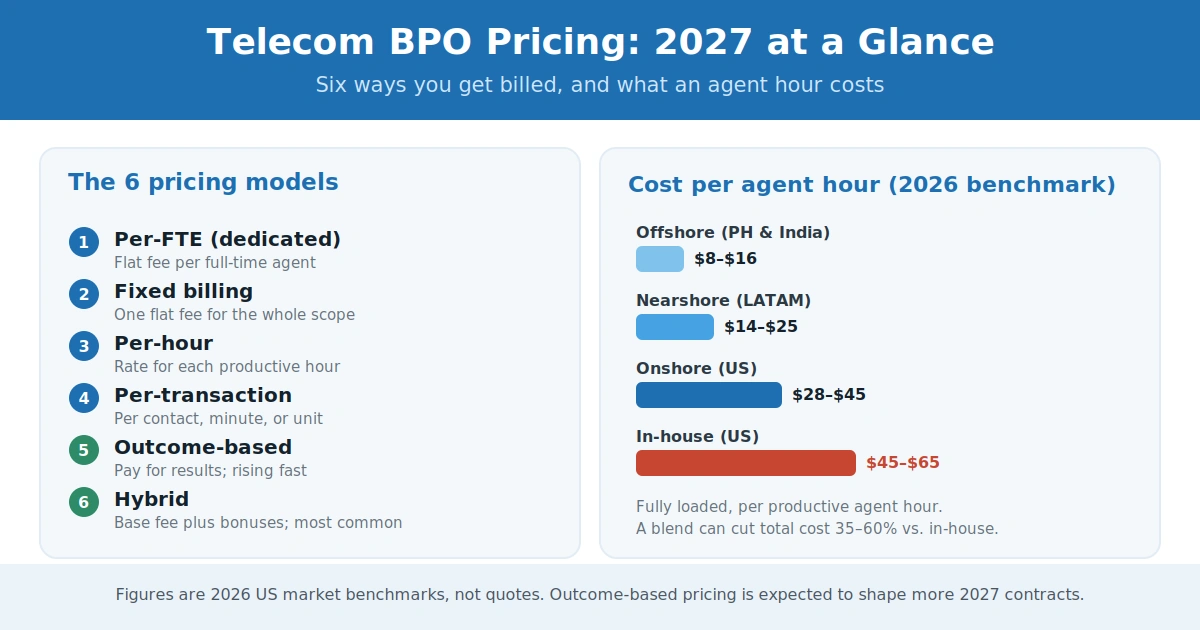 Five telecom BPO pricing models and 2026 estimated cost benchmarks by delivery location
Per-transaction and outcome-based: paying for value
Per-transaction pricing ties cost to usage. You pay per handled minute, per contact, or per resolved unit. So when volume is quiet, you spend less. This model suits digital-first and async work, like email or chat. In fact, chat often costs less per unit, because one agent handles two to four sessions at once. Still, you need tight definitions. Without them, a vendor can stretch handle times and inflate the count.
Outcome-based pricing goes a step further. Here, you pay for results, not effort. The fee links to resolutions, CSAT, first-contact resolution, or sales. So this aligns the vendor’s incentive with yours. And it is gaining ground fast. Industry data shows it rising through 2026, and buyers expect it to shape more 2027 contracts. But it only works with mature tracking and clear service-level definitions. Without clean data and clear attribution, the model breaks down in disputes.
Hybrid: where most telecom deals land
Few real contracts are pure. Most mix models to balance risk. A hybrid deal might pay a base per-FTE fee, then add a bonus for strong FCR or a penalty for weak CSAT. So you get predictable cost and aligned incentives together.
This is why hybrids dominate complex telecom programs. After all, a single operator may run care, technical support, activations, and collections at once. Each line has a different rhythm and a different goal. Therefore, one flat model rarely fits all of them. So a hybrid lets you price each workflow on its own logic. Just keep the metrics few and clear. Otherwise, too many targets turn a clean contract into a monthly argument.
What a blended quote looks like at scale
Benchmark numbers make this concrete. Take a 50-seat telecom program. Run fully in-house, it can cost roughly $2.9M to $4.7M a year, fully loaded. Move it to pure onshore outsourcing, and the range drops to about $1.8M to $2.9M. Shift to a 30/70 onshore-nearshore blend, and it falls to roughly $1.1M to $1.8M.
That blend delivers around 35% to 60% savings versus in-house. The savings do not come from cutting corners. Instead, they come from the right work sitting in the right place, priced in the right model. This is exactly the math a procurement team should run before signing.
How to read a quote without getting burned
Still, a low rate is not always a low cost. So look past the headline number and ask a few sharp questions.
- What unit am I paying for? Seat, hour, minute, or outcome. Make the vendor name it plainly.
- What is included? Training, quality, tech, and ramp time should sit in the rate, not get billed later.
- How is volume handled? Confirm what happens when contacts spike or fall.
- What are the metric definitions? For outcome or per-transaction deals, pin down every term in writing.
Ask these, and the true cost comes into focus. Skip them, and a cheap quote can cost you more within a quarter.
Price your telecom program with clarity, not guesswork
Pricing a telecom BPO contract is not about chasing the lowest hour. It is about matching the model to the work, the volume, and the goal. Get that match right, and you control cost without losing quality. This is the work Sequential Tech does for telecom operators. We run customer care, technical support, activations, billing, and collections across onshore, nearshore, and offshore sites; priced through per-FTE, fixed, per-transaction, outcome-based, and hybrid models built around your program, not a template.
So before you sign the next quote, put it to the test. Send us your scope, and our telecom pricing specialists will map it to the right model, the right shore, and a price you can defend in the boardroom.