

Model how an offshore call center cap would change your telecom shore mix, cost, and service levels. Use this step-by-step calculator method before the FCC’s 30% proposal becomes final.
Here is a question few telecom finance teams can answer today: what happens to your budget if only 30% of customer calls may leave the U.S.? The FCC put that number on the table in 2026. The rule is not final, and the number may change. Still, an offshore call center cap could reshape where your agents sit and what support costs. This guide shows how to model it, step by step, so you can see the impact before regulators decide.
What Is the Proposed Offshore Call Center Cap?
The offshore call center cap is a proposed limit on how much customer service work telecom providers may route outside the United States. The FCC released the proposal on March 27, 2026, in CG Docket No. 26-52. It would cover telecom, wireless, interconnected VoIP, cable, and satellite TV providers, along with their vendors.
The proposal uses 30% as an example cap on calls handled at foreign call centers. This is why many teams call it the FCC 30 percent offshore rule. However, the FCC also asked whether the number should be higher or lower. Comments closed on May 26, 2026, and reply comments on June 22, 2026. As of now, no final order or timeline exists. Our guide to FCC offshore call center rules covers the wider proposal.
Three other details shape any model:
- Calls involving passwords, Social Security numbers, or payment details would stay with U.S.-based agents.
- The FCC asked whether to measure the cap daily, monthly, quarterly, or yearly.
- It also asked whether to phase the cap in over time.
Does Nearshore Count Toward the Cap?
This is the question most cost models miss. The proposal does not define “foreign” in detail. Yet it refers to agents “located outside the United States.” On that wording, sites in Jamaica, Colombia, El Salvador, and Mexico would count toward the cap. Even Canadian sites would count. This matters for any provider with delivery locations spread across several countries.
So a nearshore center is not a safe harbor by default. Until a final rule says otherwise, the safest assumption is simple. Any agent outside the U.S. counts as offshore for cap purposes. Our onshore, nearshore, and offshore telecom support guide explains how each option differs in cost and coverage.
How the Shore Mix Cost Model Works
A good shore mix cost model answers three questions. First, how much volume can stay outside the U.S.? Second, what will the new mix cost? Third, can it still meet your service levels?
To answer them, the calculator needs a small set of inputs:
- Monthly contact volume and average handle time by queue
- Share of contacts that involve sensitive data
- Current share of volume at each shore
- Fully loaded cost per agent hour at each shore
- Service level, first contact resolution, and occupancy targets
- Hours of coverage needed, such as 24/7 or extended hours
The math itself is simple. Your blended cost per hour equals each shore’s share of hours multiplied by its rate, added together. Then the model checks whether the foreign share stays at or below the cap. Finally, it estimates how many agents each site needs to hit your service level.The graphic below shows all four steps in order.
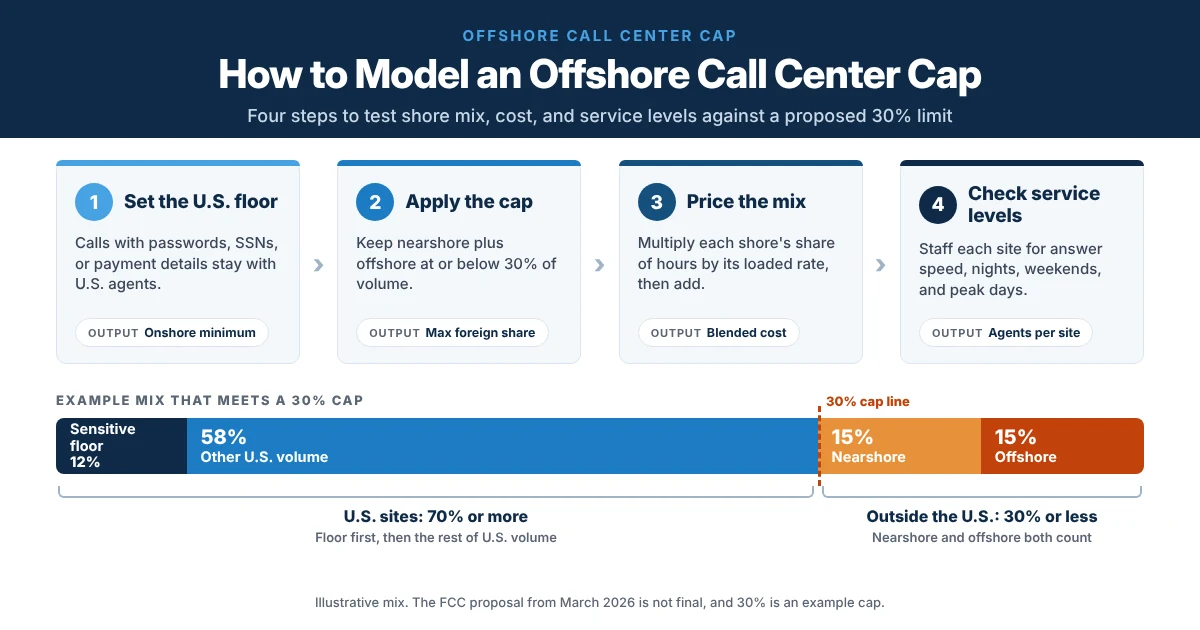
Sensitive calls set a floor for onshore volume. For example, if 12% of your contacts involve payment details or password resets, at least 12% must stay in the U.S. The cap then decides how the rest is split.
Use your own vendor quotes for rates. If you need a starting point, our guide to telecom call center outsourcing pricing explains common pricing models.
Worked Example: Onshore vs Nearshore vs Offshore Cost Under a 30% Cap
The example below uses round numbers to show how the model works. It assumes 100,000 paid agent hours per month. It also uses sample loaded rates of $32 per hour onshore, $18 nearshore, and $12 offshore. Replace these with your own figures.
| Scenario | Onshore | Nearshore | Offshore | Foreign share | Blended rate per hour | Monthly cost | Change vs. today |
|---|---|---|---|---|---|---|---|
| Today (offshore-heavy) | 15% | 15% | 70% | 85% | $15.90 | $1.59M | — |
| Cap-ready: keep offshore | 70% | 0% | 30% | 30% | $26.00 | $2.60M | +64% |
| Cap-ready: keep nearshore | 70% | 30% | 0% | 30% | $27.80 | $2.78M | +75% |
| Cap-ready: split | 70% | 15% | 15% | 30% | $26.90 | $2.69M | +69% |
Today’s mix costs about $19.1 million a year in this example. Each cap-ready mix costs between $31.2 million and $33.4 million. So meeting the cap adds roughly $12 million to $14 million a year. The biggest driver is not which foreign shore you keep. Instead, it is the jump from 15% to 70% onshore.
Keeping offshore inside the 30% looks cheapest on paper. However, cost per hour is only part of the picture. If nearshore agents resolve more calls on the first try, cost per resolved contact can tell a different story. For this reason, the calculator also compares cost per resolved contact, using your own first contact resolution and handle time data.
How an Offshore Call Center Cap Affects Service Levels
Cost is only half the model. Moving volume onshore also changes how you staff and cover each hour.
Staffing and Hiring
Each shore needs enough agents to answer calls within your service level target. Most calculators use the Erlang C formula for this step. It turns call volume, handle time, and target answer speed into required agents per interval. When volume shifts onshore, U.S. sites must hire, train, and ramp those agents first.
U.S. labor is the largest cost input. The Bureau of Labor Statistics reports a median wage of $21.53 per hour for customer service representatives in May 2025. Loaded rates run higher once you add benefits, space, and technology.
Night and Weekend Coverage
Offshore sites often cover U.S. overnight hours during their daytime. Under a cap, some of that coverage may need to move onshore. As a result, U.S. sites may need more night and weekend shifts, which can cost more.
Peak Days and the Measurement Period
The measurement period matters more than most teams expect. A yearly cap allows overflow to go offshore during storms or launches. A daily cap does not. So model your peak days, not just your monthly average.
Industry groups have raised these concerns too. In its 2026 filings, CTIA estimated that some proposals could cost the wireless industry more than $6.3 billion upfront. It also estimated at least $1.8 billion in yearly costs, according to a National Law Review summary.
Using the Results to Set Your Call Center Location Strategy
Once you run the numbers, use them to shape a call center location strategy that holds up under any final rule. Start by placing work where it fits best:
- Keep sensitive and high-value work onshore, since the proposal would require it anyway.
- Use the foreign share for work that gains the most from it, such as after-hours coverage or bilingual queues.
- Treat nearshore as foreign capacity until the rule says otherwise.
Next, run the model at several cap levels, such as 20%, 30%, and 40%. This shows how sensitive your budget is to the final number. It also helps you plan a blended delivery telecom model that can flex.
If the FCC adds a phase-in, model each step too. For example, test a path from today’s mix to 50% foreign in year one and 30% in year two. This shows the hiring pace and cash flow each step needs. Our overview of why U.S. operators are moving away from offshore-only BPO shows how others are adapting.
Finally, review your site footprint. Compare the sites you have today with the onshore capacity you would need under each scenario.
Run Your Own Numbers With the Shore-Mix Calculator
The final cap may land at 30%, change, or never pass. Either way, the leaders who model it now will have the clearest options later. Sequential Tech helps telecom operators, MVNOs, and broadband providers plan blended delivery across U.S., Canadian, nearshore, and offshore sites.
Want to see what the cap means for your own budget and service levels? Try the free shore-mix calculator and get a custom results report from our telecom operations team.
Frequently Asked Questions
What is the FCC 30 percent offshore rule?
The FCC 30 percent offshore rule is a proposed limit on how much customer service telecom providers may route to call centers outside the U.S. In March 2026, the FCC released it and used 30% as an example cap. The rule is not final, and the cap could end up higher or lower.
Does the offshore call center cap apply to nearshore centers?
It likely does. The proposal refers to agents located outside the United States, so nearshore sites in places like Jamaica, Colombia, or Mexico would count. Even Canadian sites would count on that wording. Until a final rule says otherwise, plan as if all non-U.S. sites fall under the cap.
When will the offshore call center cap take effect?
No date has been set. Comments on the proposal closed on May 26, 2026, and reply comments closed on June 22, 2026. The FCC has not issued a final order or timeline yet. It also asked whether to phase the cap in, so any final rule may allow time to adjust.
How do you calculate the cost of meeting a 30% offshore cap?
Multiply each shore’s share of agent hours by its fully loaded hourly rate, then add the results. Do this for today’s mix and for a mix with no more than 30% outside the U.S. The gap between the two is your added cost. Then check staffing for each site against your service levels.
Which calls would have to stay in the U.S. under the proposal?
Calls involving sensitive data would stay with U.S.-based agents. These include passwords, multifactor authentication codes, Social Security numbers, and bank account or credit card numbers. The FCC also asked whether the same rule should cover emails, texts, and chats. These calls set a minimum share for your onshore volume.