

A practical guide to designing a telecom BPO SLA that holds up in a crisis — with tiered MTTR, honest FCR targets, and penalty clauses that carry real financial weight.
Your telecom BPO SLA looks great, until the night a core network goes down. Then the fine print fails you. Averages hide the outage. Penalties have no teeth. And the BPO points at your engineering team while the clock keeps running. A weak service level agreement does not just miss targets. It drives churn and drains revenue. In fact, most standard SLAs look fine on paper yet fail during the crises that matter most. So let’s fix that. Here is how to design a telecom BPO SLA that truly protects your business — across MTTR, FCR, and penalties.
The Real Problem: SLAs That Look Good on Paper
Many telecom SLAs are written to be signed, not to be enforced. So they miss the moments that count. Watch for these common gaps:
- Averages hide outages. A blended MTTR buries a few long, painful failures.
- Ticket passing goes unpunished. Agents close or transfer tickets to beat the clock.
- Penalties lack teeth. Without money at risk, targets are just suggestions.
- Backlogs grow quietly. Old, complex tickets pile up with no cap.
- Blame stays fuzzy. No clear rule says when the timer can pause.
- Channels share one target. Voice, chat, and email get treated the same.
Each gap lets your BPO look compliant while your customers suffer. Worse, each one shows up as churn later. The fix is precise design. So let’s go metric by metric.
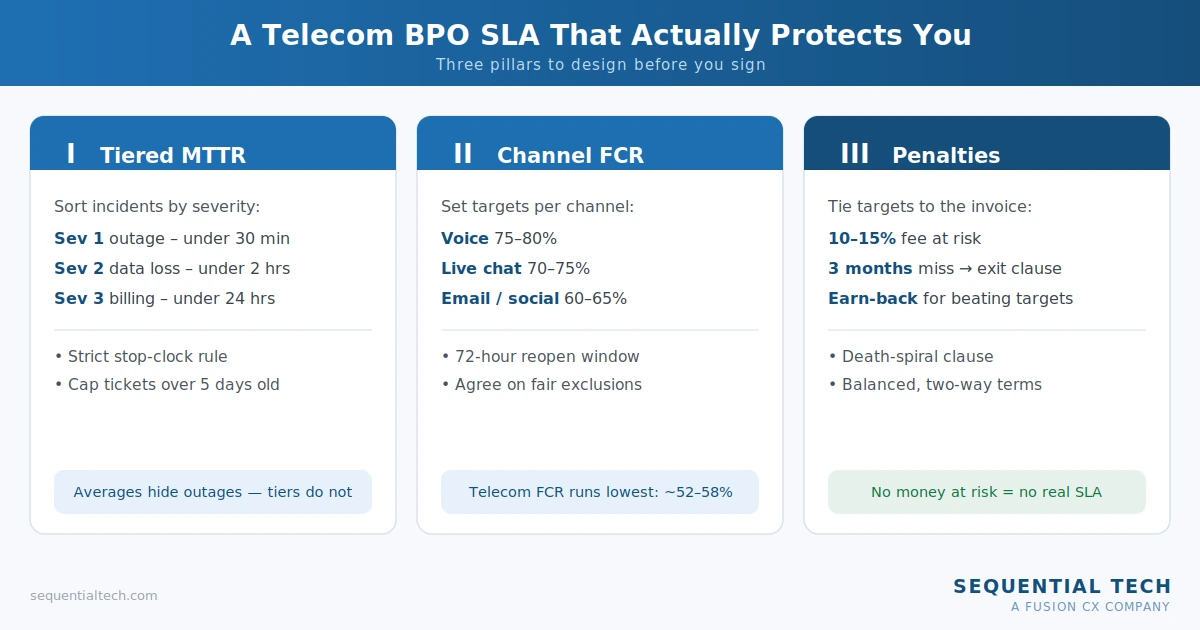 Three pillars of a protective telecom BPO SLA: tiered MTTR, channel-level FCR, and performance-based penalties.
I. Design MTTR That Reflects Real Risk
Mean Time to Resolution (MTTR) is the heart of any telecom BPO SLA. But a single average is dangerous. Why? Because thousands of quick password resets can hide a few catastrophic outages. So build MTTR with structure.
Use tiered MTTR. Never set one target. Instead, sort incidents by severity:
- Severity 1 (total network outage): under 30 minutes.
- Severity 2 (VIP issue or data loss): under 2 hours.
- Severity 3 (minor billing discrepancy): under 24 hours.
Add a stop-clock rule. BPOs often blame delays on your teams. So define exactly when the timer can pause. Pause it only for explicit customer action or a verified third-party dependency. Nothing else counts.
Cap the backlog. Limit tickets open longer than five days. This stops a slow pile-up of hard, unresolved cases.
Together, these three rules keep MTTR honest. Severity tiers also set clear priorities on the BPO’s floor. So the worst problems always get the fastest response. More importantly, all of this protects you when a real crisis hits. On the operations side, it pairs with AI-powered network MTTR reduction, where trained NOC agents turn fast diagnosis into fast fixes.
II. Make FCR Mean Something
First Contact Resolution (FCR) stops ticket passing. But only if you define it well. A loose definition lets a BPO close fast and still look good.
Set a 72-hour reopen window. Count a ticket as resolved only if the customer does not return within 72 hours for the same issue. This kills the “close and hope” habit. A shorter window would flatter the BPO. A 72-hour window reflects the real customer experience.
Use channel-specific targets. Channels resolve at different rates. So set separate baselines:
- Voice: 75%–80% FCR.
- Live chat: 70%–75% FCR.
- Email or social: 60%–65% FCR.
Align on exclusions. Some issues are not the agent’s fault. A known regional fiber cut, for example, cannot be fixed on a call. So exclude it from FCR. Agree on these exclusions up front. Fair exclusions keep the metric credible.
Realistic targets matter here. In fact, telecom posts the lowest FCR of any industry, near 52% to 58%. So aim for steady gains, not fantasy numbers. For practical levers, see how to improve first contact resolution.
III. Put Money Behind the SLA
An SLA without money is just a guideline. Money changes behavior. When a target touches the invoice, the BPO staffs and coaches to hit it. So tie performance to the BPO’s monthly invoice. Start with a clear penalty table:
| Metric | Target | At-Risk Fee (% of Invoice) | Penalty Trigger |
|---|---|---|---|
| Sev 1 MTTR | 99.5% compliance | 5.0% | Any single breach over 45 minutes |
| FCR (Voice) | ≥ 78% | 3.5% | Falling below 74% |
| Abandonment Rate | < 3% | 2.5% | Exceeding 5% for two straight days |
Then add three structures that make it work:
1. A fee-at-risk pool. Put 10% to 15% of the monthly invoice into an at-risk pool. If the BPO misses critical targets, they forfeit part of it. This pool is your leverage. It turns a broken promise into a real cost.
2. A death-spiral clause. One bad month should not end a partnership. Chronic failure should. So if the BPO misses a critical SLA — like Sev 1 MTTR — for three straight months, that triggers a material breach. You can then exit with no termination fee.
3. Balanced earn-backs. Keep the BPO motivated too. Let them earn back part of a penalty if they beat targets by a set margin — say 85% FCR — over the next two months.
This mix rewards strong work and punishes chronic failure. That balance keeps the partnership healthy.
Governance: Make the SLA Live
An SLA is only as strong as its review rhythm. So build governance in from day one. First, agree on a shared dashboard. It should show MTTR by tier, FCR by channel, and abandonment in real time. Strong service performance reporting makes this simple. Next, set a steady cadence:
- Weekly: an operational review of misses and root causes.
- Monthly: a scorecard tied to the at-risk pool.
- Quarterly: a business review of trends and targets.
Also, name one owner on each side. Because both teams see the same numbers, disputes shrink. Keep the reviews short and specific. A focused 30-minute weekly beats a long, vague monthly. As a result, the SLA stays alive, not buried in a contract drawer.
The 2025–2026 Benchmarks to Anchor Your SLA
Good targets start with real data. Here is where the numbers sit today:
- FCR. The cross-industry average is 70%, per SQM Group. Telecom sits lowest, near 52% to 58%. World-class is 80%, reached by only about 5% of centers.
- FCR value. Every 1-point FCR gain lifts CSAT by about 1%. Each repeat contact also costs roughly $13.50.
- Abandonment. The industry average is about 5% to 6%. Under 5% is good, and top performers hold 3% or less.
- Outages. The median major outage runs about 53 minutes. At scale, downtime can cost around $9,000 per minute.
Use these to set fair targets. Remember, telecom is complex, so your FCR targets should sit below the cross-industry average. Set them too high, and the BPO games the metric. Set them too low, and you lose protection.
Common SLA Mistakes to Avoid
Even careful teams slip on a few common errors. So watch for these:
- Chasing vanity metrics. Track outcomes like FCR, not just call counts.
- No baseline. Measure current numbers first, then set targets.
- One target for every channel. Voice and email are not the same.
- Vague exclusions. Undefined exclusions lead to endless disputes.
- Penalties you never enforce. An unused clause trains the BPO to ignore it.
- No earn-back. All stick and no carrot burns out the partnership.
Avoid these six, and your SLA stays both fair and firm. Each mistake looks small on its own. Together, they hollow out the whole agreement.
Roll Out New SLAs Without Disruption
Do not switch every penalty on overnight. Instead, phase the rollout. Start with a baseline period of 30 to 60 days. Measure closely, but do not penalize yet. Then run a soft launch. Share scorecards and hold reviews, with penalties still paused. Finally, switch on full enforcement once both teams trust the data. This ramp builds buy-in. It also catches measurement errors before money is on the line. Set a clear enforcement date in the contract, so no one is surprised when penalties begin. In short, a calm rollout makes the SLA stick.
Your SLA Design Checklist
Before you sign, check each box:
- Is MTTR tiered by severity, not a single average?
- Is the stop-clock rule strict and specific?
- Is there a backlog cap for old tickets?
- Is FCR defined with a 72-hour reopen window?
- Are FCR targets set per channel?
- Is 10% to 15% of the invoice at risk?
- Is there a death-spiral clause for chronic failure?
Seven yeses mean your SLA protects you. Any single no is a gap to close.
Build an SLA That Actually Protects You
An SLA should defend your revenue and your customers — not just your vendor. Sequential Tech, a Fusion CX company, runs telecom operations to exactly that standard, under SLAs built for mission-critical uptime.
Stop Signing SLAs That Protect Your BPO – Not You.
Sequential Tech delivers customer care, technical support, service assurance, and network operations under SLAs with tiered MTTR, channel-level FCR, and penalties tied straight to the invoice.