

Learn the top telecom risk management challenges for 2026, from $41.82 billion in fraud to AI, skills, and FCC rules, with steps to mitigate each.
One stolen identity can open a phone line that never gets paid for. One fake call can hand a fraudster a customer’s account. In 2025, losses like these added up to $41.82 billion across the global telecom industry. Fraud is only part of the picture, though. Cyber threats, new AI tools, staff gaps, and shifting rules all put telecoms at risk. This guide explains the top risks for telecom companies in 2026 and how to reduce each one.
What Is Telecom Risk Management?
Telecom risk management is the process of finding, ranking, and reducing the threats that can hurt a telecom’s customers, revenue, or reputation. It covers fraud, cybersecurity, compliance, network reliability, and day-to-day operations.
Good telecom risk management is not a one-time audit. Instead, it is a daily practice that runs through sign-up, billing, support calls, and the network itself. Many operators pair internal teams with outside risk management support to cover every stage.
The Top Risks for Telecom Companies in 2026
Each year, EY ranks the top telecom industry risks. On its 2026 list, privacy, security, and trust come first. Ineffective transformation through new technologies comes second, followed by talent, skills, and culture. The graphic below shows the top-ranked risks and what fraud already costs the industry.
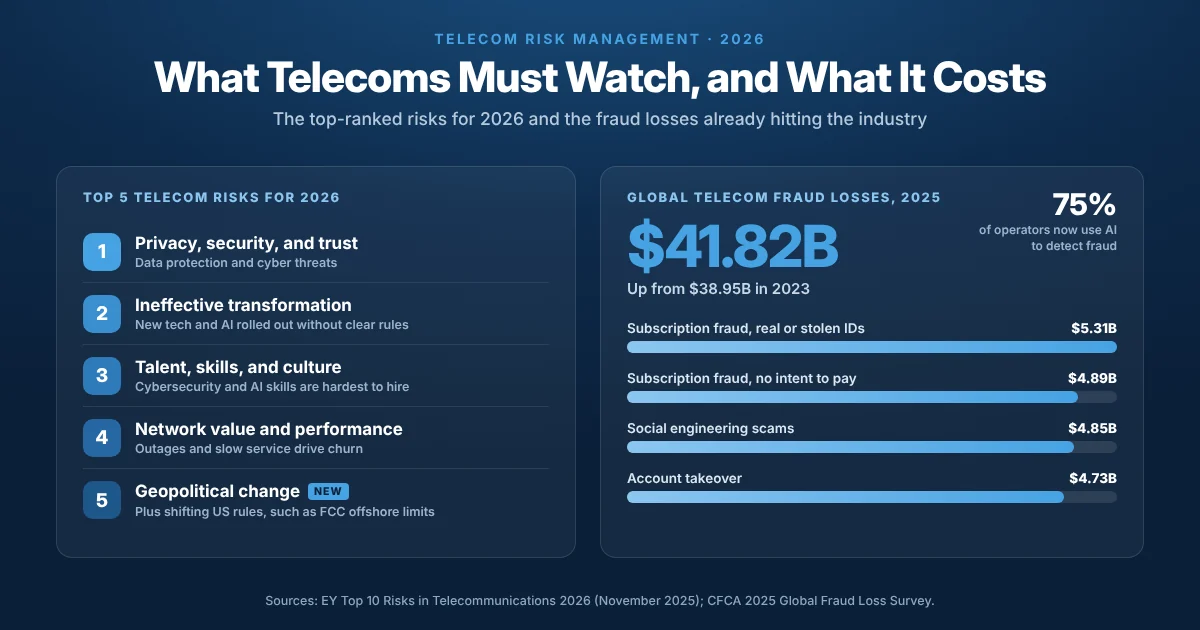 The top-ranked telecom risks for 2026, and the fraud losses already hitting the industry.
1. Privacy, Security, and Trust
Telecoms hold huge amounts of personal data, from call records to payment details. That makes them a prime target for attackers. As a result, a single breach can damage customer trust for years.
To reduce these telecom cybersecurity risks, limit who can see sensitive data and require multifactor authentication for staff. A zero-trust data model helps here. Also, keep payment and password calls with approved agents through sensitive data call routing.
2. Fraud at Sign-Up and on the Phone
Fraud is the most direct threat to revenue. The CFCA’s 2025 survey found that global telecom fraud losses rose to $41.82 billion, up from $38.95 billion in 2023. The top fraud types were:
- Subscription fraud using real or stolen identities: $5.31 billion
- Subscription fraud with no intent to pay: $4.89 billion
- Social engineering scams: $4.85 billion
- Account takeover fraud: $4.73 billion
Subscription fraud in telecom often starts at sign-up. So strong identity checks during activations and onboarding matter most. Account takeover, by contrast, usually starts with a phone call. Agents need firm checks before any SIM change, as our guide to SIM swap fraud prevention explains. They should also learn to spot deepfake audio.
The good news is that telecom fraud prevention is improving. The same survey found that 75% of operators now use AI or machine learning to detect fraud, up from 38% in 2023.
3. AI and Transformation That Go Wrong
New technology can cut costs, but rushed rollouts create new risks. In fact, only 59% of telecoms have a robust way to manage AI risk, compared with 66% across all sectors, according to EY’s 2026 telecom risk report.
To reduce this risk, set clear rules before launch. Decide what each AI tool may do, who reviews its output, and how to test it. Then start small and keep people in charge of key decisions.
4. Talent and Skills Gaps
Telecoms struggle to hire the right skills. EY found that cybersecurity is the hardest skill to fill, cited by 67% of telecoms. Meanwhile, 55% of telecom security chiefs say their budgets are too small.
Frontline teams face pressure, too. High agent attrition means new staff handle sensitive accounts before they are fully trained. Regular training, clear career paths, and skilled outside partners can close these gaps.
5. Regulatory and Geopolitical Change
EY added geopolitical change to its 2026 list for the first time, at number five. In the US, telecom regulatory compliance is also shifting. In March 2026, the FCC proposed limits on offshore call centers and U.S.-only handling of sensitive data. The rule is not final yet. Still, our guide to FCC offshore call center rules explains how to prepare.
To stay ahead, track pending rules, map which teams they affect, and review partner locations and certifications each year.
6. Network Performance and Changing Customer Needs
Outages and slow service drive customers away. They also raise support costs. Strong service assurance helps teams find faults early and fix them before customers notice.
Telecom Risk Management at a Glance
The table below pairs each risk with its warning signs and practical mitigation steps.
| Risk | Warning signs | How to mitigate |
|---|---|---|
| Privacy and security | Unusual data access, failed logins | Zero-trust access, staff MFA, data masking |
| Subscription fraud | New accounts with unpaid first bills | Identity checks at sign-up, device limits |
| Account takeover | Sudden SIM or email changes | Step-up checks before account changes |
| AI and transformation | Tools launched without testing | AI rules, human review, small pilots |
| Talent gaps | Open security roles, high attrition | Training, career paths, skilled partners |
| Regulation | New FCC or state rules | Compliance tracking and yearly reviews |
| Network performance | Rising repeat calls and outages | Proactive monitoring and fast fixes |
A Simple Framework for Risk Mitigation
Strong risk mitigation strategies for telecoms follow four steps.
First, list your risks and rank them by likely cost and impact. Second, give each risk a clear owner. Third, track a few warning signs for each one, such as unpaid first bills or sudden SIM changes. Finally, test your controls often and update them as threats change.
This approach turns telecom operational risk into a routine part of the business. It also helps leaders spend money where it reduces the most risk.
Reduce Risk Across Every Customer Touchpoint
Telecom risks are growing, but most of them can be managed with the right people, processes, and data. Sequential Tech helps telecom operators, MVNOs, and broadband providers reduce fraud and compliance risk with trained teams for risk management, activations, and collections and recovery. Our teams follow strict security controls across U.S., Canadian, nearshore, and offshore sites. Talk to our risk management expert about a fraud and compliance review of your customer operations.
Frequently Asked Questions
What is telecom risk management?
Telecom risk management is the process of finding, ranking, and reducing threats to a telecom’s customers, revenue, and reputation. It covers fraud, cybersecurity, compliance, network reliability, and daily operations. Strong programs combine clear owners, good data, trained teams, and regular testing.
What are the biggest risks for telecom companies?
EY’s 2026 list ranks privacy, security, and trust as the top risk. Ineffective transformation through new technologies comes second, followed by talent, skills, and culture. Fraud also remains a major threat, with global losses of $41.82 billion in 2025.
What is subscription fraud in telecom?
Subscription fraud happens when someone opens an account with stolen or fake details, or with no plan to pay. Fraudsters often take phones or services and leave the bill unpaid. Strong identity checks at sign-up are the best defense.
How can telecoms prevent account takeover fraud?
Telecoms can prevent account takeover fraud by verifying identity before any SIM change, port-out, or email update. Step-up checks, alerts to customers, and well-trained agents all help. Agents should also watch for social engineering and deepfake voices.
How is AI changing telecom fraud prevention?
AI helps telecoms spot fraud patterns faster than people can alone. The CFCA’s 2025 survey found that 75% of operators now use AI or machine learning for fraud detection. However, AI still needs human review and clear rules.