

Broadband prices in the US fell 6% in 2025 after inflation. Learn how $92.6 billion in fiber investment and competition shape prices, speeds, and bills.
Most household bills keep climbing. Groceries cost more, and so does rent. Yet one monthly bill has quietly moved the other way. After adjusting for inflation, broadband prices in the US have fallen for 11 straight years. That happened even as providers poured $92.6 billion into their networks in 2025 alone. It sounds like a paradox, but it is not. This guide explains why broadband prices keep dropping, what role fiber plays, and what it means for your own internet bill.
Are Broadband Prices in the US Really Dropping?
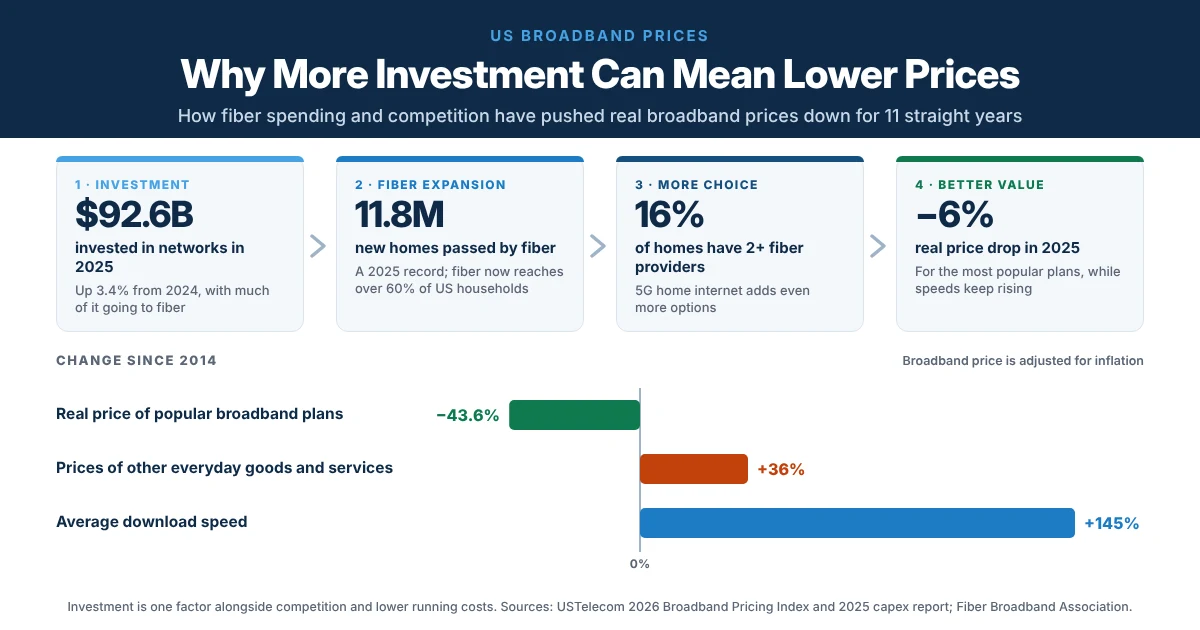
Yes, by the most common industry measure. USTelecom’s 2026 Broadband Pricing Index found that real prices for the most popular home internet plans, from 100 to 940 Mbps, fell 6% in 2025. Since 2014, they are down 43.6%. Over the same period, prices for other everyday goods and services rose about 36%.
The drop shows up at every speed level. In 2025, prices fell 17.2% for entry plans and 8.3% for midrange plans. Gigabit plans fell 4.9%. Meanwhile, average download speeds for popular plans rose 145% since 2014.
There is one key detail. These US broadband price trends are adjusted for inflation. In plain dollars, plan prices stayed mostly flat. So your bill may not have shrunk, but it now buys far more speed.
The $92 Billion Fiber Boom Behind Faster Networks
Broadband providers invested $92.6 billion in US communications infrastructure in 2025, according to USTelecom’s latest capex report. That is 3.4% more than in 2024. Since 2020, telecom infrastructure investment has averaged about $92 billion a year.
Much of this fiber broadband investment replaces older copper and cable lines. In other words, US fiber-optic infrastructure investment is now the main way providers upgrade home internet. For broadband and fixed-line providers, fiber carries more data, handles more devices, and supports faster upload speeds.
Why More Investment Can Lead to Lower Prices
Spending billions while charging less may seem odd. However, several forces work together. Investment is one factor, not the only cause. The graphic below shows how these forces connect.
More Competition for Your Business
This fiber internet expansion in the US often gives homes a second or third choice. Fiber passed a record 11.8 million new US homes in 2025 and now reaches over 60% of households. In addition, 16% of homes have more than one fiber provider, the Fiber Broadband Association reports.
Fixed wireless adds even more pressure. New 5G home internet services give many areas another option. In fact, J.D. Power found that wireless home internet sign-ups grew 15% over six months, compared with 6% for wired service. When customers can switch easily, providers compete on price and speed. This is the core link between broadband competition and pricing.
Fiber Can Cost Less to Run Over Time
Fiber is costly to build, but it usually needs fewer repairs than older copper. Once it is in the ground, providers can raise speeds by upgrading the equipment at each end. They do not need to lay new cables. Over time, these savings help keep internet service provider pricing steady.
Better Operations Lower the Cost to Serve
Network upgrades also make daily operations simpler. Faster order management shortens installs. Strong service assurance finds faults before they cause outages. AI tools can also cut repeat support calls. Each saving lowers the cost to serve a customer, which makes broadband price reductions easier to sustain.
US Broadband Industry Trends at a Glance
The table below sums up the latest numbers.
| Measure | Latest figure | Source |
|---|---|---|
| Industry investment, 2025 | $92.6 billion, up 3.4% | USTelecom |
| Real price change, popular plans, 2025 | Down 6.0% | USTelecom |
| Real price change, popular plans, since 2014 | Down 43.6% | USTelecom |
| Real price change, gigabit plans, 2025 | Down 4.9% | USTelecom |
| Average download speed, since 2014 | Up 145% | USTelecom |
| New homes passed by fiber, 2025 | 11.8 million, a record | Fiber Broadband Association |
| US households passed by fiber | Over 60% | Fiber Broadband Association |
Advertised Prices vs. Your Actual Bill
Price indexes track plan prices. Your monthly bill, however, can include more. That gap explains why some households do not feel prices falling. Common extras include:
- Equipment or router rental fees
- Promotional prices that rise after 12 or 24 months
- Taxes and other surcharges
- Lost discounts if you drop autopay or paperless billing
These extras matter to customers. In a 2025 Reviews.org survey, 67% of internet customers said they had switched or considered switching over hidden fees or surprise charges. FCC broadband labels help by showing the monthly price, promotion length, and added fees before you buy. Clear billing and usage information also builds trust after you sign up.
What Falling Prices Mean When You Compare Providers
Falling real prices are good news for broadband affordability and access to affordable high-speed internet. Still, the best deal depends on your address. First, compare the total monthly cost, not the headline price. Next, check what you will pay after any promotion ends. Then compare speed per dollar, including upload speed if you work from home.
Fiber broadband benefits for consumers often include matching upload and download speeds. Finally, weigh reliability and support, because a cheap plan with frequent outages still costs you. You can start with our list of top broadband service providers in the USA. For deeper data, see the full US Telecom 2026 Broadband Pricing Index.
Deliver More Value With Every Connection
Lower prices and faster speeds only matter when customers also get reliable service and clear bills. Sequential Tech helps broadband and fiber providers run order management, service assurance, technical support, and billing support with telecom-trained teams and AI-enabled tools. The result is a lower cost to serve and a better customer experience. Talk to our telecom expert about outsourcing solutions that help you deliver reliable, affordable connectivity.
Frequently Asked Questions
Why are broadband prices in the US dropping?
Broadband prices in the US are dropping in real terms because of more competition, network upgrades, and steady investment. New fiber and 5G home internet options give customers more choices. As a result, providers compete on price and speed. USTelecom found real prices for popular plans fell 6% in 2025.
How much do broadband providers invest each year?
US broadband providers invested $92.6 billion in communications infrastructure in 2025, according to USTelecom. That was 3.4% more than in 2024. Since 2020, investment has averaged about $92 billion a year, with much of it going to fiber networks.
Is fiber internet cheaper than cable?
It depends on where you live and which providers serve your address. Fiber plans are often priced close to cable plans at similar download speeds. However, fiber usually offers much faster upload speeds. Compare the total monthly cost, including fees and post-promotion prices, before you choose.
Why does my internet bill not feel cheaper?
Most price trends are adjusted for inflation, so plan prices in plain dollars stayed mostly flat. Your bill may also include equipment fees, taxes, or a higher rate after a promotion ends. Check your provider’s broadband label to see the full monthly cost.
Will broadband prices keep falling?
No one can promise that. Still, the forces behind recent drops remain strong. Fiber keeps expanding, 5G home internet adds competition, and providers keep investing. If these trends continue, real prices are likely to stay steady or keep easing, while speeds keep rising.