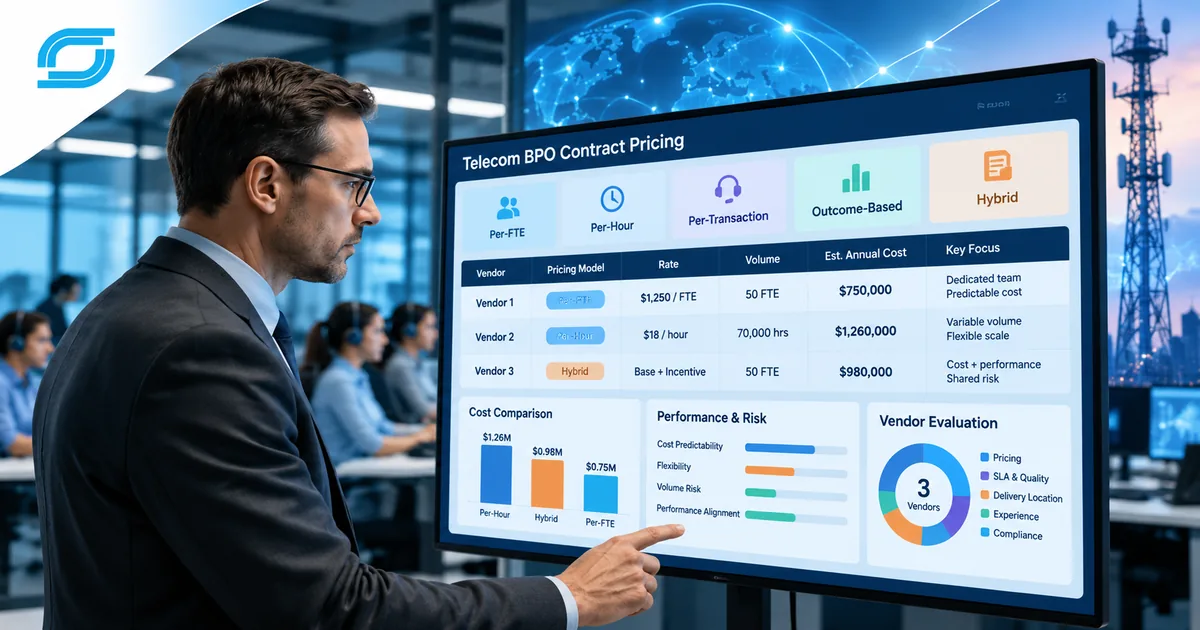

Build your own inbound team, or hand it to a partner? This guide compares the in-house vs outsourced telecom call center models on cost, speed, and control, so you can pick the right fit.
Every growing telecom operator hits the same fork in the road. Call volume is climbing. The support team is stretched. And there are two choices. Build a bigger in-house call center, with all the hiring, tech, and real estate that brings. Or hand inbound support to a specialist partner. Both can work. But they pull your budget, your speed, and your control in very different directions. Pick wrong, and you either overspend or fall behind your subscribers. So before you commit, it helps to see the two models side by side.
The two models in plain terms
The choice is really build or buy. In-house means you own the whole customer care operation. You hire the agents, buy the tools, rent the space, and run the training. You hold full control, but you also carry every cost. Outsourcing means a partner runs inbound support for you. They bring trained agents, proven tech, and ready capacity. You gain speed and flexibility, and you share control through contracts and service levels. Neither is automatically better. But the stakes are high either way, because more than half of consumers switch after a single bad experience.
Think of it like transport. In-house is owning a fleet of vehicles. You control everything, but you also fuel, fix, and park them. Outsourcing, by contrast, is like hiring a trusted carrier. They run the fleet, and you set the destinations. So both get you there. But the cost and the effort differ sharply. And that difference is what this guide unpacks.
Telecom adds its own demands, as well. Agents must grasp SIMs, plans, porting, and outages. So whichever model you pick, telecom fluency is not optional. In-house teams build it slowly, over months of training. A specialist telecom inbound call center partner, by contrast, brings it on day one. So for many operators, that head start tips the scale.
In-house vs. outsourced: a head-to-head view
So how do the two models compare on the factors that matter most? The table below lays them out side by side, from staffing to cost to reach.
| Factor | In-house | Outsourced |
|---|---|---|
| Staffing | Internal hiring and training | Ready, trained agents |
| Speed to scale | Slower; weeks to months | Faster; days to weeks |
| 24/7 coverage | Costly night shifts | Built in across shores |
| Telecom expertise | Must build it internally | Available through a specialist |
| Technology | Your own investment | Provider-supported |
| Quality assurance | Internal only | Provider plus your governance |
| Cost structure | Fixed overhead | Variable, tied to volume |
| Geographic reach | Limited | Multi-shore and global |
One pattern stands out. In-house gives you control, while outsourcing gives you speed and flexibility. So the best choice depends on which of those your operation needs most right now.
It is also worth noting what the table does not show. Control and quality depend on how well you manage either model. So the rows are a starting point, not a verdict. In the end, your execution still decides the outcome.
Cost: what each model really costs
Cost is often the deciding factor, so look closely. An in-house US agent costs around $75,000 a year once you add salary, benefits, management, tech, and space, per 2025 cost benchmarks. You carry that cost whether calls are busy or quiet. Outsourced agents, by contrast, run from about $8 to $25 an hour depending on location, and you pay mainly for productive time. The average cost per call sits near $2.70 to $5.60. So outsourcing often lowers cost per contact, especially when volume swings. Still, a small and steady operation may find in-house cost-competitive. Run the numbers for your own volume before you decide.
Scale changes the math, too. A small, steady operation spreads fixed costs across every call, so in-house can stay competitive. But as volume grows and swings, idle in-house capacity gets expensive. So the larger and spikier your volume, the more outsourcing tends to save. Therefore, model your own numbers across a full year, not just a busy month.
The hidden costs of in-house
In-house looks straightforward on the surface. But several costs hide below it. First, recruitment and training never really stop, because agents leave and new ones join. Second, technology needs upgrades, licenses, and support. Third, you pay for space, power, and management, busy or not. And fourth, you carry the risk of turnover, which runs high in call centers. So the true cost of in-house is often larger than the salary line suggests.
What outsourcing asks you to manage
Outsourcing is not free of trade-offs, though. You hand day-to-day control to a partner, so trust and governance matter. Quality can slip if you pick the wrong vendor or skip oversight. And a weak partner may not know telecom well enough. So the model works best when you choose carefully and stay involved. In practice, that means setting clear service levels, reviewing metrics often, and treating the partner as an extension of your team. Done well, outsourcing becomes a competitive advantage, not just a cost play.
The two models at a glance
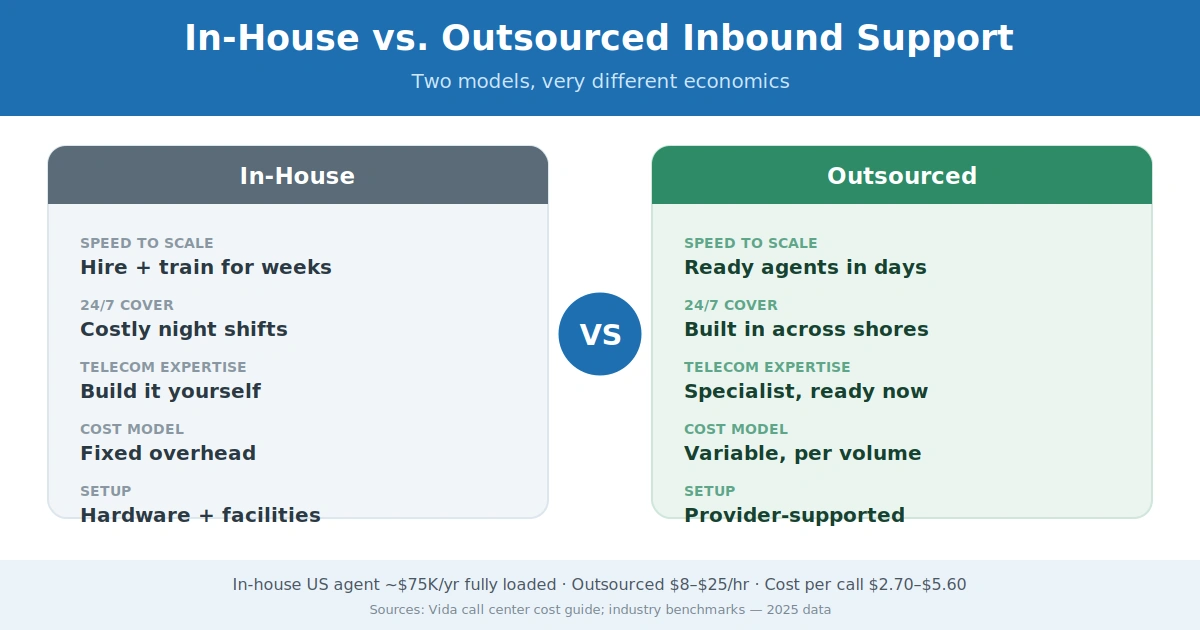 In-house and outsourced telecom support models compared across cost, speed, coverage, and expertise.
When each model makes sense
There is no single winner, so match the model to your situation. In-house tends to fit when support is a core differentiator, volume is steady, and you have the budget and time to build. Outsourcing tends to fit when you need to scale fast during spikes, cover nights and weekends, or control cost as volume swings. Many operators also blend the two. They keep a small in-house core for complex calls, then use a partner for overflow, after-hours, and peaks. For a growing operator, that flexibility often becomes a real edge, not just a cost play.
The hybrid model deserves a closer look, because it is where many operators land. In this setup, a small in-house team handles your most complex or sensitive calls. Meanwhile, a partner absorbs overflow, after-hours, and seasonal peaks. So you keep control where it counts, and gain flexibility everywhere else. For a growing telecom brand, that balance is hard to beat.
Your type of operation matters as well. A large MNO with steady, core support may lean in-house. A lean MVNO or a fast-growing brand often leans on a partner. So there is no universal answer. Instead, there is only the model that fits your shape. So how do you choose? Start with your numbers. Map your volume, your peaks, and your budget. Then ask which model meets them without strain.
A few simple rules can guide you. If support quality is your main differentiator, keep more of it in-house. But if speed and flexibility matter more, lean on a partner. And if your volume is unpredictable, a hybrid gives you room to flex. So let the trait you value most point the way. And once you lean toward outsourcing, the next step is knowing what to look for in a provider.
Choose the model that fits your growth
So here is the bottom line. Build or buy is not a gut call; it is a math problem, and the numbers rarely lie. This is where Sequential Tech earns its keep for telecom operators. Our telecom inbound call center teams can run your full inbound queue, extend your in-house crew, or cover overflow and after-hours, all priced to your volume. So bring us your call data, and we will model both paths beside you, line by line. Book a working session, and see which model actually wins on your numbers.