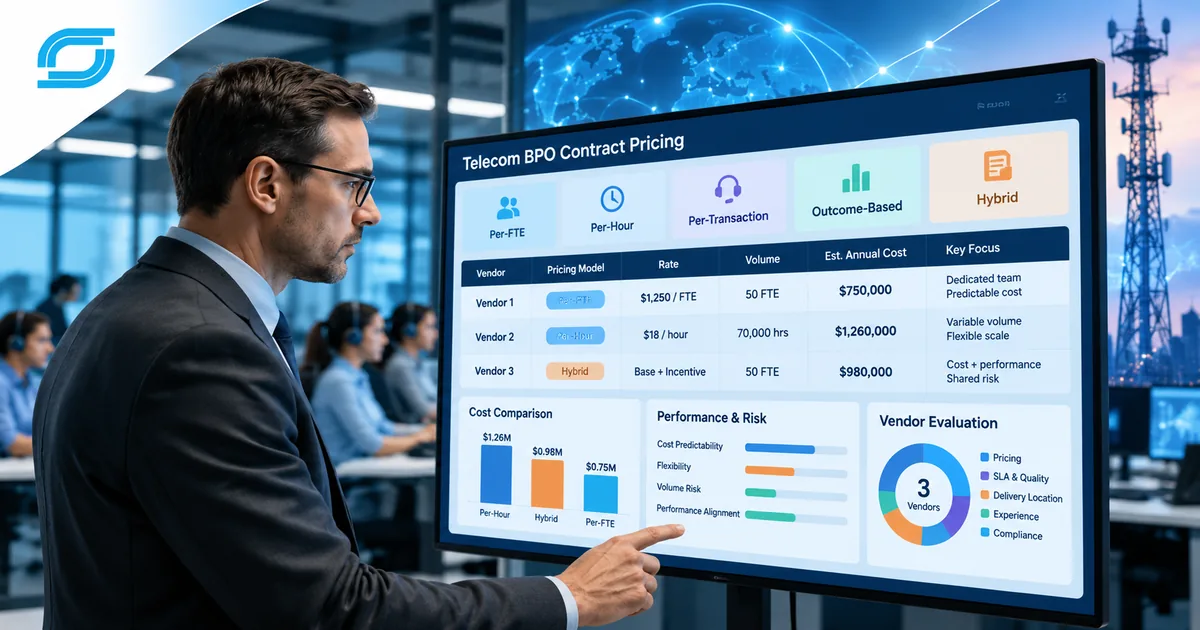

Inbound call volume rarely grows on a smooth line. This guide shows how telecom inbound call center outsourcing lets operators absorb spikes, add 24/7 cover, and protect CX, without adding internal headcount.
Your network has an outage on a Tuesday morning. Within minutes, the phone lines light up. Calls triple, then quadruple. Your in-house team of twenty now faces the work of sixty. Hold times stretch past ten minutes. Frustrated subscribers hang up, and some never come back. Hiring more agents takes months. The spike lasts hours. This gap, between volume you cannot predict and a team you cannot grow fast enough, is the core problem of telecom support. And it is exactly the problem outsourcing is built to solve.
Why telecom inbound volume is so hard to staff
Telecom call volume does not arrive in a steady stream. It surges, often without warning. A product launch brings a wave of setup questions. A billing cycle sparks a run of disputes. An outage floods the lines in minutes. And holidays or promotions add their own peaks. Each spike is short but sharp. Your internal team, though, is a fixed cost. You staff for the average, not the peak. So when volume jumps, the team cannot keep up. Hire for the peak instead, and you pay for idle agents the rest of the year. Either way, fixed headcount and variable demand do not match.
Consider a simple example. Say you run a lean MVNO support team. On a normal day, the team handles calls with room to spare. Then you launch a new plan. Suddenly, sign-up and setup calls double overnight. So your agents fall behind within an hour. Wait times grow, and new customers form their first impression on hold. In other words, the very moment you want to impress, your team is underwater. And this is one of the clearest signs a support team is stretched too thin, a pattern that repeats across the industry.
The real cost of under-staffed support
Short-staffing has a price, and subscribers pay it first. When hold times climb, patience drops. Calls get abandoned. Issues go unresolved. And in telecom, that quickly turns into churn. Zendesk reports that more than half of consumers switch to a competitor after just one bad experience. Expectations have risen too. About 62% of CX leaders say they feel behind on the instant, always-on service customers now demand. So a missed call is not a small thing. It is a subscriber deciding whether to stay.
The damage does not stop at one call, either. An unhappy subscriber often tells friends and leaves reviews. So one bad experience can cost you more than one customer. And in a market where switching is easy, that risk is very real. Because of this, the support queue is not just an operations metric. Instead, it is a direct line to revenue.
When spikes outrun a fixed team
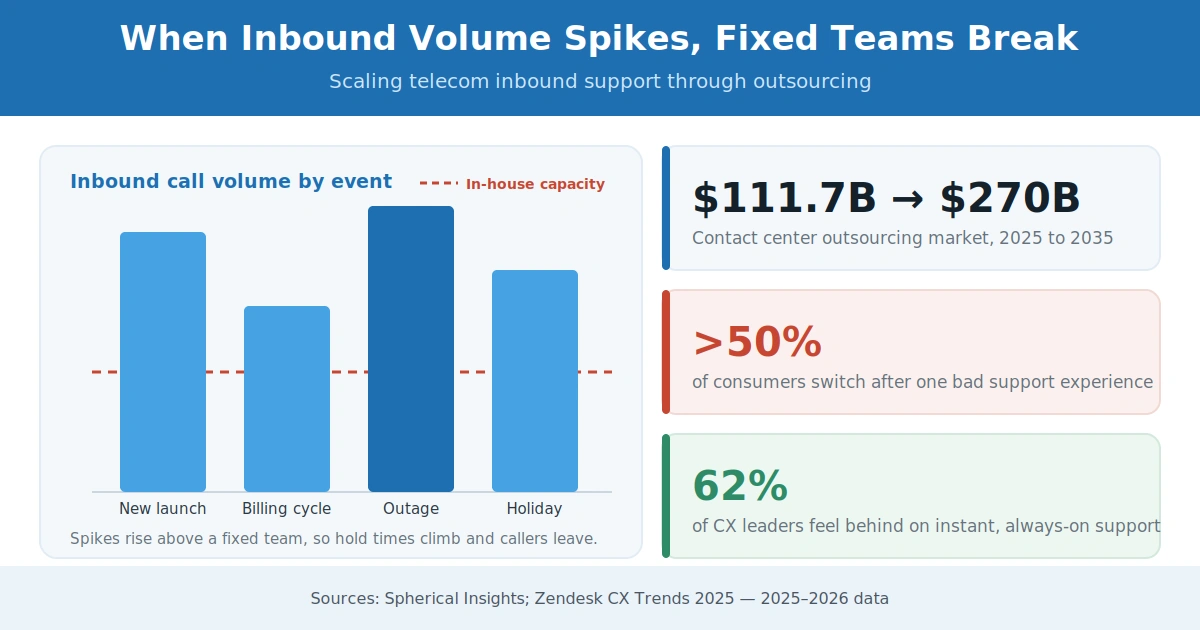 Inbound call spikes can quickly exceed fixed in-house telecom support capacity.
Two ways to scale: overflow vs. fully outsourced
Scaling is not all-or-nothing. This is where telecom inbound call center outsourcing comes in, and it works in more than one way. You can add help only at the peaks, or hand over the whole queue. The table below sums up the main models.
| Scaling model | How it works | Best for |
|---|---|---|
| Overflow support | A partner takes calls only when your own queue overflows | Steady base volume with sharp, short peaks |
| Fully outsourced | A partner runs your whole inbound queue end to end | Lean teams or fast subscriber growth |
| 24/7 extension | A partner covers nights, weekends, and holidays | Round-the-clock cover without night shifts |
| Blended AI + human | Bots handle simple calls; agents take the rest | High volume of routine, repeat questions |
Each model shifts work off your core team in a different way. So the right fit depends on your volume pattern and your goals. If you are weighing building the capacity yourself, compare it with our guide on in-house vs. outsourced telecom call centers.
Overflow support is often the easiest first step. Here, your own team answers first. Then, when the queue passes a set threshold, extra calls route to your partner. So your subscribers never hear a busy tone, yet you keep your core team in place. Fully outsourced support goes further, though. In this model, the partner owns the whole inbound queue, which frees your staff for product and network work. Between these two, most operators find a fit for their stage of growth.
The 24/7 and AI + human model
Modern scaling leans on two tools. First, round-the-clock cover. Telecom issues do not wait for office hours, so your customer care cannot either. A partner with global sites keeps lines open at 2 a.m. without asking your team to work nights. Second, a blend of AI and human agents. Bots and voice agents can handle simple, repeat questions, like balance checks or plan details. That frees human agents for the hard calls, such as outages or billing disputes. Together, these let you handle far more volume with the same core team.
There is a cost angle here too. Night and weekend shifts are expensive to staff in-house. But a partner with global sites already runs those hours. So you gain always-on cover without paying a premium for it. The AI layer adds more savings as well. When bots deflect the simplest calls, your human agents handle fewer but higher-value contacts. As a result, broader customer support outsourcing lets the same team resolve more of what truly matters.
What scaling through outsourcing actually costs
Cost is where outsourcing often surprises operators. The contact center outsourcing market is growing fast, from about $111.7 billion in 2025 toward $270 billion by 2035, as more brands make this shift. industry forecasts point the same way. The reason is simple math. You pay for productive time, not idle seats. You skip the cost of hiring, training, and tech for a team you only need at peak. And you turn a fixed cost into a flexible one that rises and falls with volume. For lean operators, that flexibility turns straight into real savings.
There is also a speed benefit. Hiring and training a new agent can take weeks or months. A partner, though, can add trained agents in days. So when a spike hits, you respond now, not next quarter. And that speed is often worth as much as the cost savings.
What to look for when you scale through a partner
Scaling well is not only about adding seats. Instead, it is about adding the right ones. So look for a partner with real telecom experience, not general call handling. Also, check that they can flex both up and down, fast. Then confirm they report clear metrics, so you can see service levels in real time. And make sure their tools connect to your systems. Get these right, and extra capacity feels like an extension of your own team.
Finally, think about culture and brand voice. Your partner’s agents speak for you. So they should sound like your team, follow your tone, and protect your brand on every call. Because when the handoff is smooth, subscribers never notice where your team ends and the partner begins.
Scale your inbound support without the hiring scramble
Here is the hard truth. The next volume spike is already on its way, and it will not wait for your hiring plan. So the real question is simple: will your support flex, or will it break? At Sequential Tech, flexing is the job. Our telecom inbound call center teams absorb spikes, add 24/7 cover, and blend AI with skilled agents, so you grow support without growing headcount. Let’s pressure-test your inbound setup before the next surge hits. Talk to our expert, and we will map a scaling plan to your real call patterns, peak by peak.