
The right telecom inbound call center provider protects your subscribers; the wrong one costs you churn. These 10 criteria help B2B buyers compare vendors and choose with confidence.
Picking a support partner feels simple, until it is not. On paper, every telecom inbound call center provider promises the same thing: great service, low cost, happy subscribers. But the gap between vendors is wide. One partner resolves issues on the first call. Another leaves your customers on hold and your brand bruised. And because support is the voice of your company, that choice follows you. So how do you tell a strong provider from a risky one? You score them against the signals that actually predict success. Here are the ten that matter most.
Why the provider choice matters in telecom
Telecom support is high-stakes. Calls are often urgent: an outage, a billing shock, a failed activation. Subscribers want fast, expert help, and they remember when they do not get it. Zendesk finds that most consumers will switch after a single bad experience. So the provider you pick shapes both your cost and your subscriber loyalty. A specialist telecom inbound call center partner is built to protect both.
Think about what a support call represents. Often, it is the only human contact a subscriber has with your brand. So a single call can build loyalty or break it. A strong provider turns a frustrated caller into a keeper. A weak one does the opposite. Because of that, the choice deserves real care, not a quick quote comparison.
This shift is industry-wide, too. More operators now treat a specialist provider as the default, not the exception. In fact, the contact center outsourcing market is climbing toward $270 billion by 2035. So the pool of choices is larger than ever. That is good news. But it also makes a clear scoring method essential. Without one, strong and weak vendors can look alike on a sales call.
The 10 criteria to score every provider
A good shortlist starts with clear standards. Score each provider against the ten criteria below. Together, they cover capability, quality, and risk. And each one maps to a real moment your subscribers will feel with your customer care team.
| Criterion | What to check |
|---|---|
| 1. Telecom industry experience | Proven telecom clients and agents who know the domain |
| 2. Inbound call handling capacity | Can absorb your peak volume without long waits |
| 3. 24/7 availability | Round-the-clock cover across time zones |
| 4. Omnichannel support | Voice, chat, SMS, email, and app in one view |
| 5. Technical escalation | Clear paths for outages and complex faults |
| 6. CRM / BSS / OSS integration | Connects to your billing and network systems |
| 7. QA and call monitoring | Live scoring, coaching, and quality reviews |
| 8. SLA and KPI reporting | Transparent metrics you can hold them to |
| 9. Data security and compliance | Strong controls and relevant certifications |
| 10. Scalability and global delivery | Multi-shore capacity that grows with you |
The criteria that carry the most weight
All ten criteria matter, but a few carry extra weight in telecom. Telecom experience comes first. An agent who understands SIMs, plans, and outages resolves calls faster, with fewer transfers. Integration comes next. When the provider’s tools connect to your CRM, BSS, and OSS, agents see the full account and fix issues in one call. And SLAs tie it together. A clear telecom BPO SLA turns promises into numbers you can hold the partner to. So weight these three heavily when you score.
Three more criteria protect you from risk. Quality assurance keeps standards high through live scoring and coaching. Security and compliance guard your subscriber data, which telecom holds in volume. And scalability makes sure the partner can grow with you, not just start with you. So think of these three as the safety net under the whole engagement.
Channels and timing round out the picture. Today’s subscribers move between voice, chat, and app, so your provider should too. And when a fault runs deep, there must be a clear path to a specialist. Telecom calls also come at odd hours, during an outage or a late-night activation. So a provider without true 24/7 cover leaves gaps when you need them least.
The cost of a wrong choice is high, too. A weak provider can raise churn, miss SLAs, and force a painful switch later. So the time you spend scoring upfront pays back quickly. In other words, due diligence is cheaper than a failed partnership.
The 10-criteria scorecard
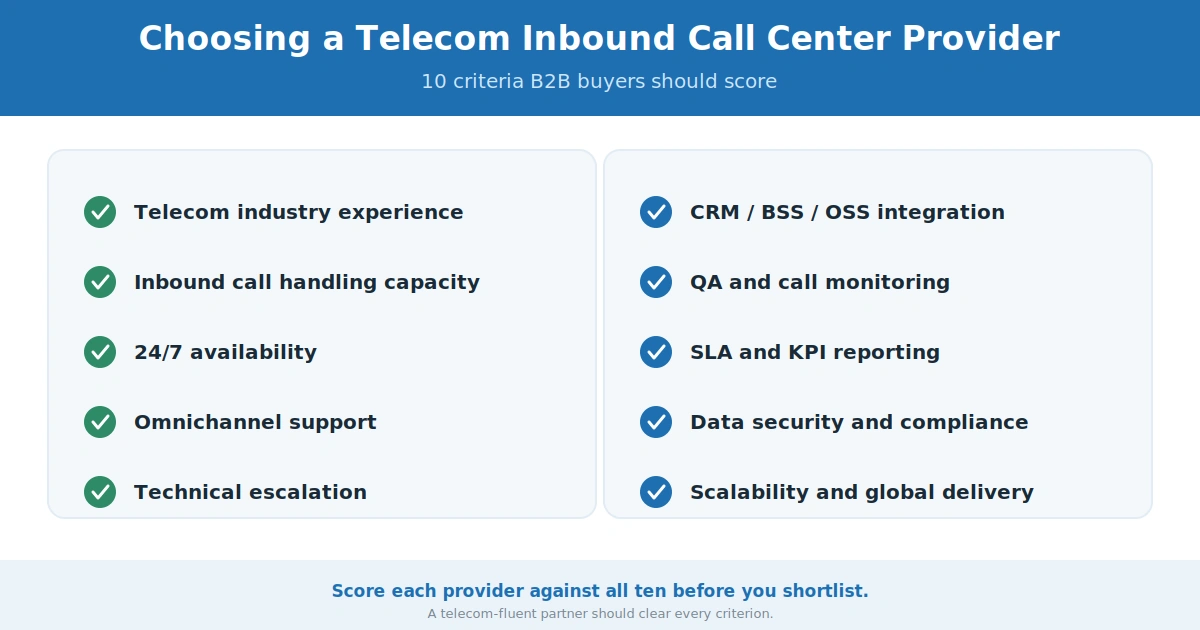 Ten criteria B2B buyers should use to evaluate telecom inbound call center providers
A quick vendor evaluation checklist
Scoring is easier with a simple checklist. Rate each provider from one to five on every criterion. Then weigh the ones that matter most to your operation.
- Ask for telecom references: Talk to current clients in your segment.
- Test peak handling: Confirm how they staff for spikes and 24/7 cover.
- Review the SLA: Pin down metrics, targets, and penalties in writing.
- Check integrations: Verify they connect to your CRM, BSS, and OSS.
- Audit security: Confirm compliance and data-handling controls.
Add up the scores, and your shortlist appears. And for a wider view beyond inbound, our key factors for selecting a telecom BPO provider covers the full picture.
Red flags to watch for
Scoring is also about spotting risk early. So watch for a few warning signs. Be cautious if a provider cannot name telecom clients. Be wary if they dodge questions about SLAs or penalties. And think twice if they promise a very low rate with no detail on staffing or quality. A price that looks too good often hides thin coverage. So treat vague answers as a red flag, not a small gap.
Once you have scores, compare them side by side. The best provider is rarely the cheapest or the biggest. Instead, it is the one that clears your must-haves and fits your telecom needs. So let your criteria, not a sales pitch, lead the decision.
Frequently asked questions
When should a telecom operator outsource inbound support? When call volume outgrows your team, when you need 24/7 cover, or when hiring cannot keep pace with growth. In those cases, a provider scales faster than in-house hiring. Our guide on in-house vs. outsourced call centers digs deeper.
What is the most important criterion? Telecom experience. An agent who knows the domain resolves calls faster and transfers less. So the rest of the criteria build on that base.
How many providers should you compare? Shortlist three to five. Score each against the ten criteria, then run deeper checks on the top two. That keeps the process rigorous without stalling it.
Does provider choice affect AI and automation? Yes. A strong provider blends AI with human agents, so simple calls self-serve and complex ones reach an expert. So ask how they balance the two.
What should a telecom inbound SLA include? At a minimum, set targets for first-contact resolution, average handle time, service level, and abandonment rate. Then add penalties if the targets are missed. So get these terms in writing before you sign.
Choose a partner built for telecom
You now hold the scorecard. So use it, and put every provider on it, including us. At Sequential Tech, we built our telecom inbound call center to clear all ten: telecom-trained agents, 24/7 omnichannel cover, deep CRM, BSS, and OSS integration, and transparent SLA reporting. So do not take our word for it. Schedule a scorecard walkthrough, and judge us criterion by criterion, the same way you judge everyone else.