

A telecom churn reduction outsourcing guide that models what a save is worth at each stage — proactive, save desk, and win-back, so you recover the most lifetime value for the least cost.
Here is a hard truth for telecom leaders. By the time a customer calls to cancel, you have already lost most of the fight. The decision was made weeks ago. Yet most retention programs wait for that call. Then they spend big on a last-minute save. There is a smarter way. Treat retention as an economics problem, not just a service one. In other words, model the value of intervening at each stage of churn. This guide shows you how. It also shows why telecom churn reduction outsourcing can shift the math in your favor.
The Real Problem: Retention Without the Math
Most churn content tells you how to be nicer to customers. Almost none tells you what a save is worth. So teams guess. They spend the same effort on every account. And they act too late. That is expensive. Here is what goes wrong when the economics are ignored:
- Late intervention. You act at the cancellation call, when save rates are lowest.
- Flat spending. You spend the same on a $20 line and a $200 account.
- No LTV view. You count saves, not the lifetime value you kept.
- Blunt offers. You hand out discounts you did not need to give.
- No stage model. You treat proactive, save desk, and win-back as one budget.
Each gap quietly drains margin. The fix is a simple economics model.
The Three Stages of Churn Intervention
Churn is not one event. It is a journey with three windows. Each window has its own economics.
I. Proactive (weeks before). Behavioral signals show frustration early. Think a missed payment, a support spike, or falling usage. Here, save rates are highest and costs are lowest. You reach the customer before they decide.
II. Save desk (the cancellation call). Now the customer has decided to leave. So you need a strong, fast offer. When a customer engages with a good offer, 25% to 40% stay. But the cost is higher, and you often give a discount. These are the save-desk moments that stop a cancellation.
III. Win-back (after they leave). The customer is gone. A win-back campaign tries to bring them back. Reactivation rates run about 10% to 15%. This stage is the hardest and priciest. Still, it recovers value that was already lost.
The Economics of a Save
Now put numbers on it. The idea is simple. The value of one save equals the lifetime value you keep, minus the cost to keep it.
Value of a save = Recovered LTV − Cost to save
Then multiply by how many you save. So two levers drive the math: your save rate and your cost per save. Both change sharply by stage. Earlier stages win on both. You save more customers, and each save costs less. For example, keep a $50-ARPU customer for another 14 months, and you hold about $700 in value. If the save costs $40, the net is $660. Do that 500 times, and the math adds up fast.
Intervention Economics by Stage
The table below shows the pattern. It uses simple, illustrative numbers: 1,000 at-risk subscribers, $50 ARPU, and about $700 in recovered lifetime value.
| Stage | Timing | Save / Win Rate | Cost per Save | Net Value (per 1,000) |
|---|---|---|---|---|
| I. Proactive | Weeks before | ~50% | ~$40 | ~$330,000 |
| II. Save Desk | At the cancellation call | ~30% | ~$70 | ~$189,000 |
| III. Win-Back | After they leave | ~12% | ~$120 | ~$70,000 |
Note: Returning subscribers often come back on cheaper plans. So real win-back LTV can be lower than the figure shown.
The message is clear. The same 1,000 at-risk subscribers are worth far more when you act early. Proactive intervention returns roughly $330,000. Win-back returns about $70,000. Both are positive. But the order matters.
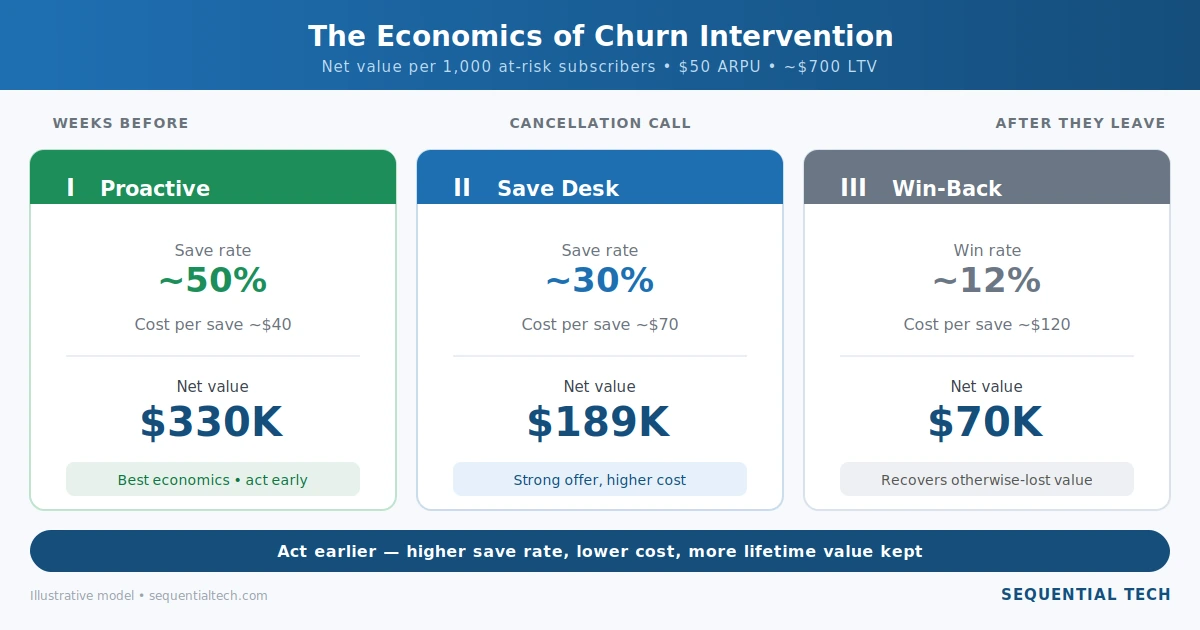 Net value per 1,000 at-risk subscribers falls sharply from proactive to win-back.
Why Earlier Beats Later
So why does early action win? Three reasons stack up:
- Higher save rates. You reach the customer before the decision hardens.
- Lower cost per save. A quick call beats a deep discount or a full re-acquisition.
- Full lifetime value. You keep the whole relationship, not a discounted version.
There is a catch, though. Early action needs early signals. You cannot save what you cannot see. So proactive retention depends on good data and fast outreach.
The Signals That Trigger Early Intervention
Proactive retention only works if you can see churn coming. So watch the signals. In telecom, the early flags are clear:
- A missed or late payment.
- A spike in support contacts.
- A sudden drop in usage or data.
- A failed activation or install.
- A complaint about a bill or an outage.
- A visit to a cancellation or porting page.
Each signal raises churn risk. So each one should trigger fast, targeted outreach. The sooner you act, the cheaper the save.
The 2025–2026 Numbers Behind the Model
The model rests on real data. Here is where telecom sits today:
- Churn is costly. Postpaid churn runs about 10% to 20% a year. For a 1-million-subscriber carrier at $50 ARPU, a 20% loss is around $120 million a year.
- Winning back is cheap. Reactivating a lapsed customer costs 5 to 10 times less than acquiring a new one.
- Acquisition is expensive. New subscriber acquisition costs about four times monthly ARPU, and often $300 or more per line.
- Small gains pay off. Lifting retention by just 5% can raise profits by 25% to 95%.
- Service drives it. About 39% of cancellations trace back to poor customer service.
These numbers explain the whole model. Retention almost always beats replacement. And earlier retention beats later retention.
Build Your Own Intervention Model
You can model this for your own base. It takes five inputs. Pull these numbers first:
1. Your ARPU. The average revenue per user, per month.
2. Your recovered LTV. How long a saved customer stays, times margin.
3. Your save rate by stage. Proactive, save desk, and win-back.
4. Your cost per save. Staff, tools, and any offer or discount.
5. Your at-risk volume. How many accounts show churn signals.
Then apply the formula at each stage. The stage with the best net value is where your next dollar should go. For most operators, that is the proactive layer.
How Telecom Churn Reduction Outsourcing Changes the Math
Here is where telecom churn reduction outsourcing shifts the economics. A specialized retention partner improves both levers at once. It raises save rates with trained save-desk and win-back teams. And it lowers cost per save through scale and process. It also runs the proactive layer that most in-house teams skip. So you catch churn earlier, save more, and spend less.
The proof is measurable. In Sequential Tech programs, churn has dropped by up to 22%. Win-back results have improved by up to 18%. That is the model working in the real world.
Save Customers While Saving Is Still Cheap
Churn does not start at the cancellation call. It starts weeks earlier, in the behavior. The operators who win model the economics and act early. The rest keep paying to replace what they could have kept.
Stop Waiting For The Cancellation Call
Sequential Tech, a Fusion CX company, runs proactive retention, save-desk, and win-back programs that cut churn by up to 22% and lift win-back by up to 18% — with the economics modeled for your ARPU and LTV.