The US Hispanic market is large, young, and mobile-first. This guide shows how bilingual customer support turns Spanish-language service into real subscriber growth for MVNOs and prepaid brands.
A new subscriber activates your prepaid SIM on a Friday night. Something goes wrong with her data plan. She calls support, but the only option is English. She speaks Spanish at home, so she hangs up. By Monday, she has switched to a brand that answered in her language. That one call just cost you a customer, plus the lifetime value behind her. For MVNOs chasing the US Hispanic market, small moments like this decide growth. And language sits at the center of almost every one of them.
The US Hispanic market is too big to ignore
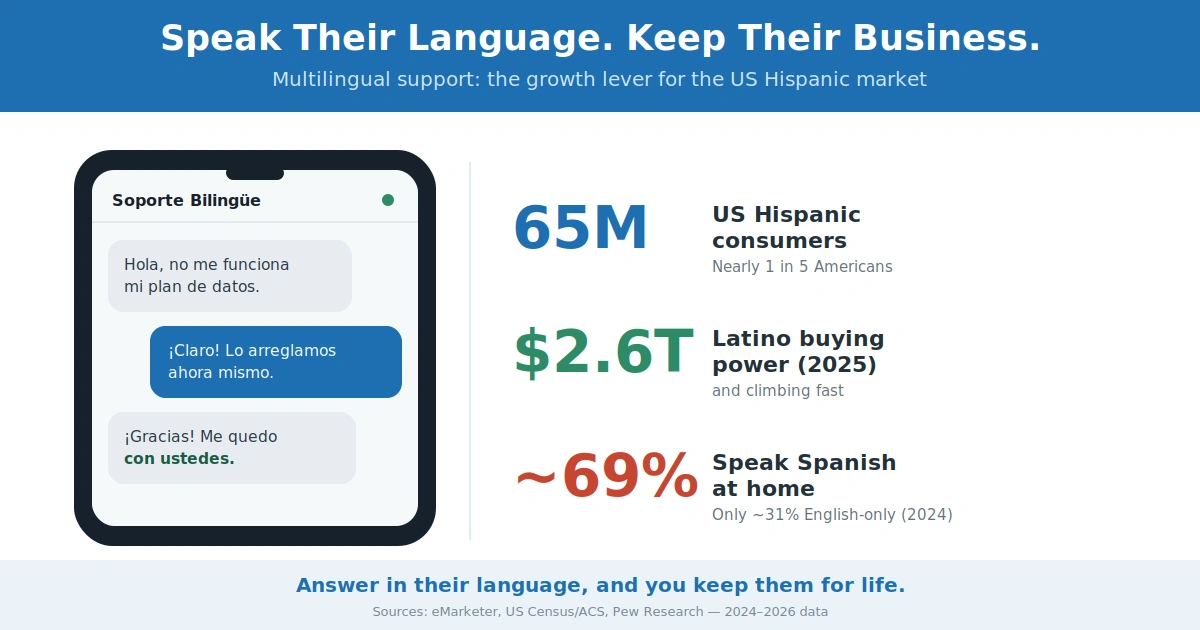
The US Hispanic community is one of the country’s fastest-growing groups. Today it numbers about 65 million people, or nearly one in five US residents. It is also young, digital, and mobile-first. On top of that, its spending power keeps climbing. Latino buying power is projected to reach $2.6 trillion in 2025. So this is not a niche audience. It is a mainstream growth engine. For prepaid and MVNO brands, it is also a natural fit. Many Hispanic households prefer prepaid mobile plans and value flexible, no-contract service. That makes this segment central to your growth, not a side bet.
Age is a big part of the story. The median age of US Hispanics is well below the national average. Younger users adopt mobile services early, and they switch brands often. So first impressions carry real weight. And support is one of the first things a new subscriber tests.
Here is the opportunity in one snapshot. The figures below show both the size of this market and the role language plays in it.
The US Hispanic mobile opportunity at a glance
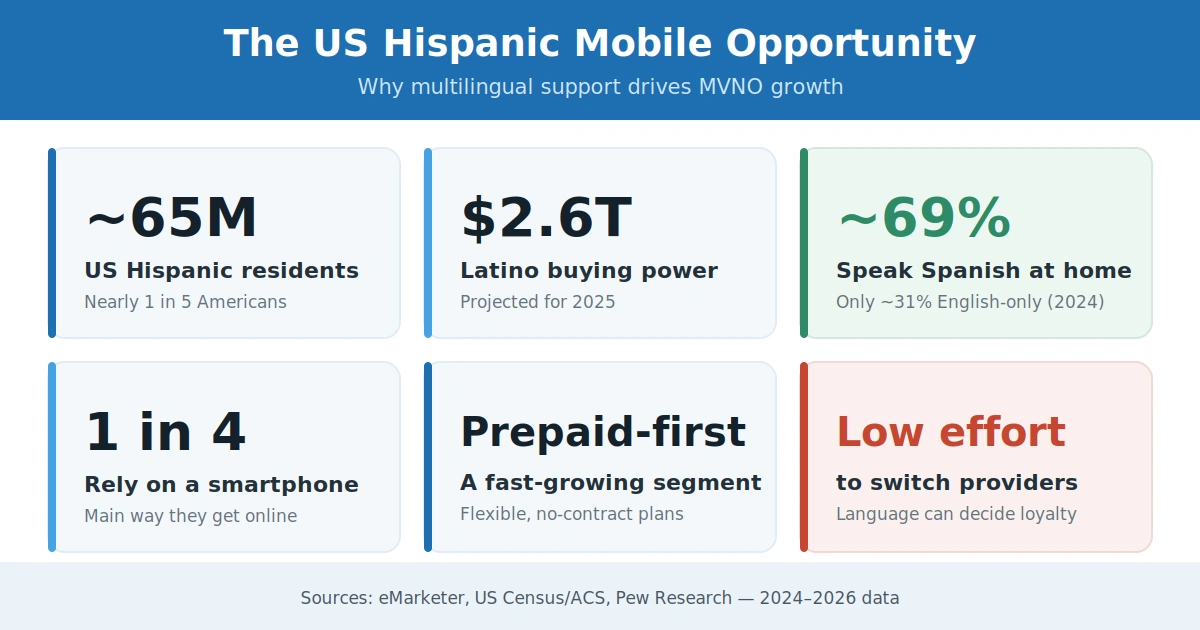 Key 2024–2026 signals behind the US Hispanic mobile market.
Why language drives loyalty in prepaid
Prepaid is a low-friction market. There is no long contract to hold anyone in place. So a subscriber can leave the moment service frustrates them. And frustration often starts with language. In 2024, only about 31% of US Hispanics spoke only English at home. That means close to seven in ten use Spanish at home at least part of the time. When a billing or network problem gets stressful, people want to explain it in their own words.
This group is also highly mobile-dependent. About one in four Hispanic adults rely on a smartphone as their main way to get online. So the phone is not just a convenience. It is the primary link to work, family, and money. When it stops working, the support call carries real weight. Answer it well, and you build trust. Answer it poorly, and you hand a loyal customer to a rival, plus a costly win-back later.
Trust also grows when people feel understood. A caller who hears their own language relaxes. The talk moves faster, and the fix lands sooner. That comfort builds a real bond with the brand. And in prepaid, where loyalty runs thin, that bond is worth money. A happy subscriber refills on time. They also tell friends and family. In close-knit Hispanic communities, that kind of referral spreads fast.
So one support call can tip either way. The two paths below make the stakes clear.
One subscriber, two outcomes
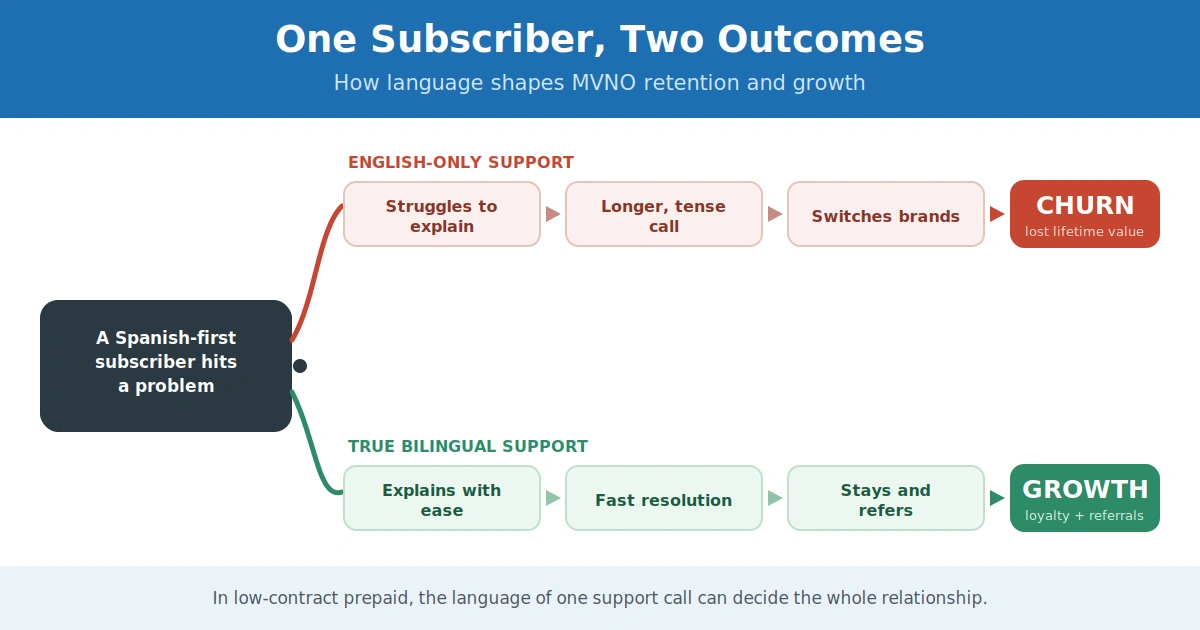 How Bilingual Support Impacts MVNO Churn and Growth
Bilingual support is a growth lever, not a cost line
Many brands treat bilingual support as an expense to trim. But that view misses the revenue it protects and creates. Strong bilingual support lifts first-contact resolution. It also raises satisfaction. And it cuts the churn that quietly drains prepaid bases. On top of that, it helps you win new subscribers through word of mouth, which runs strong in Hispanic communities. The table below shows how the two approaches compare across the subscriber journey.
The math is simple. Winning a new prepaid subscriber costs money in ads and promotions. Keeping one costs far less. So every churned customer you save drops straight to the bottom line. Good bilingual support saves many of them. It also lifts the value of each account, because happy users stay longer and spend more.
| Subscriber touchpoint | English-only support | True bilingual support |
|---|---|---|
| Onboarding & activation | Confusing for Spanish-first users; more drop-off | Smooth setup in the customer’s own language |
| First support call | Longer calls and repeated transfers | Faster first-contact resolution |
| Billing & plan questions | Misunderstandings and disputes | Clear answers and fewer complaints |
| Satisfaction (CSAT) | Lower scores among Spanish-first users | Higher trust and loyalty |
| Churn risk | Easy to leave in frustration | Stronger reasons to stay |
| New growth | Few referrals | Positive word of mouth and reviews |
So the pattern is clear. Language is not just a service detail. Instead, it shapes whether a subscriber stays or walks away.
Common mistakes MVNOs make with Hispanic subscribers
Good intentions are not enough. Many brands try to serve Hispanic subscribers, yet they still get the basics wrong. These are the mistakes that cost the most.
- Machine translation only: Auto-translated replies feel cold, and they often read wrong.
- English-first menus: A long English phone menu frustrates callers before an agent even answers.
- Spanish as overflow: Treating Spanish calls as a backup queue means longer waits for those users.
- One-size scripts: Ignoring dialect and tone makes support feel generic and distant.
- No Spanish quality checks: Without review in Spanish, small errors slip by unnoticed.
Fix these, and you remove much of the friction that pushes subscribers away.
What strong bilingual telecom support looks like
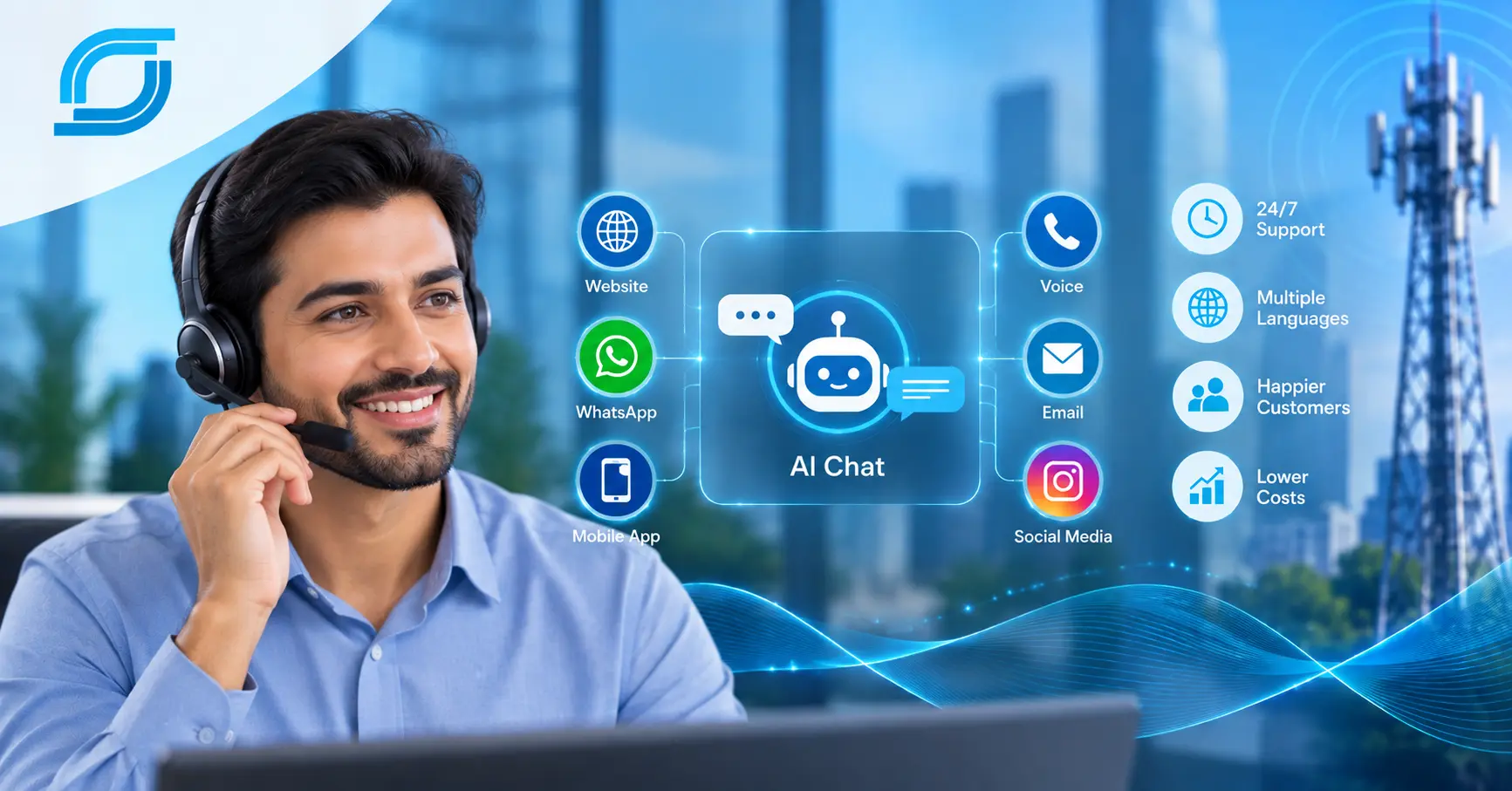
Real bilingual support goes beyond a quick translation. It needs native-level fluency and cultural understanding. Agents should sound natural, not scripted. They should also grasp local context, tone, and everyday slang. Beyond voice, coverage should span the channels subscribers actually use. That means calls, chat, SMS, and messaging apps. Quality must stay consistent too. A Spanish-speaking customer deserves the same fast, accurate customer care as an English-speaking one. And help should be ready at nights and weekends, when most prepaid issues come up.
Accent and dialect matter as well. Spanish is not one single voice. A good team speaks in a clear, neutral accent that most subscribers understand. Agents should also handle Spanglish with ease, since many US Hispanic users blend both languages. On top of that, quality scoring should run in Spanish, not just English. That way, nothing slips through the cracks.
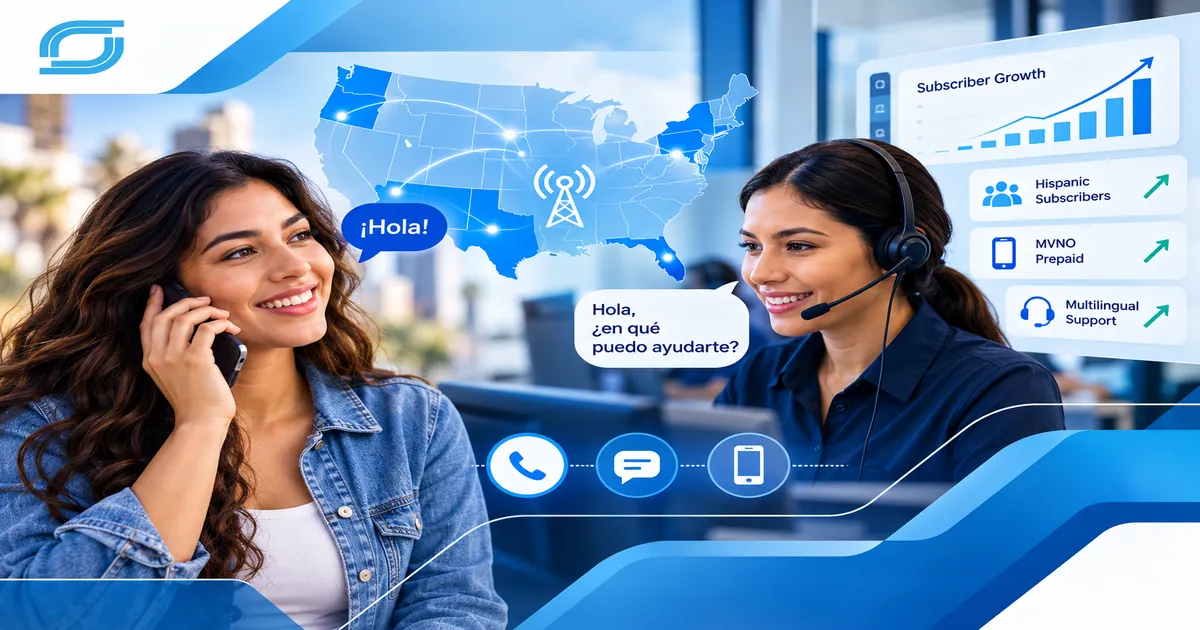
Done well, it feels effortless to the customer. The quick exchange below shows what that looks like in action.
Speak their language, keep their business
 US Hispanic Mobile Market and Multilingual Support
How outsourcing makes bilingual support scalable
Building a large bilingual team in-house is hard and slow. Hiring, training, and quality control all take time and money. This is where bilingual customer support telecom outsourcing helps. A specialist partner already has bilingual agents, telecom technical support training, and proven workflows. So you scale fast, protect quality, and control cost at once. Established bilingual call center outsourcing providers run Spanish-language support at volume across voice and digital channels. Many brands also use Spanish-language support outsourcing to enter new language markets without heavy setup. For a telecom brand, that speed can decide who leads the Hispanic market.
The right partner also flexes with demand. Prepaid volume spikes around paydays, promotions, and outages. A strong outsourcing team scales agents up and down to match. So you avoid long hold times without paying for idle seats. This is one reason many MVNOs now outsource support. When you pick a partner, look for real telecom experience, native bilingual agents, and clear quality reporting in both languages.
Turn language into your next growth channel
The US Hispanic market rewards brands that show up in the right language, with real care. For MVNOs and prepaid providers, that is a clear path to lower churn and faster growth. This is the work Sequential Tech does for telecom operators. We run Spanish-language and bilingual customer support, technical support, and retention programs across voice, chat, and messaging, staffed by bilingual agents who know telecom.
So if you are ready to reach Hispanic subscribers the right way, let’s talk. Book a free consultation, and we will map a bilingual support plan built around your subscribers and your growth goals.