

Compare onshore, nearshore, and offshore telecom support on cost, CX, and compliance—then build a blended model that routes each task to the right shore.
Every telecom leader faces the same question sooner or later: onshore, nearshore, or offshore? Choose offshore, and you chase the lowest cost. Onshore promises tight control, but the price is steep. Nearshore splits the difference. Here is the catch, though—treating onshore, nearshore, and offshore telecom support as one or the other choice is the real mistake. The best operators no longer pick a single location. Instead, they build a blended model that routes each task to the shore that fits it best. This guide shows you how to do the same, step by step.
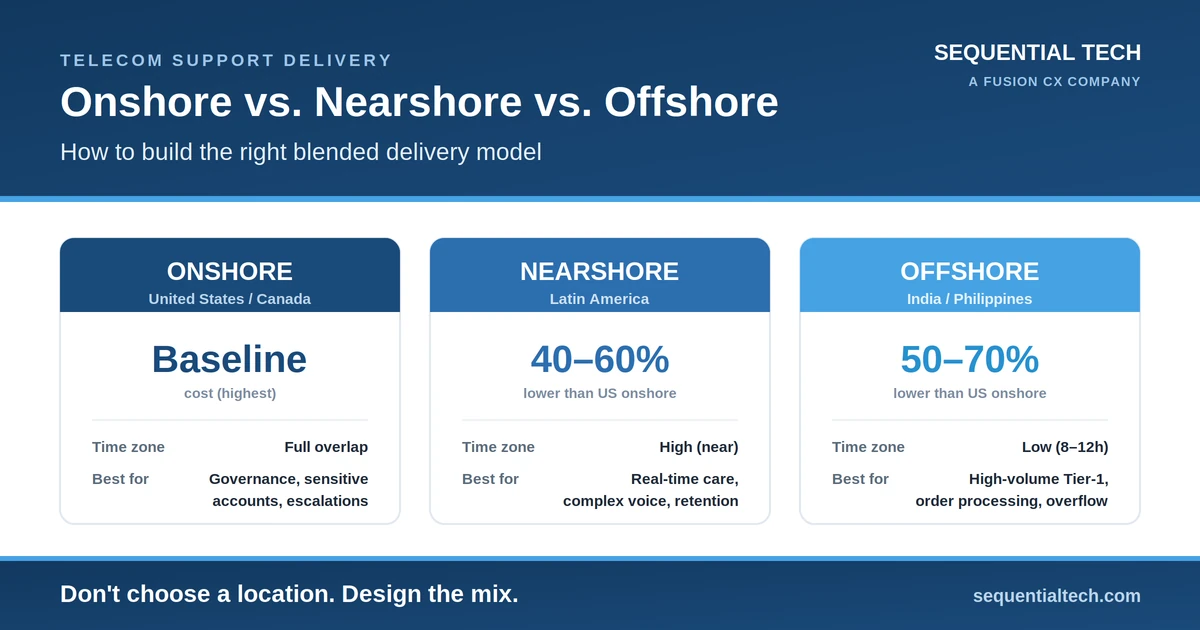 Compare onshore, nearshore, and offshore telecom support to build the right blended delivery model.
Why One-Location Telecom Support Quietly Costs You More
Most cost comparisons stop at the hourly rate. That is where the trouble starts. A single-shore model can look cheap on the spreadsheet. Yet it often leaks money in places the rate card never shows. In fact, the biggest costs usually show up months after the contract is signed. For a COO, CFO, or procurement lead, these are the hidden costs that matter most:
- Compliance exposure: US telecom data sits under FCC CPNI rules, the TCPA, PCI DSS, and SOC 2. Move it to the wrong place, and the risk lands on you.
- CX drift: Accent friction and time-zone gaps drag down CSAT and first-contact resolution. Both of these feed churn.
- Attrition and rework: Offshore support attrition can run 30–60% a year. As a result, every replacement adds hiring, training, and error costs.
- Slow collaboration: A 12-hour time gap can turn a five-minute fix into a next-day ticket.
- One-size scaling: High-volume work and sensitive work need different teams. One shore rarely does both well.
So the real question is not which single location is cheapest. Instead, it is which mix keeps total cost, compliance, and customer experience in balance. That shift in thinking is the whole point of a blended model.
Onshore vs. Nearshore vs. Offshore Telecom Support: A Side-by-Side Look
Each model has a real strength. However, none wins on every measure. The table below compares onshore nearshore offshore telecom support across the five factors telecom buyers weigh most.
| Factor | Onshore (US / Canada) | Nearshore (Latin America) | Offshore (India / Philippines) |
|---|---|---|---|
| Cost vs. US onshore | Baseline (highest) | ~40–60% lower | ~50–70% lower |
| Time-zone overlap | Full | High (same or near) | Low (8–12 hours) |
| Voice CX & accent fit | Highest | High; bilingual (EN/ES) | Strong; very large talent pool |
| Data residency & compliance | Strongest (data stays in US) | Strong | Needs added controls |
| Best-fit work | Governance, sensitive, escalations | Real-time CX, complex voice | High-volume, well-defined tasks |
Read across the rows, and one thing is clear. No column wins outright. That is exactly why a blend beats a single pick for most telecom operators.
The Three Models in Plain Terms
Onshore telecom support
Onshore means your support sits in the United States or Canada. It gives you the tightest control and the strongest data residency. It also costs the most. So use it where control matters most: sensitive accounts, complex escalations, and program governance. By contrast, running your whole operation onshore rarely pays off, because the rate is simply too high for routine, high-volume work.
Nearshore telecom support
Nearshore means teams in Latin America, close to US time zones. You get bilingual English and Spanish agents, cultural fit, and strong voice quality—usually at 40–60% below US onshore. Because the clocks line up, coaching and escalations happen in real time, not overnight. Demand here is climbing fast, too. The region’s call and contact center outsourcing market is projected to grow from about $11.5 billion in 2024 to roughly $20.4 billion by 2030, per Grand View Research. That pace outruns the global average.
Offshore telecom support
Offshore means hubs in India or the Philippines. It brings the deepest cost savings and the largest 24/7 talent pools. It fits high-volume, well-defined work best. Still, the savings are real, and the scale is hard to match. For example, a sudden volume spike is far easier to absorb offshore than anywhere else. For regulated telecom data, though, add strong security controls and clear data rules from day one.
How to Build the Right Blended Delivery Model
A blended model is not random. Instead, it follows a simple order. Work through these five steps:
- Start with the workflow, not the map. First, list each task—activations, billing, Tier-1 tech, retention, back office. Location comes later.
- Score each task on five factors. Next, rate cost pressure, CX sensitivity, compliance risk, collaboration need, and skill level. A quick 1-to-5 score per factor is enough to start.
- Match each task to a shore. Sensitive and governance work goes onshore. Real-time voice and CX belong nearshore. High-volume, locked-process work runs offshore.
- Set one quality standard everywhere. Then use shared KPIs, QA, and reporting, so every site is measured the same way.
- Review and rebalance. Volumes and rules change. Therefore, revisit the mix each quarter, and shift work as needed.
This approach reflects where the market has moved. In the Deloitte Global Outsourcing Survey, skilled talent and agility now sit beside cost as top reasons to outsource. Back in 2020, 70% of firms named cost as the main driver. Today, by contrast, buyers optimize for fit, not price alone.
See a Blended Model in Action
Picture a mid-size US mobile operator. It faces rising volume, tight margins, and strict data rules. A blended model splits the work cleanly. For example, the operator can route each stream to the shore that fits it best:
- Onshore handles fraud escalations and sensitive account changes, so US data stays in the US.
- Nearshore covers daytime customer care and complex voice support, so accents and time zones match the customer base.
- Offshore runs after-hours Tier-1, order processing, and back-office work, so cost per contact stays low.
As a result, the operator protects compliance, keeps CX high, and still cuts cost. That balance is the payoff of right-shore telecom support. The exact split will differ by operator, of course, yet the logic holds across the board. Above all, a thoughtful blend beats forcing every task into one location.
Match Each Telecom Workflow to the Right Shore
Here is a quick reference for building your own mix. Use it as a starting map, then adjust for your rules and volumes.
- Onshore: program governance, fraud and risk escalations, sensitive account changes, and executive complaints.
- Nearshore: inbound customer care, complex technical support, retention and save-desk, and bilingual voice.
- Offshore: high-volume Tier-1, order processing, back-office data work, and after-hours overflow.
Meanwhile, multilingual coverage ties it together. As a result, customers get help in their own language, wherever the work sits.
Build Your Blended Telecom Support Model
Sequential Tech runs telecom support across all three shores. Our teams span the US, Canada, Latin America, Asia, and EMEA, with 40+ delivery locations across 13 countries. That global footprint lets us design one blended model for you, instead of forcing a single location.
We cover the full subscriber lifecycle: customer care, technical support, activations and onboarding, billing, retention, collections, order management, and fraud and risk. AI-powered QA, sentiment analysis, and accent harmonization keep quality steady across every site. The result is right-shored telecom support—balanced for cost, compliance, and customer experience.
Ready to map your workflows to the right shore? Talk to an expert, and we will help you build the mix.