Fixed wireless access has topped 15 million US subscribers, yet analysts now see its growth runway shortening. As acquisition slows, the frictionless setup that wins FWA customers becomes the frictionless exit that loses them — which makes support, not marketing, the decisive retention lever.
A new customer signs up for your 5G home internet on a Monday. A small gateway lands on her doorstep by Tuesday. She sets it near a window, powers it on, and she is streaming within the hour, with no technician, no truck, and no four-hour appointment window. So that friction-free setup is exactly why fixed wireless access is winning millions of homes. But it is also why those homes are so easy to lose. After all, the same box that arrived in the mail can be unplugged and shipped back just as quickly. For operators riding the FWA wave, then, an uncomfortable question follows: is your support model built for customers who can leave as easily as they joined?
The growth is real, but the runway is shortening
Fixed wireless access has moved from experiment to mainstream. By early 2026, the big three carriers reported more than 15 million FWA lines between them, led by T-Mobile near 8.5 million and Verizon around 5.1 million. Meanwhile, its share of broadband households has climbed from roughly 12% in mid-2025 to about 15%. Plans run $50 to $100 a month, and Ookla data puts typical speeds at 100 to 500 Mbps — fast enough for most homes.
Here is the part many operators overlook. That runway has a hard edge. New Street Research estimated in late 2025 that the big three can serve roughly 32 million FWA subscribers before capacity runs out. Today, T-Mobile already uses about two-thirds of its headroom, and Verizon about half. So New Street expects net additions to decelerate from 2026 onward.
| Carrier | FWA subscribers | Capacity used | Net-add trend |
|---|---|---|---|
| T-Mobile | ~8.5 million | ~67% | 1.7M → 1.8M (strong) |
| Verizon | ~5.1 million | ~50% | 1.5M → 1.1M (cooling) |
| AT&T | Scaling up | ~17% | 0.5M → 0.9M (rising) |
FWA capacity and net-add trends by carrier. Sources: carrier Q1 2026 results; New Street Research (Dec 2025).
The implication is sharp. The easy growth phase is cooling. So when you can no longer simply add your way to scale, the subscribers you already have become the asset you cannot afford to lose. In that market, retention stops being a back-office metric. Instead, it becomes the growth strategy.
The Self-Install Paradox
Call it the Self-Install Paradox. The very thing that makes FWA easy to buy makes it just as easy to abandon. After all, there is no wiring to run and no install appointment to book. So a frustrated customer does not have to schedule anything to leave. They box up the gateway, print a label, and they are gone by the weekend.
Yet wired broadband never worked this way. A fiber or cable switch meant appointments, drilling, and days of waiting. That friction quietly held people in place, even when they were unhappy. But FWA removes the friction from both the join and the exit. As a result, loyalty can no longer coast on inertia. Instead, it has to be earned in the experience — and that experience runs straight through your support team.
Why FWA support is a different discipline
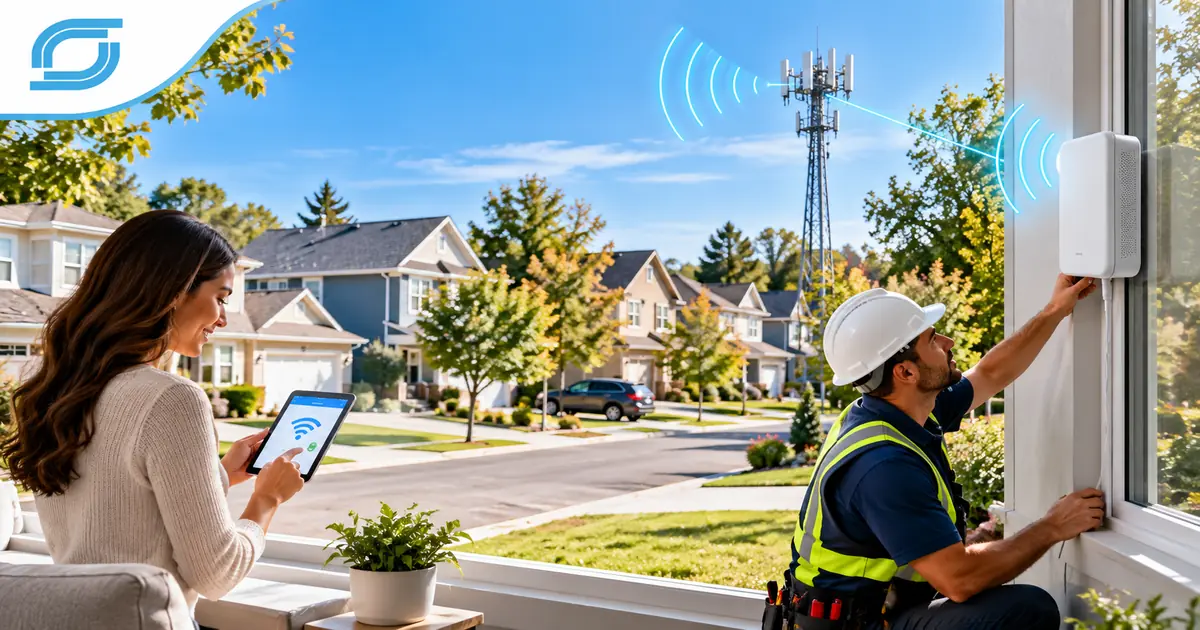
Traditional broadband leans on a truck roll. A technician drives out, drills, and installs. FWA shifts that work to the customer. Self-install is cheaper and faster for you, but it hands the hardest moment — the setup — to someone with no training.
Self-install sounds simple on a spec sheet. In the living room, it is anything but. Signal quality depends on where the gateway sits, and a few feet can change everything. So customers call about speed, placement, and dropouts far more than wired users ever did. Your first-line support becomes a remote signal engineer, not a dispatcher.
Two support models, side by side
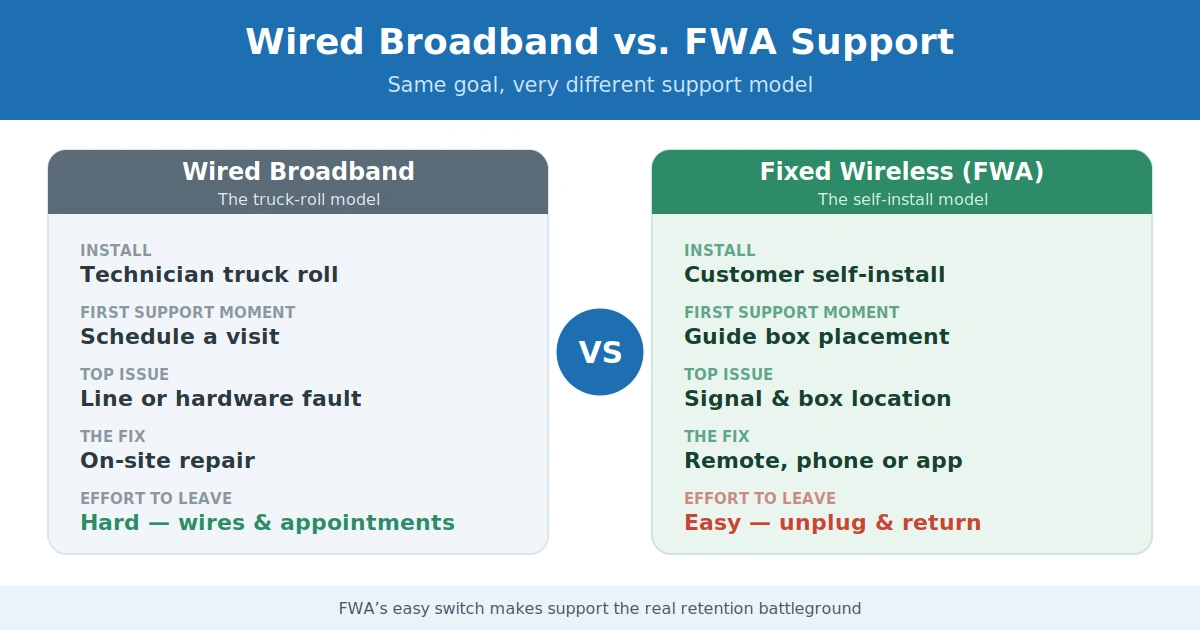 Wired broadband vs. fixed wireless access — the same goal, a very different support model.
Contact volume behaves differently, too. A wired subscriber may call once at install and rarely again. But an FWA subscriber often calls several times in the first month, testing placements, checking speeds, and learning the app. So that front-loaded curve reshapes how you staff and train.
Still, the last row above is the one that should keep you up at night. An FWA customer can quit with almost no friction. Retention, then, depends far less on the network and far more on how your team handles the moments around it.
The new churn: carrier versus carrier
For years, FWA poached customers from cable and fiber. In 2026, the fight is turning inward. FWA providers now compete for each other’s subscribers. A T-Mobile user tries Verizon; a Verizon user tests a regional plan. This cross-shopping churn is accelerating precisely because switching costs almost nothing.
And the economics make the stakes plain. Winning a new FWA subscriber costs real money in advertising, promotions, and gateway hardware. Yet saving an at-risk one usually costs a fraction of that. So every avoided switch protects both recurring revenue and the acquisition spend already sunk into that customer. In a capacity-constrained market, a sharp save desk is not a cost center — it is margin protection.
So the mental model has to change. FWA retention is no longer only a defense against cable. It is a defense against the carrier one box away. And that battle is won or lost at the support layer, one interaction at a time.
Building an FWA-ready support model
A support model tuned for FWA looks different from a wired-broadband help desk. It concentrates on the moments unique to wireless home internet. Four capabilities matter most.
- Guided self-install. Walk customers through gateway placement in plain, confident steps. A smooth first hour sets the tone for the whole relationship.
- Remote signal troubleshooting. Equip agents to read signal metrics and resolve dropouts over the phone. Most FWA faults are about location, not broken hardware.
- First-contact resolution. Because a second call is a churn risk, fixing the issue the first time is your strongest defense. Good tools and tight scripts make that routine.
- Fast save-desk response. When a customer signals they are leaving, the window to save them is measured in days, not weeks.
Still, these are specialized skills. They call for agents who understand radio signals, mobile apps, and self-install flows, and who move fast enough to match the convenience customers signed up for. Proactive outreach helps as well; for example, a simple text about optimal gateway placement can prevent a frustrated call before it happens.
Meanwhile, scale is the other half of the problem. FWA volume is spiky, so a plan launch or a network event can double your queue overnight. Hiring for those peaks in-house is slow and expensive, yet missing them means lost saves and higher churn. Flexible, telecom-trained capacity is what keeps quality steady when demand spikes.
Turn FWA growth into durable loyalty
Fixed wireless access remains one of the great growth stories in US home internet. But with the runway shortening, the operators who win the next phase will be the ones who treat support as a retention engine, not a line item. That means guided installs, remote signal expertise, and quick saves built into every interaction. This is the work Sequential Tech does for mobile operators and broadband providers running fixed wireless programs — self-install guidance, remote troubleshooting, billing, and retention and win-back, delivered by telecom-trained teams across onshore, nearshore, and offshore sites.
If your FWA base is scaling faster than your support can follow, book a free consultation, and turn easy-to-leave subscribers into ones who stay.