
U.S. telecom companies outsource customer support to cut costs, scale 24/7, and adopt AI. Discover the key benefits and 2026 trends driving this fast-growing shift.
A frustrated subscriber waits eleven minutes on hold to fix one billing error. She hangs up, and by dinner she has switched carriers. Sadly, this scene plays out across the USA every day. In fact, telecom churn runs as high as 20% to 50% each year, and replacing a single subscriber costs around $300. Those losses add up fast, and they rarely show on one clear line of the budget.
So how are smart operators fighting back? Increasingly, they turn to telecom customer support outsourcing. This move is no longer just a cost play, either. Instead, it has become a way to grow and protect revenue. Below, we break down why U.S. telecom companies outsource customer support, the key benefits they gain, and the trends shaping this shift in 2026.
Why U.S. Telecom Companies Are Outsourcing
Telecom support is uniquely hard to run. Call volumes are huge, and issues range from billing to outages to SIM swaps. Meanwhile, customer patience keeps shrinking fast. In fact, 77% of consumers now feel no real loyalty to their telecom provider. So the pressure to serve people well has never been higher. On top of that, telecom is the most outsourced industry for customer support, which shows how common this move has become.
Here is what pushes operators toward customer support outsourcing:
- High churn that drains recurring revenue every month.
- Rising labor costs for hiring, training, and keeping agents.
- Volume spikes during launches, outages, and holidays.
- Round-the-clock demand that in-house teams struggle to cover.
- Complex issues that need specialized telecom skills.
- Pressure to adopt AI without building it from scratch.
Because these pressures keep growing, in-house-only support often falls behind. Hiring alone rarely solves the problem, since agent turnover stays stubbornly high. However, a specialized partner can close the gap quickly. Therefore, more carriers now treat telecom call center outsourcing as a core strategy rather than a quick fix.
What Telecom Companies Outsource Most
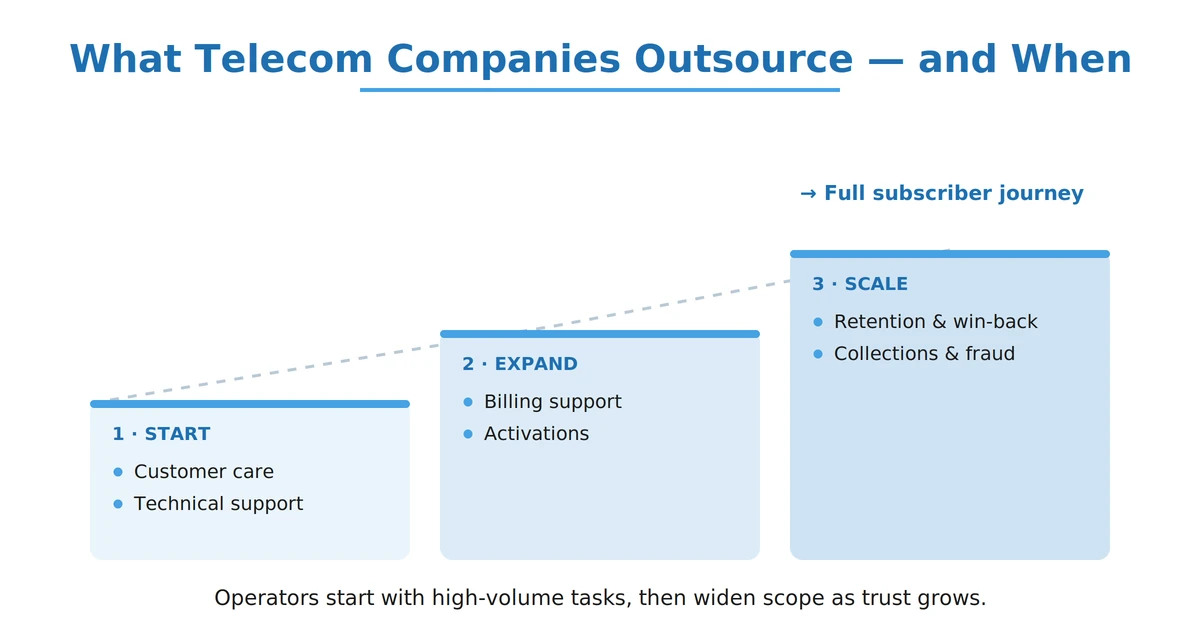
Not every task moves to a partner at once. Instead, operators usually start with high-volume, process-driven work. Common functions include:
- Customer care for everyday questions and account changes.
- Technical support for connectivity, devices, and outages.
- Billing support for disputes, refunds, and payment help.
- Activations and onboarding for new subscribers and SIMs.
- Retention and win-back to save at-risk accounts.
- Collections and fraud management to protect revenue.
Because these tasks follow clear workflows, they suit trained outsourced teams well. Over time, many operators expand the scope as trust grows. Eventually, the partner supports the full subscriber journey end to end.
Key Benefits of Telecom Customer Support Outsourcing
Outsourcing does far more than trim costs. Done well, it lifts both efficiency and customer experience at once. That double win is exactly why the trend keeps spreading. Here are the key benefits U.S. telecom companies gain:
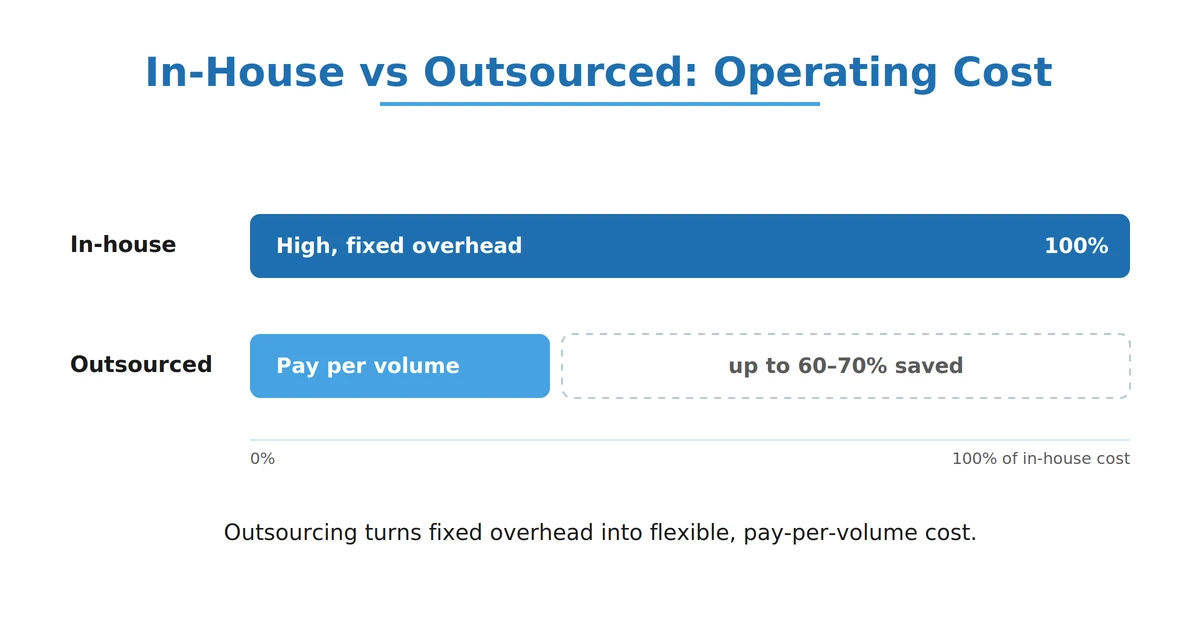
- Big cost savings. Outsourcing call center work can cut operating costs by 60% to 70%. Indeed, 59% of companies name cost savings as their top reason to outsource. Those savings cover labor, real estate, tools, and training. Better still, they arrive without any drop in service quality.
- Flexible scaling. You pay only for the volume you actually receive. So a busy week and a quiet week no longer cost the same amount. As a result, seasonal spikes stop blowing up your budget.
- Round-the-clock service. A strong partner covers nights, weekends, and holidays with ease. As a result, customers get help whenever they need it. Many partners also add multilingual support for diverse U.S. markets.
- Specialized telecom expertise. Trained agents already understand billing, provisioning, and technical support. Therefore, first-contact resolution rates climb quickly. In turn, repeat calls and complaints both drop. Notably, telecom technical calls average over eleven minutes, so skilled agents save real time.
- Built-in AI and tools. Partners bring CRM, analytics, and AI from day one. In fact, CRM integration can lift first-call resolution by 17% and trim handle time by 12%. So you gain modern tools without a heavy build.
- More focus on the network. Freed from support overhead, operators can focus on 5G, coverage, and growth. In short, they get to do what they do best. Meanwhile, the partner keeps the support engine running smoothly.
In-House vs Outsourced Telecom Support
The visual and table below compare the two models across the factors that matter most.
| Factor | In-House Support | Outsourced Telecom Support |
|---|---|---|
| Operating cost | High, mostly fixed overhead | Up to 60% to 70% lower |
| Scalability | Slow to add or cut staff | Flexes with call volume |
| Coverage | Limited hours | 24/7 and multilingual |
| Telecom expertise | Built slowly over time | Trained agents from day one |
| Technology | Costly to build alone | AI and CRM included |
| Focus | Split across many tasks | Freed for network and growth |
Top Trends in Telecom Customer Support Outsourcing for 2026
The model keeps evolving at speed. These trends now define telecom BPO in 2026:
- AI-powered interactions. In fact, Gartner reports that 91% of customer service leaders are under pressure to adopt AI in 2026. Today, bots already resolve many routine questions on their own. This frees agents for the calls that truly need a human. As a result, both speed and satisfaction improve together.
- Blended human and AI teams. AI handles simple, repeat questions with ease. Meanwhile, skilled agents take complex, emotional, or high-value calls. Together, they deliver speed without losing the human touch.
- Nearshore and multi-shore delivery. Latin America is growing fastest for U.S.-facing work. So operators now blend onshore, nearshore, and offshore teams. This mix balances cost, quality, and time-zone coverage. It also keeps sensitive or complex calls closer to home.
- True omnichannel support. Voice, chat, email, and social finally connect as one omnichannel journey. In fact, 78% of enterprise buyers adopted omnichannel support in 2025. As a result, customers never have to repeat themselves.
- Stronger security and compliance. Partners invest heavily in SOC 2, PCI-DSS, and data protection. Therefore, sensitive subscriber data stays far safer. This matters more than ever as fraud attempts rise.
Why This Matters for U.S. Operators
The stakes keep rising every single year. According to Deloitte, AI is reshaping how telecom operators compete and serve customers. At the same time, the tools to fix this already exist. The global BPO market reached $328.4 billion in 2025 and is on track for $358.6 billion in 2026, with IT and telecom holding the largest share. Simply put, the talent, playbooks, and AI are ready today. So operators no longer need to build support from the ground up. Instead, they can plug into proven telecom outsourcing services and move fast. The best partners also grow with you, adding channels and languages as you scale. In the end, the carriers who answer quickly and resolve fully will keep the most subscribers.
Powering Smarter Support for U.S. Telecom Operators
Sequential Tech delivers specialized telecom customer support outsourcing for U.S. operators. Our teams handle customer care, technical support, billing, activations, retention, and fraud management across voice, chat, email, and social. In addition, we pair skilled agents with AI-powered quality tools that lift first-call resolution and reduce churn. Whether you run an MNO, an MVNO, or a broadband brand, our telecom outsourcing services help you cut costs and keep customers.