
A US subscriber waits eleven minutes on hold to fix one billing line. She hangs up. By dinner, she has ported her number to a rival and taken three family lines with her. That is not a service story. That is a revenue story. In 2026, the gap between operators who grow and operators who bleed subscribers often comes down to who answers the phone, how fast, and how well. This is exactly why telecom call center outsourcing has moved from a cost lever to a growth lever. If you are already comparing partners, this guide is for you. Below, we break down the pain, the math, the service mix, and the questions to ask before you sign.
The Pain Point: Support Costs Climb While Subscribers Walk Out
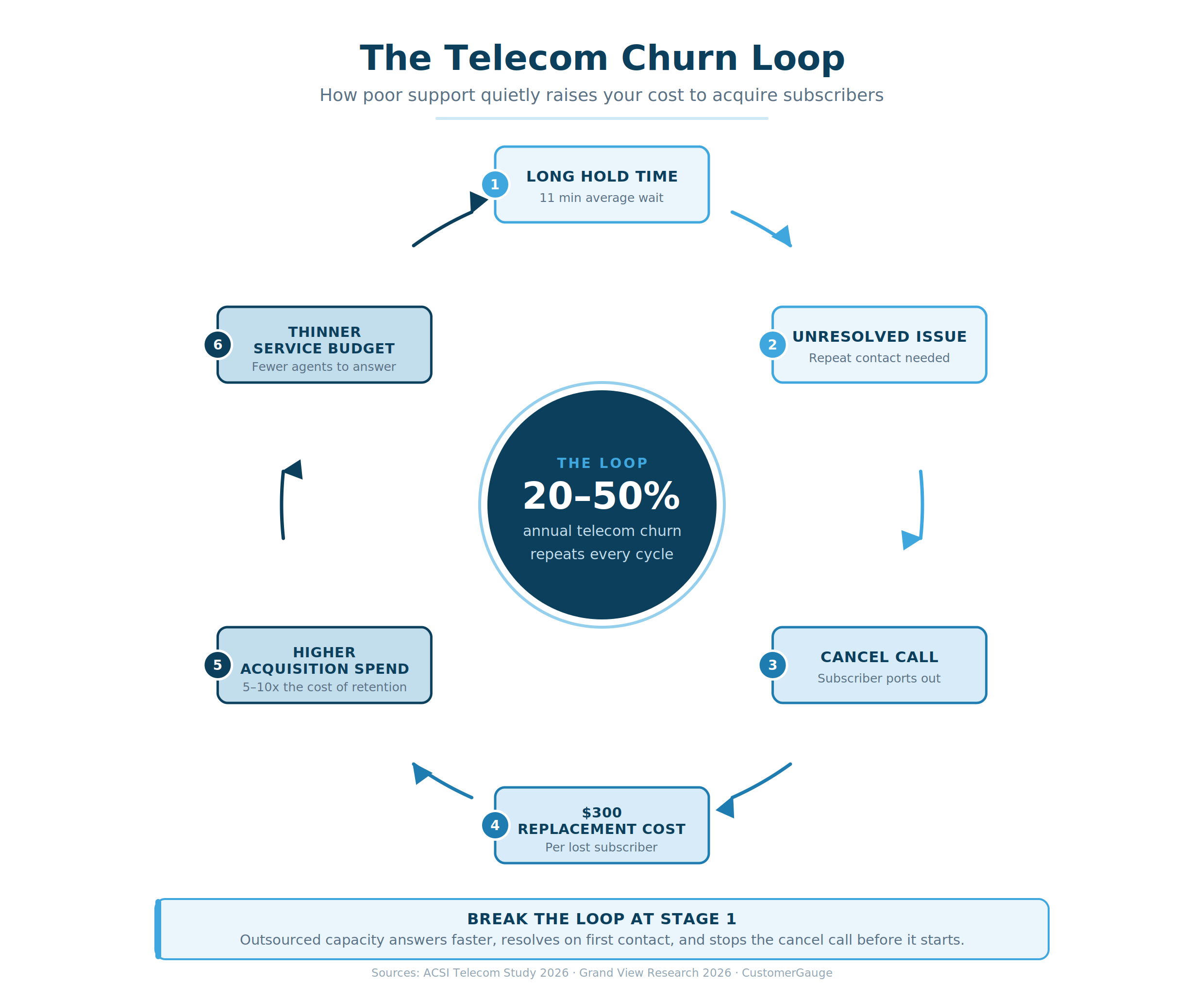
Most US operators are not short on tools. They are short on capacity, coverage, and consistency. Meanwhile, the pressure keeps building. Here is what actually hurts:- Churn is expensive. Telecom annual churn commonly runs 20–50%, and replacing a subscriber can cost around $300 each. At scale, that is tens of millions of dollars per year and most of those exits trace back to a fixable service moment.
- Retention beats acquisition by a lot. In the US market, winning a new subscriber costs roughly 5–10 times more than keeping the one you have.
- Satisfaction is only “okay”. ACSI’s 2026 telecom study puts ISPs at 73 out of 100, with non-fiber at just 71. Wireless hit a record 77, so the bar is rising fast. On the broadband side, churn usually has a support fix, not a network fix.
- Volume spikes are brutal. Outages, promos, port-ins, and fiber builds create demand your fixed headcount cannot absorb.
- Hiring never stops. Recruiting, training, and attrition quietly eat the budget you meant to spend on network and product.
- Channels multiplied. Voice, chat, email, app, and social all need coverage. Around 72% of customer-care contacts now run through digital channels, and disconnected channels quietly cost you subscribers.
- First contact fails. Repeat calls burn cost twice and drain trust once.
Five Reasons Telecom Call Center Outsourcing Wins in 2026
I. The market has matured
The global BPO market reached $328.4 billion in 2025 and is on track for $358.6 billion in 2026, with IT and telecom holding the largest end-use share. Translation: the talent, tooling, and playbooks already exist. You do not have to build them.II. Costs turn variable
In-house support is a fixed cost with a rigid ceiling. Outsourced support flexes. You pay for volume you actually receive, so a storm week and a quiet week no longer cost the same. The in-house versus outsourced cost gap widens as volume swings.III. Hybrid AI plus humans is now standard
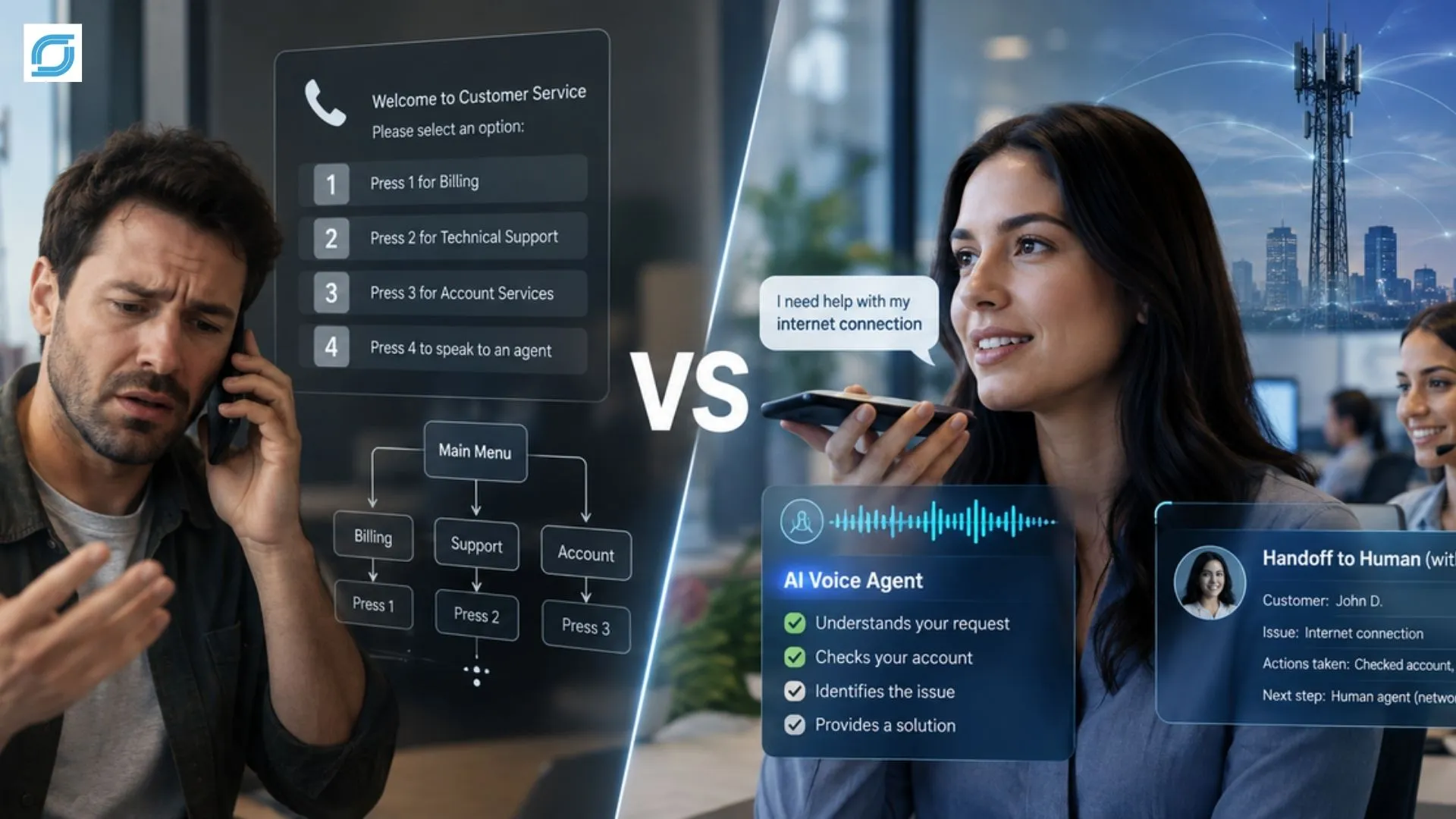
Roughly 61% of organizations use automation to handle heavy contact volume. Good partners route simple asks, balance checks, plan changes, SIM swaps — to bots, then send angry, complex, or high-value calls to trained specialists. Done right, AI lifts first contact resolution instead of hiding calls.IV. Speed to launch
Standing up a new site takes months. A specialist partner can ramp trained agents in weeks, which matters when you launch fiber in a new metro or absorb an acquisition. It also matters at signup, since churn often starts at activation.V. Retention becomes a measurable service
This is the big one. Modern telecom customer care services include save desks, win-back calls, and churn-risk outreach. Since a 1% churn reduction can meaningfully lift profit, support stops being overhead and starts paying rent, which is why operators now hire a retention outsourcing partner, not just a vendor.What US Operators Actually Outsource
Not every function belongs outside. Use the table below to decide what to move first.| Function | What it covers | Why outsource it | Metric to watch |
|---|---|---|---|
| Inbound subscriber care | Billing, plans, SIM, outage status | Absorbs volume spikes without new headcount | First contact resolution, AHT |
| Technical support (Tier 1–2) | Router, fiber, 5G home, activation | Certified agents beat generalists | Repeat contact rate, truck rolls avoided |
| Retention and save desk | Cancel calls, win-back, offer matching | Directly protects recurring revenue | Save rate, churn % |
| Onboarding and activation | New line setup, port-in, install follow-up | Early friction predicts early churn | 30-day churn, activation success |
| Billing and collections | Disputes, payment plans, recovery | Trained, compliant recovery lifts cash | Recovery rate, dispute time |
| Back-office and order support | Provisioning, data entry, order fixes | Frees internal teams for network work | Order accuracy, cycle time |
| Outbound sales and upsell | Upgrades, bundles, fiber conversion | Turns service calls into revenue | Attach rate, revenue per contact |
How to Judge a Telecom BPO Partner
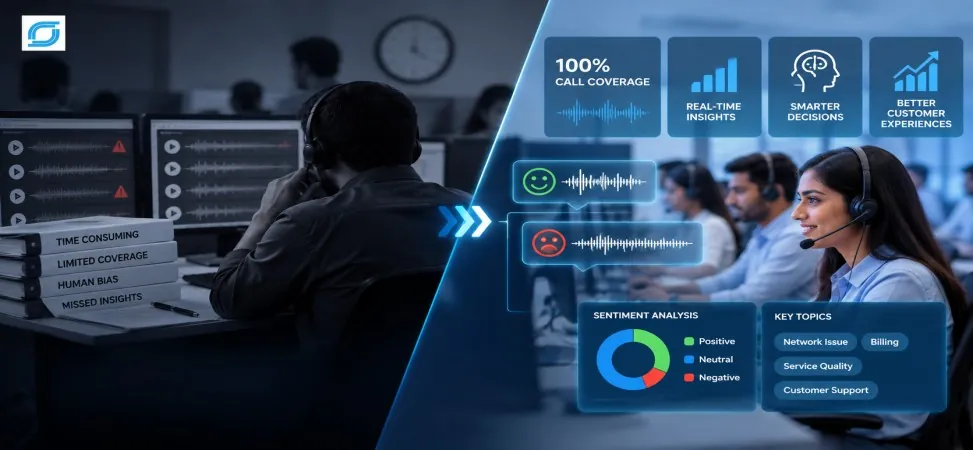
You are past “Should we?” You are on “Which one?” So ask harder questions and check them against the key factors for selecting a telecom BPO provider. 1. Do they know telecom, or just calls? Ask for named telecom clients, agent certification paths, and OSS/BSS familiarity. Generic CX shops learn on your subscribers. 2. Can they prove outcomes, not activity? Ask for churn, save rate, and FCR movement from a comparable account. Handling time alone tells you nothing about loyalty. 3. Is the delivery model right? Offshore lowers cost. Onshore and nearshore protect accent, culture, and complex calls. Compare the tradeoffs in our onshore, nearshore, and offshore telecom BPO guide. Most US operators land on a blended delivery model. 4. How do they use AI? Look for automated quality monitoring across 100% of contacts, not 2% sampling. Ask what stays human. 5. Are compliance and security tight? CPNI, TCPA, PCI DSS, and state privacy rules are non-negotiable. Get the audit trail in writing. 6. Does the contract share risk? Outcome-linked SLAs beat pure per-hour pricing.Signs You Have Outgrown In-House Support
- Hold times spike every promo or outage.
- Agent attrition sits above 40%.
- Cancel calls go to whoever is free.
- You cannot staff nights, weekends, or Spanish-language demand.
- Support has no churn target.
Turn Subscriber Support Into a Retention Engine
Sequential Tech’s telecom BPO teams cover inbound care; Tier 1–2 technical support; retention and save desks; activation, billing and collections; and outbound upsell — with 24/7 bilingual agents, omnichannel coverage, AI-assisted quality monitoring, flexible onshore/offshore delivery, and CPNI, TCPA, and PCI-aligned compliance. Build Your Telecom Support Team →Shortlisting vendors is easier with a framework: these key factors for selecting a telecom BPO provider are a practical starting point.