
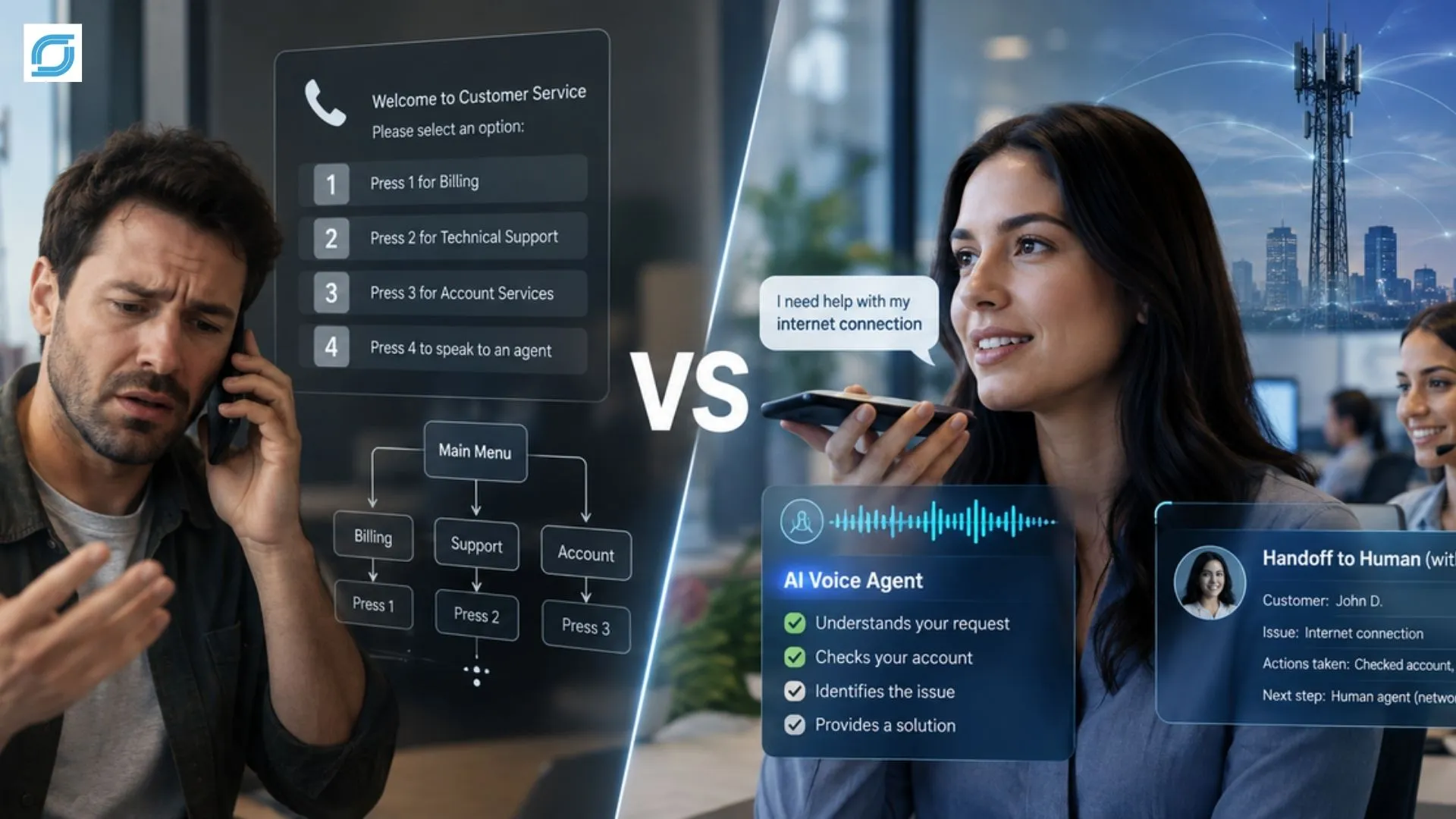
A clear, data-backed comparison of AI voice agents and traditional IVR for telecom — how conversational AI resolves more calls, cuts costs, and ends menu-tree frustration.
Press 1 for billing. Press 2 for support. Press 0 to scream. For years, that was the telecom phone experience. Customers hate it, and the data proves it. In fact, 61% of consumers say IVR gives them a poor experience. So a big question now sits on every telecom leader’s desk. Should you keep the old IVR, or switch to an AI voice agent?
This guide breaks down the AI voice agent vs IVR debate in plain terms. You will see how each one works, where each one fits, and what the 2025–2026 numbers say.
The Real Problem: Why Customers Dread the IVR
The classic IVR was built to route calls, not to help people. So it often gets in the way. The result is friction on your most important channel. Here is what the data shows:
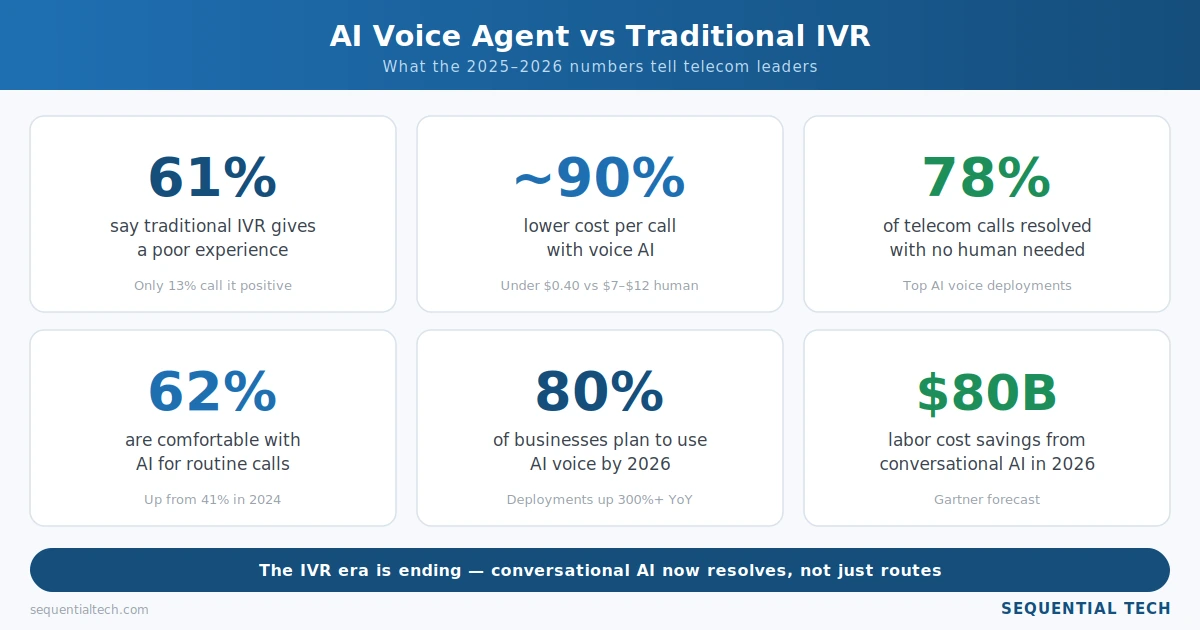
- 61% of consumers say IVR makes for a poor experience. Only 13% call it positive.
- 27% of calls get abandoned after a caller reaches an IVR.
- 42% of consumers name complex IVR menus as a top service frustration.
- 70% of callers would rather speak to a human than fight a menu tree.
- Repeat and transfer loops force customers to explain the same issue again and again.
Each one is a churn risk. In telecom, calls touch bills, outages, and activations. So that risk is very real. The case for change is strong.
Why This Matters More in Telecom
Telecom raises the stakes. Call volumes here are huge. So even a small friction rate hits millions of customers. The calls are also high-stakes: billing, outages, activations, and porting. One bad IVR loop during an outage can spike churn fast. Moreover, telecom teams run 24/7 across many regions and languages. A rigid, single-language IVR simply cannot keep up. That is why an AI voice agent for telecom is more than a trend. It fits how telecom actually works.
What Is an AI Voice Agent?
An AI voice agent is not a smarter menu. Instead, it is a different kind of technology. It uses conversational AI and natural language processing to understand what a caller means. Then it replies in natural speech. It can also finish tasks by connecting to your billing and provisioning systems. In short, the caller just talks, and the agent helps. There are no menu trees to memorize. This is the heart of the conversational AI vs IVR shift.
AI Voice Agent vs Traditional IVR: Side by Side
The contrast is easy to see when you line them up.
| Feature | Traditional IVR | AI Voice Agent |
|---|---|---|
| Input | Keypad presses and fixed phrases | Natural, everyday speech |
| Understanding | Menu options only | Intent and context |
| Interruptions | Repeats the prompt | Adapts and keeps going |
| Languages | One tree per language | 15+, switchable mid-call |
| Task completion | Basic routing | End-to-end resolution |
| Escalation | Rigid transfer | Handoff with full context |
| Updates | Weeks of dev work | Hours |
| Availability | 24/7 but limited | 24/7 and capable |
 AI voice agent vs traditional IVR — the 2025-2026 numbers telecom leaders should know
Where AI Voice Agents Win for Telecom
So where does the AI voice agent pull ahead? Four areas matter most for telecom.
I. Natural conversation. Callers speak plainly. The agent understands, even off-script. So there is no “I didn’t get that” loop.
II. Real task resolution. The agent checks balances, resets passwords, and confirms outages. It does not just route. In fact, top telecom deployments resolve up to 78% of calls without a human. That is a big lift in first contact resolution.
III. Smart escalation. When a call needs a person, the agent hands it off with full context. So the customer never repeats themselves.
IV. Scale and languages. The agent runs 24/7 with no hold queues. It also handles 15+ languages and switches mid-call.
Together, these free your human agents for complex, high-value work.
The 2025–2026 Data Telecom Leaders Should Know
This shift is not hype. It is measurable. Here is where the numbers sit today:
- Cost. A human call costs about $7 to $12. An AI voice call can cost under $0.40. That is a 90% drop per interaction.
- Containment. Modern voice AI resolves 55% to 70% of calls on its own. Some deployments reach 80%.
- Adoption. About 80% of businesses plan to use AI voice tech in service by 2026. Production deployments grew over 300% year over year.
- Comfort. 62% of consumers are now fine using an AI voice agent for routine tasks. That is up from 41% in 2024.
- Savings. Gartner expects conversational AI to cut contact center labor costs by $80 billion in 2026.
- Speed. AI also trims average handle time by 30% to 40% per case.
The market backs this up. The global voice agents market is on track to grow more than tenfold this decade. Spending has also flipped from IVR upkeep to conversational AI. Clearly, the direction is set.
When IVR Still Makes Sense
AI voice agents are strong. But they are not magic. So keep a clear head. A simple IVR can still handle basic routing at low cost. And some calls truly need a human. About 73% of people still prefer a person for complex or emotional issues.
Also, watch the containment trap. A “contained” call that solves nothing is a false win. So measure real resolution, not just deflection. Finally, check voice quality. Clear speech and low latency matter most. Pick a tool that replies in under one second and sounds natural.
What to Look For in a Telecom Voice AI
Not every voice AI is built for telecom. So evaluate carefully. Before you buy, check these:
- Telecom integrations. It should connect to your OSS, BSS, and CRM.
- Low latency. Aim for replies under one second.
- Real resolution. Look for proof of end-to-end task completion, not just deflection.
- Clean escalation. It must hand off to agents with full context.
- Languages. It should cover your regions and switch mid-call.
- Fast, safe rollout. Ask for a phased plan and a clear go-live date.
Six clear yeses mean the tool fits telecom. Any gap is a reason to keep looking.
How to Switch Without Disruption
You do not have to rip out your IVR overnight. Instead, phase the change. First, pick a few high-volume intents, like balance checks or outage status. Next, let the AI voice agent handle those, with a human safety net. Then measure resolution, CSAT, and cost. Finally, expand as the results hold.
This keeps risk low and service live. Most telecom deployments go live in about two to four weeks. So you see value fast, without a risky “big bang” cutover.
Move Beyond the Menu Tree
The IVR era is ending. Telecom leaders who act now gain lower costs and happier customers. Those who wait keep paying the frustration tax.
Stop Making Customers Press 1 for Frustration
Sequential Tech deploys an AI voice agent that understands natural speech, resolves up to 78% of calls, and escalates with full context — across customer care, technical support, and activations, live in two to four weeks.