
Learn how tech support outsourcing with a high-tech contact center pairs skilled agents with AI, remote diagnostics, and network monitoring to fix telecom issues faster.
A customer’s fiber light is blinking red. Their Wi-Fi drops every hour, and they work from home. They call support, wait 20 minutes, and reach an agent who reads a script and books a truck roll. The real fix was a simple router setting. Moments like this cost telecoms money and loyal customers. That is why more operators are turning to tech support outsourcing with a high-tech contact center, where skilled agents and smart tools fix problems on the first contact.
Quick answer: Tech support outsourcing means hiring a specialist partner to run your customer technical support. A high-tech contact center pairs trained Tier 1 and Tier 2 agents with AI-assisted troubleshooting, remote diagnostics, network monitoring, and omnichannel tools. The result is faster fixes, fewer truck rolls, and support that scales with demand.
Why Telecom Tech Support Is Harder to Run In-House in 2026
Telecom support is more technical than ever. Customers now call about fiber, 5G home internet, fixed wireless, mesh Wi-Fi, smart home devices, and streaming apps. Each one has its own setup steps and failure points.
At the same time, call volumes swing hard. A fiber launch, a storm, or a network outage can double calls overnight. Hiring and training enough in-house agents for these peaks is slow and expensive. As a result, many teams face long hold times, tired agents, and repeat calls. These are common signs that it is time to outsource your help desk.
Outsourced technical support solves this with a ready team, proven tools, and room to scale. A specialist telecom technical support partner already has trained agents, telecom-ready systems, and flexible staffing in place.
What Makes a Contact Center “High-Tech”
Many vendors promise “trained experts.” However, the real difference is the technology behind those experts. A high-tech contact center gives every agent the tools to see the problem, test it, and fix it fast. The graphic below shows the six core layers.
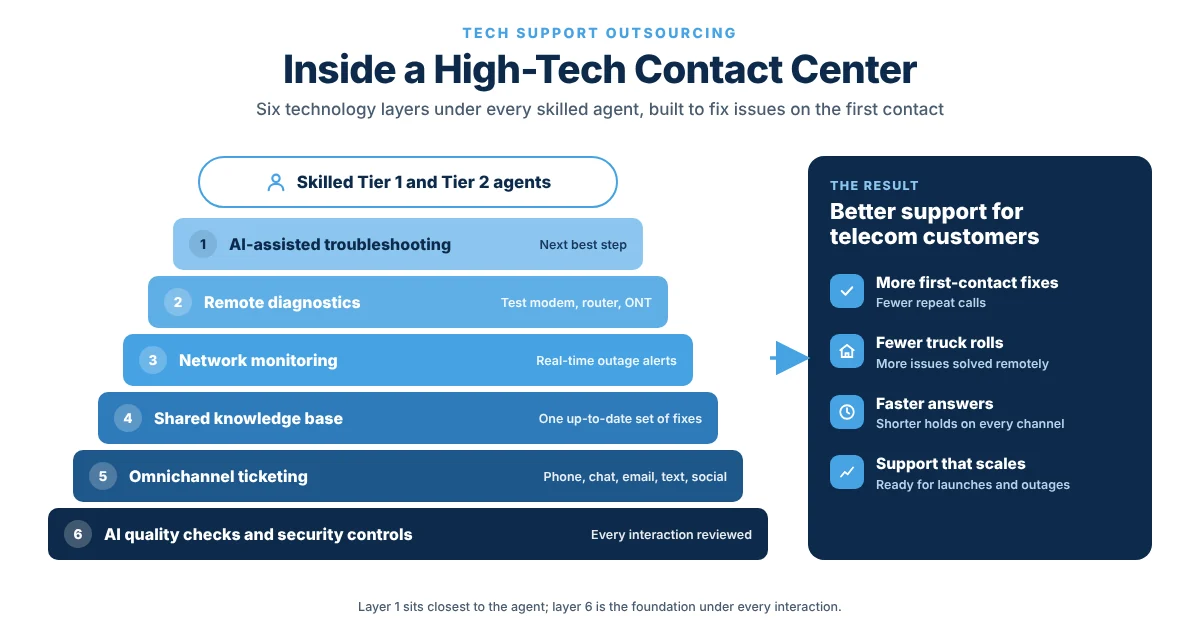 Six technology layers enabling faster telecom support and higher first contact resolution.
1. AI-Assisted Troubleshooting
AI tools suggest the next best step as the agent talks to the customer. They pull up likely causes, guided fixes, and past cases. As a result, newer agents can solve complex issues with confidence. Modern AI solutions bring this guidance into every call.
2. Remote Diagnostics
Agents can check the modem, router, or ONT from a distance. They can run speed tests, read signal levels, and reboot devices. This step alone prevents many needless truck rolls.
3. Network Monitoring
Agents see outages and network alerts in real time. So they can tell customers about a known outage right away instead of troubleshooting a device that works. Strong service assurance links the contact center to the network team.
4. A Shared Knowledge Base
Every agent works from the same up-to-date guides. When a new device or firmware issue appears, the fix goes into the knowledge base the same day.
5. Omnichannel Ticketing
Customers can reach support by phone, chat, email, text, or social media. Each case keeps its full history, so customers never have to repeat themselves.
6. AI Quality Checks and Security Controls
AI quality management reviews every interaction, not just a small sample. Meanwhile, security controls such as PCI DSS, SOC 2, and HIPAA-ready processes protect customer data. Always ask a partner to show its security certifications.
Together, these tools lift first contact resolution. Our guide to AI and first contact resolution in telecom tech support explains how.
Traditional vs. High-Tech Contact Center
The table below shows how a high-tech contact center differs from a traditional one.
| Area | Traditional contact center | High-tech contact center |
|---|---|---|
| Troubleshooting | Fixed scripts | AI-guided steps based on the issue |
| Device checks | Customer reads lights over the phone | Remote diagnostics on modem, router, or ONT |
| Outage awareness | Agents learn late | Real-time network alerts |
| Channels | Mostly phone | Phone, chat, email, text, and social |
| Quality checks | Small call samples | AI review of every interaction |
| Scaling | Weeks to hire and train | Flexible staffing for spikes |
| Typical result | Repeat calls and truck rolls | Higher first contact resolution |
Why Skilled People Still Matter in AI-Driven Support
Technology helps, but people still solve the hardest problems. In fact, 87% of customers say companies that use GenAI for service must offer a way to reach a human agent, according to a 2026 Gartner survey. Only half say GenAI makes their interactions easier. Gartner also found that only 27% of customers would try a chatbot again after a bad experience.
Service leaders see the same trend. In April 2026, Gartner reported that 85% of service and support leaders are expanding human agent responsibilities, not cutting them.
That is why the best model blends AI with skilled human tiers. Tier 1 agents handle common issues, such as Wi-Fi setup, password resets, and simple outages. Tier 2 agents solve deeper device, signal, and network problems. Finally, complex network faults go to engineering with full notes, so no one starts from scratch.
Location matters, too. The FCC has proposed rules that would limit offshore customer service for telecom and cable providers, and require US-based agents for sensitive tasks such as password changes. So many operators now blend onshore telecom BPO teams with nearshore and offshore sites.
How to Choose a Tech Support Outsourcing Partner
Not every partner is ready for telecom. Use this checklist when you compare options:
- Telecom experience: The partner should know fiber, cable, wireless, and fixed wireless support.
- Technology stack: Ask to see its AI tools, remote diagnostics, and ticketing systems in action.
- Security and compliance: Check certifications and data controls.
- Flexible locations: Look for onshore, nearshore, and offshore options.
- Clear SLAs: Agree on targets for speed, quality, and resolution. Our guide to telecom BPO SLAs can help.
- Smooth transition: Ask for a step-by-step launch plan with training and testing.
KPIs That Prove Your Tech Support Partner Is Working
Track a few clear numbers each month. Key metrics include first contact resolution, average handle time, truck roll rate, repeat call rate, customer satisfaction, and Net Promoter Score. For a full list, see our guide to telecom technical support KPIs.
Get Expert Tech Support Without the In-House Strain
The right tech support outsourcing partner gives your customers fast, accurate help and gives your team room to grow. Sequential Tech combines telecom-trained Tier 1 and Tier 2 agents with AI-assisted troubleshooting, remote diagnostics, and AI quality management. We support US ISPs, fiber and cable providers, wireless carriers, and MVNOs from onshore, nearshore, and offshore sites. Talk to our tech support experts to see how a high-tech contact center can raise your first contact resolution.
Frequently Asked Questions
What is tech support outsourcing?
Tech support outsourcing means hiring a specialist partner to handle your customers’ technical questions and issues. The partner provides trained agents, tools, and systems. For telecoms, this often covers internet, Wi-Fi, device, and service troubleshooting by phone, chat, email, and text.
What makes a contact center high-tech?
A high-tech contact center gives agents tools such as AI-assisted troubleshooting, remote diagnostics, real-time network alerts, a shared knowledge base, and omnichannel ticketing. It also uses AI to review call quality. These tools help agents fix more issues on the first contact.
What is the difference between Tier 1 and Tier 2 technical support?
Tier 1 technical support handles common issues, such as Wi-Fi setup, password resets, and basic outages. Tier 2 handles deeper problems, such as device faults, signal issues, and complex configurations. Issues that Tier 2 cannot solve go to network engineers.
Is outsourced technical support secure?
Outsourced technical support can be very secure when the partner follows strong standards. Look for PCI DSS and SOC 2 compliance, strict access controls, and regular audits. Onshore teams can also handle sensitive tasks, such as account and password changes.
How does outsourcing tech support reduce truck rolls?
Outsourcing tech support to a high-tech contact center reduces truck rolls by fixing more issues remotely. Agents use remote diagnostics to test devices, check signal levels, and reboot equipment. They also see known outages, so they avoid sending technicians for problems the network team is already fixing.