Learn how 5G customer service is changing in 2026, from home internet setup and eSIM issues to agent tools, and what support teams must change.
A customer switches to 5G home internet. The box sits in a closet, the speed drops at night, and the first call to support ends with “try restarting it.” That call is becoming common. As 5G grows, customers call about new things, and old scripts no longer work. This guide explains how 5G customer service is changing in 2026, what customers now call about, and what support teams should do to keep up.
What Is 5G Customer Service?
5G customer service is the support telecoms give customers who use 5G phones, 5G home internet, and 5G business services. It covers setup, billing, troubleshooting, and coverage questions. It also includes the new tools that 5G gives support teams.
The shift is now hard to ignore. By the end of 2025, 5G carried 48% of all mobile data traffic. Worldwide, there were 3.1 billion 5G subscriptions by early 2026. In addition, North America is expected to reach close to or above 90% 5G adoption by 2031. So for most carriers, 5G is no longer a niche. It is the main network that 5G and emerging technology providers must support every day. That is why telecom customer support in 2026 looks so different.
New Reasons Customers Call in the 5G Era
5G brings new services, and each one creates new support questions. The graphic below shows the five biggest new contact drivers.
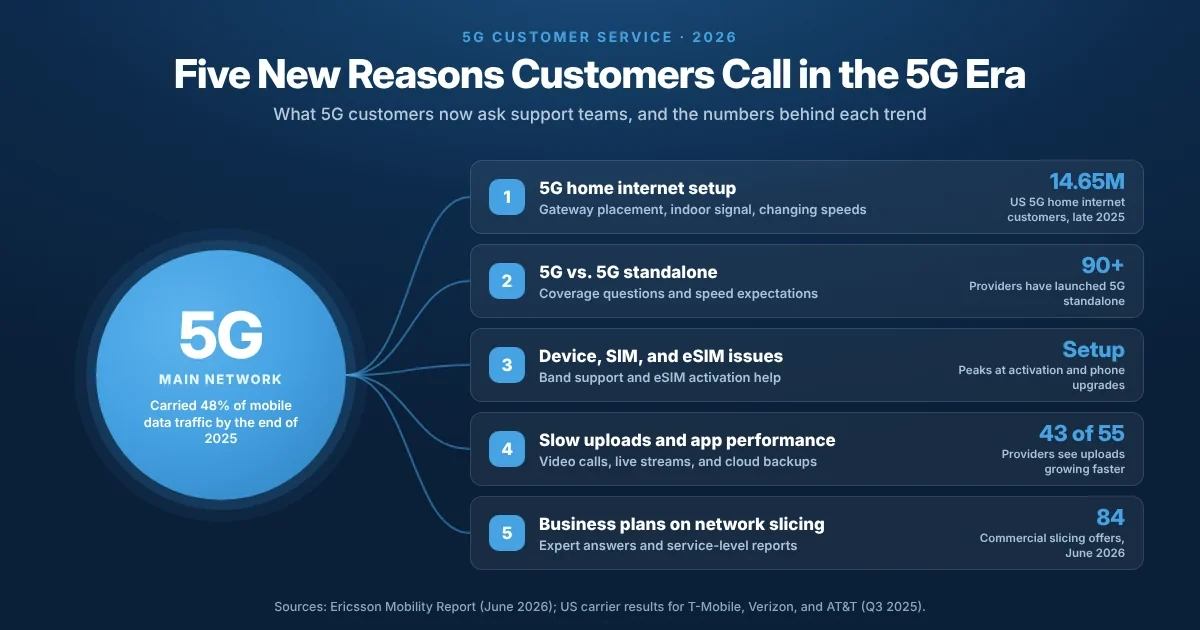 Five new reasons customers contact telecom support in the 5G era, and what each one needs.
5G Home Internet Setup
5G home internet, also called fixed wireless access (FWA), is growing fast. Today, 71% of FWA providers offer the service over 5G, up from 57% a year earlier. In the US alone, T-Mobile, Verizon, and AT&T served about 14.65 million FWA customers by late 2025.
These customers set up their own gateway. As a result, many 5G home internet support calls are about where to place the box, weak indoor signal, or speeds that change through the day. Our guide to fixed wireless access customer support covers these issues in detail.
Coverage and “5G vs. 5G Standalone” Confusion
Many customers see a 5G icon but do not get the speed they expect. Part of the reason is that there are two kinds of 5G. Most early networks were “non-standalone,” built on top of 4G. 5G standalone runs on its own core, and more than 90 providers have launched it so far. Agents need to explain the difference in simple terms. Our article on 5G standalone troubleshooting explains what changes.
Device, SIM, and eSIM Issues
Older phones may not support every 5G band. New phones often use eSIM instead of a physical SIM card. Both create setup questions, especially during activations and onboarding. eSIM support needs clear, step-by-step guidance.
Slow Uploads and App Performance
People now send more data than before, through video calls, live streams, and cloud backups. In fact, Ericsson found that upload traffic grew faster than download at 43 of 55 providers it studied. So complaints are shifting from “slow downloads” to “my video call freezes” or “my uploads fail.”
Business Customers and Network Slicing
Network slicing lets a carrier reserve part of its 5G network for one customer or use. By June 2026, there were 84 commercial slicing offers worldwide, up from 65 in late 2025, according to the Ericsson Mobility Report. Business customers on these plans expect fast, expert answers and clear service-level reports.
How 5G Helps Contact Centers
5G does not only create new questions. It also gives every 5G contact center better tools.
First, agents can see live network data during a call, such as signal strength and recent drops. That makes 5G troubleshooting faster. Second, video support lets agents see a customer’s setup, such as where a gateway sits. Third, AI tools, including an AI voice agent, can handle simple checks and pass complex cases to people. Finally, agents can now fix many settings remotely, without a technician visit.
4G-Era vs. 5G-Era Customer Support
The table below shows how support work is changing.
| Area | 4G-era support | 5G-era support |
|---|---|---|
| Main products | Phones and mobile data | Phones, home internet, and business slices |
| Top complaints | Dropped calls, slow downloads | Gateway placement, upload speed, eSIM setup |
| Agent tools | Account history and scripts | Live network data, video, and AI assist |
| Troubleshooting | Restart and escalate | Guided checks, remote fixes, then escalate |
| Business support | Standard plans | Slice-based plans with service-level reports |
| Key metrics | Handle time, first contact resolution | Resolution, repeat contacts, and network experience |
What Support Teams Must Change
The impact of 5G on call centers goes beyond new topics. Teams also need new skills and new ways of working.
Start with training. Agents should understand 5G basics, home gateway setup, and eSIM steps. Next, build tiered troubleshooting. Simple fixes stay at the front line, while network and business cases go to skilled 5G technical support experts.
Then update your knowledge base. Add short guides for each new contact driver, with pictures where they help. Also, track the right metrics. Repeat contacts and network experience scores often reveal more than handle time alone.
Finally, plan for scale. Many carriers add outside customer care capacity when 5G home internet grows quickly. Growth was steady through 2025, as the top three US carriers passed 14.6 million FWA customers. Our guide to 5G customer support outsourcing explains when that makes sense.
The Limits of 5G for Customer Service
5G improves many things, but it does not fix weak processes. Poor scripts, unclear bills, and slow escalations still frustrate customers. Coverage also varies by area and indoors. So a strong 5G customer experience still depends on well-trained people and clear, honest answers.
Prepare Your Support Teams for 5G Customers
5G is now the main network for most US customers, and support teams need to keep pace. Sequential Tech helps wireless carriers, MVNOs, and 5G home internet providers with customer care, technical support, activations, and AI-enabled tools built for 5G. Our telecom-trained teams handle setup, troubleshooting, and escalations across U.S., Canadian, nearshore, and offshore sites. Talk to our 5G support team about preparing your care and technical support teams for 5G customers.
Frequently Asked Questions
How does 5G change telecom customer service?
5G creates new reasons for customers to call, such as 5G home internet setup, eSIM activation, and upload problems. It also gives agents better tools, including live network data, video support, and AI assistance. As a result, support teams need new skills and updated guides.
What do 5G home internet customers call about most?
5G home internet customers often call about gateway placement, weak indoor signal, and speeds that change during the day. Many also need help with setup and billing. Clear setup guides and patient, well-trained agents solve most of these issues on the first contact.
What is the difference between 5G and 5G standalone?
Early 5G networks were non-standalone, which means they ran on top of a 4G core. 5G standalone uses its own 5G core. It supports newer features, such as network slicing and lower delays. More than 90 providers have launched 5G standalone so far.
How does 5G help contact centers?
5G helps contact centers by giving agents live network data, smoother video support, and better AI tools. Agents can see signal problems during a call and often fix settings remotely. This can cut repeat calls and technician visits.
Will 5G reduce the need for human support agents?
No. AI and self-service will handle more simple tasks, but 5G also adds new, complex questions. Home internet setup, business slicing plans, and network issues still need skilled people. In practice, agents shift toward harder cases.