
Discover 10 telecom debt collection strategies for 2026 that recover more revenue, follow US rules, and keep good customers, from early reminders to AI tools.
A missed phone bill rarely starts as bad debt. It starts as a busy week, a lost job, or a card that expired. What happens next decides whether you get paid and keep the customer or lose both. The right telecom debt collection strategies recover more money while keeping good customers on your network. This guide shares 10 proven approaches for 2026, built around US rules, current data, and a retention-first mindset.
Why Telecom Debt Collection Is Changing
Telecom collections look very different than they did a few years ago. Customers expect to pay by text or app, not by phone. Many households also feel steady money stress. At the same time, rules on calls and texts keep shifting.
As a result, the old model of repeated calls and fast disconnects no longer works well. Modern telecom collections services mix digital outreach, flexible plans, and careful rule checks. Many operators also use specialist collections and recovery teams to run this work at scale.
10 Telecom Debt Collection Strategies That Work
The strategies below follow the account from before the due date to final recovery. The graphic shows how they fit across the collections lifecycle.
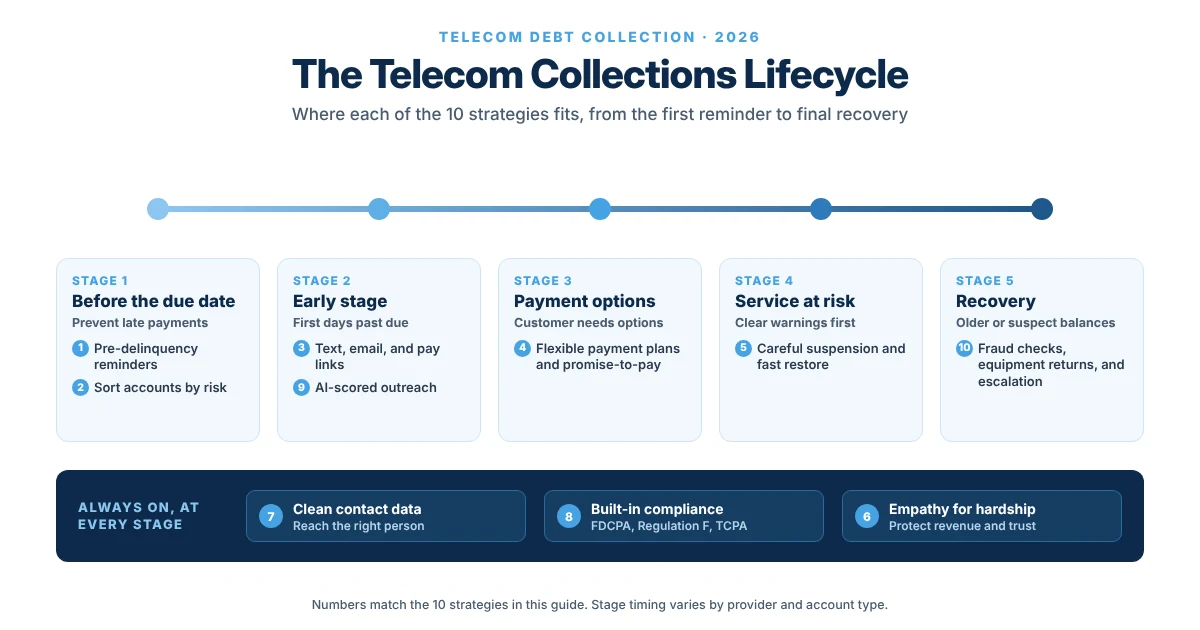 Telecom collections work best in stages, from friendly reminders to fair, compliant recovery.
1. Start With Pre-Delinquency Outreach
The best collection is the one you never need. Pre-delinquency outreach means reminding customers before a bill is due. Send a short text or email a few days ahead, and flag expired cards early. Clear bills also help, so strong billing support reduces disputes that delay payment.
2. Segment Accounts by Risk and Balance
Not every past-due account needs the same approach. A loyal customer who is five days late needs a gentle nudge. A new account with no payment history needs a closer look. So sort past-due telecom accounts by risk, balance, and tenure, then match each group to the right treatment.
3. Lead With Digital Debt Collection
Many customers would rather pay through a link than talk to an agent. Digital debt collection uses text, email, app alerts, and self-service payment portals. It works best for early-stage collections. Rich messaging can also help, as our guide to RCS-based debt resolution explains. Keep every message short, clear, and easy to act on.
4. Offer Flexible Payment Plans
A customer who cannot pay in full may still pay in parts. Flexible payment plans, payment date changes, and promise-to-pay options keep money coming in. Keep the terms simple, confirm them in writing, and send a reminder before each payment.
5. Use Service Suspension Carefully
Suspending service is a strong tool, but it can push customers to leave for good. Give clear warnings before any suspension, and follow state rules. Then make it easy to turn service back on as soon as the customer pays. Customers who do leave may still return, so connect collections with retention and win-back efforts.
6. Train Agents to Handle Hardship With Empathy
Money stress is common. In fact, 16% of US adults did not pay all their bills in full in the month before a Federal Reserve survey on 2025 finances. Agents should listen first, offer options, and avoid pressure. A respectful telecom collections call center protects both revenue and reputation. This is the heart of customer retention in collections.
7. Keep Contact Data Clean
Calls and texts only work when they reach the right person. Wrong numbers waste time and can create compliance risk. So update contact details every time you speak with a customer. Also confirm consent for texts and calls, and remove numbers that customers no longer use.
8. Build Debt Collection Compliance Into Every Step
Debt collection compliance is not optional. Third-party collectors must follow the FDCPA and Regulation F. Regulation F limits most call attempts to seven in seven days per debt. In-house telecom teams must also follow the TCPA and state laws. In addition, the FCC has delayed its “revoke-all” consent rule until January 31, 2027. Our guides to outbound calling compliance and AI voice TCPA rules cover the details.
9. Use Analytics and AI to Predict Who Will Pay
AI in debt collection helps teams focus effort where it matters. Models can score each account by its chance of payment, as our article on predictive payment behavior modeling shows. An AI voice agent can also send compliant reminders and take simple payments. Still, people should review scores and handle sensitive cases.
10. Separate Fraud From Hardship, Then Escalate Wisely
Some unpaid accounts are not hardship at all. Subscription fraud with no intent to pay cost telecoms $4.89 billion in the CFCA’s 2025 survey. Flag these early with risk management checks. Also track unpaid phone balances and unreturned equipment, since both add to losses. For older, larger balances, telecom debt collection outsourcing can help. A partner can run soft and hard collections, settlements, and receivables management for you.
Telecom Collections Strategies at a Glance
The table below pairs each strategy with when to use it and the metric to track.
| Strategy | When to use it | Metric to track |
|---|---|---|
| Pre-delinquency outreach | Before the due date | On-time payment rate |
| Risk segmentation | As soon as a bill is late | Recovery rate by segment |
| Digital collections | First 1 to 30 days past due | Digital payment rate |
| Flexible payment plans | Customer cannot pay in full | Promise-to-pay kept rate |
| Careful service suspension | After clear warnings | Restore and retention rate |
| Hardship-trained agents | Any customer in money stress | Customer satisfaction, complaints |
| Clean contact data | Every interaction | Right-party contact rate |
| Built-in compliance | Every call and text | Complaints and audit findings |
| Analytics and AI | Large account volumes | Dollars recovered per contact |
| Fraud checks and escalation | Older or suspect balances | Net bad debt write-offs |
Together, these steps turn telecom bad debt recovery into a steady process that is easy to measure. They also simplify telecom collection workflow management.
Recover More Revenue While Keeping Good Customers
Strong telecom debt collection strategies balance firm recovery with fair treatment. Sequential Tech helps telecom operators, MVNOs, and broadband providers with telecom debt recovery services, billing support, and retention teams. Our compliance-trained agents handle soft and hard collections, payment plans, settlements, and payment follow-up across U.S., Canadian, nearshore, and offshore sites. Talk to our collectionsexpertabout a recovery program review built around your accounts.
Frequently Asked Questions
What are the best telecom debt collection strategies?
The best telecom debt collection strategies start before a bill is due. They include early reminders, sorting accounts by risk, digital payment options, and flexible payment plans. Strong programs also train agents in empathy, keep contact data clean, follow US rules, and use analytics to focus effort.
What is pre-delinquency outreach in telecom?
Pre-delinquency outreach means contacting customers before a bill becomes past due. Telecoms send reminders by text, email, or app a few days before the due date. They also flag expired cards early. This simple step prevents many late payments.
Which rules apply to telecom debt collection in the US?
Third-party collectors must follow the FDCPA and Regulation F, which limits most call attempts. All telecom collectors must follow the TCPA for calls and texts, plus state laws. The FCC has also delayed its “revoke-all” consent rule until January 31, 2027.
How can telecoms collect debt without losing customers?
Telecoms keep customers by offering flexible payment plans, clear warnings before a shutoff, and a fast way to turn service back on. Agents should treat hardship with respect. After recovery, retention teams can win back customers who left during the process.
When should a telecom outsource debt collection?
Telecoms often outsource when volumes grow, balances age, or in-house teams lack skilled staff. A telecom collections BPO can add soft and hard collections capacity, compliance skills, and longer hours. Choose one with telecom experience and strong security controls.