
How telecom companies generate free sales leads from care, moving, and cancellation calls, SEO, AI search, YouTube, and chatbots, then convert them in call centers.
Your next best telecom sales lead may already be on hold in your call center. A customer calls about slow Wi-Fi while three people work from home. Next, a small business owner asks about adding phone lines. Then a family calls to move service to a new address. Each call is a sales chance, and it costs nothing to find. This guide shows how telecom companies can generate telecom sales leads for free, using their call centers, search, AI, video, and social media instead of paid ads.
Quick answer: Telecom companies can generate sales leads for free by turning care, moving, and cancellation calls into sales chances, following up on abandoned orders, finding business buyers on LinkedIn, ranking in search and AI answers, posting YouTube explainers, and adding an AI chatbot that hands warm leads to a telecom call center.
Where Free Telecom Sales Leads Hide
Most telecom companies spend heavily to buy new leads. However, many of their warmest leads are already in the building. They sit in customer care calls, billing questions, moves, and cancellations. They also sit in old quotes and orders that never closed.
That is why a telecom call center matters so much. Trained agents talk to thousands of customers every day. With the right process, they can spot upgrade needs, log leads, and hand them to sales. A strong telecom customer care team does this without hurting service quality.
Free inbound channels then add new leads on top. Search, AI answers, social media, YouTube, and chatbots bring in buyers who are already looking. Your call center then answers, qualifies, and converts them. For more local and consumer tactics, see our guide on how to generate telecom leads for free.
Keep in mind that “free” means no ad spend or data fees. It still takes time and training. However, most of these methods keep producing leads long after you set them up.
10 Free Ways to Generate Telecom Sales Leads
The methods below fall into two groups. The first five come from sales conversations, either calls you already get or outreach you start. Meanwhile, the last five build inbound demand that your call center can convert. Each one includes a telecom example and a speed label.
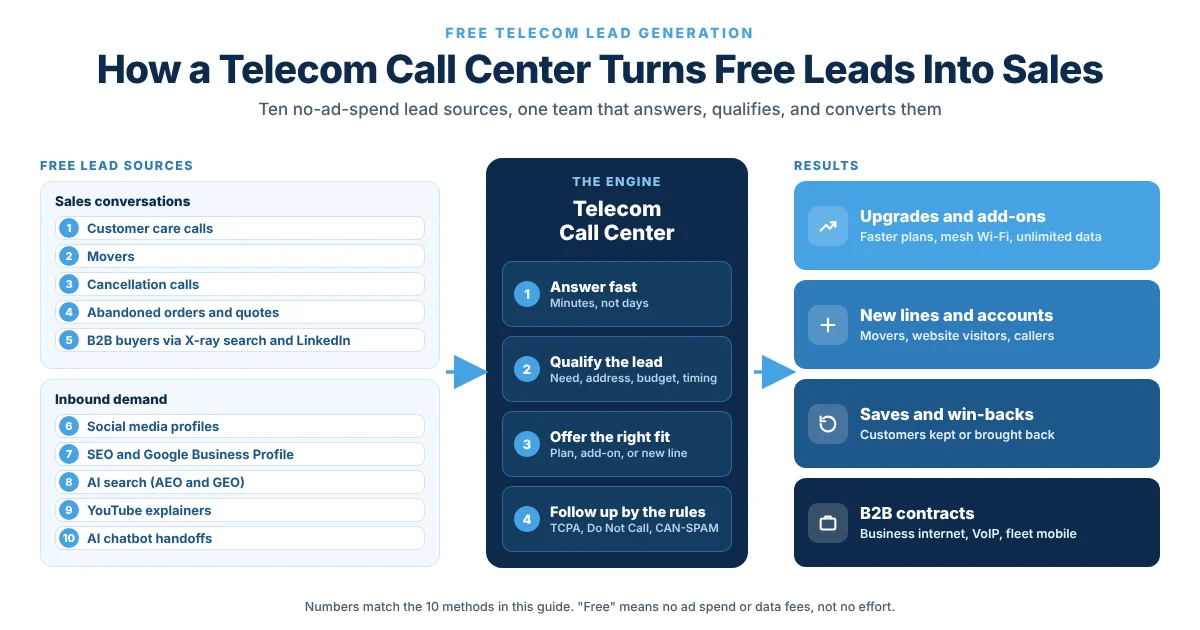 Explore 10 free telecom lead sources and how call centers answer, qualify, and convert prospects into customers.
1. Turn Customer Care Calls Into Sales Leads
Every care call shows what a customer needs. A complaint about slow speeds may point to a plan upgrade. A question about data overages may point to an unlimited plan. Likewise, a call about a new baby or a home office may point to more lines or faster internet.
So train agents to listen for these signals. First, fix the issue the customer called about. Then, if it fits, offer a better option or log the lead for sales. Many teams call this approach service-to-sales or care-to-sales.
Telecom example: A fiber customer calls about Wi-Fi drops in a large home. The agent fixes the router settings, then offers a mesh Wi-Fi add-on. The customer says yes.
2. Capture Movers and Service-Change Calls
Moving is one of the biggest buying moments in telecom. About 1 in 9 Americans changed homes in 2024, according to US Census data. Each move is a chance to keep a customer, upgrade them, or win a new one.
Make sure agents treat every “transfer of service” call as a sales call. Check what is available at the new address, and offer the best fit. Also, ask whether the customer needs a home office setup or a second line.
Telecom example: A cable customer calls to cancel because of a move. The agent finds that fiber serves the new address and books an install for move-in day.
3. Turn Cancellation Calls Into Win-Back Leads
Not every cancellation is final. Some customers leave over price, a bad experience, or a rival’s promo. A trained save desk can often fix the problem on the call. Even when the customer leaves, the reason gives you a clear win-back lead for later.
Log each cancellation reason in your CRM. Then plan follow-up at the right time, such as when a promo ends. Our guide to telecom win-back strategies explains how to time these calls.
Telecom example: A customer leaves for a rival’s 12-month promo. Eleven months later, the call center calls with a loyalty offer, and the customer returns.
4. Follow Up on Abandoned Orders and Old Quotes
Many buyers start an order online and never finish. Others get a quote and go quiet. These are warm leads, because they already showed clear interest. Yet many telecom companies never call them back.
So set up a daily list of abandoned carts, failed credit checks, and open quotes. Then have agents call or text within the rules. Often, a quick call solves a simple problem, such as a missing address or an install date question.
Telecom example: A small business starts a business internet order but stops at the install step. An agent calls the next morning, answers a question about downtime, and closes the order.
5. Find Business Buyers With Google X-Ray Search and LinkedIn
For B2B telecom sales, such as business internet, VoIP, SD-WAN, or fleet mobile plans, you need named decision-makers. Google X-ray search helps. Simply combine a job title, a place, and the LinkedIn site filter. For example, search: site:linkedin.com/in “IT manager” Dallas. You can also add an industry, such as healthcare or retail.
LinkedIn groups help, too. Join groups where IT and operations leaders meet. Answer questions and share useful tips before you pitch. Then a B2B sales team or outbound call center can follow up with a short, relevant message.
Telecom example: A business telecom provider finds 30 IT managers at clinics in its fiber footprint. An outbound team calls each one about a faster, more reliable connection.
Search and read profiles by hand, and follow LinkedIn’s user agreement. Do not scrape profiles or use bots.
6. Optimize Your Social Media Profiles
Social media optimization turns your profiles into lead sources. Make sure each profile clearly says what you offer and where. Add a phone number, a booking link, and service area details. Also, reply fast to comments and direct messages, because many of them are sales questions.
Then post useful local content each week. Share tips on Wi-Fi setup, outage updates, and new service areas. Simple, helpful posts earn more trust than hard sales posts.
Telecom example: A regional ISP posts that fiber has reached a new neighborhood. Dozens of people comment with their addresses, and the call center calls each one back.
7. Rank in Google With SEO and Google Business Profile
Most buyers search Google before they call. So build pages that match what they search for, such as “fiber internet in [city]” or “business VoIP for small offices.” Then answer real buyer questions in short, clear articles.
Local SEO matters too. Keep a complete Google Business Profile for each store or office. Add hours, photos, services, and a call button. Also, ask happy customers for reviews. As a result, more people find you and call your sales line directly.
Telecom example: A wireless retailer adds weekly photos and answers reviews on its Google Business Profile. Calls from Google Maps rise, and agents convert many of them into new lines.
8. Win AI Answers With AEO and GEO
Buyers now ask AI tools which provider to choose. In fact, half of B2B software buyers now start their research in an AI chatbot instead of Google, according to G2’s 2025 buyer research. Telecom buyers are moving the same way.
Answer engine optimization (AEO) and generative engine optimization (GEO) help AI tools find and recommend you. Write clear, direct answers to common questions about plans, prices, and coverage. Add FAQ sections and structured data to your pages. Also, earn mentions on trusted sites, such as local news and review platforms.
Telecom example: A fiber provider adds a clear FAQ on “Is fiber available in my area?” AI assistants start quoting it, and more buyers call to check their address.
9. Publish YouTube Explainers
Video builds trust before the first call. Short YouTube explainers can show how installs work, how to choose a plan, or how business VoIP saves money. Buyers often watch these while they compare providers.
To rank, use titles that match search terms, such as “How fiber installation works.” Add chapters, captions, and a phone number in the description. Then share each video on social media and embed it on related pages.
Telecom example: A provider posts a three-minute install walkthrough. Viewers call the number in the description, and agents book installs on the spot.
10. Add an AI Chatbot That Hands Leads to Your Call Center
Website visitors often leave without calling. An AI chatbot can greet them, answer basic questions, and check service at their address. It can also ask a few qualifying questions. A well-designed chat AI tool then passes warm leads to live agents, day or night.
Telecom example: A visitor asks the chatbot about business internet at 10 p.m. The bot collects the details, and a sales agent calls back at 9 a.m. the next day.
Free Telecom Sales Lead Sources Compared
The table below compares each method by lead type, speed, and the role your call center plays.
| Lead source | Lead type | Call center role | Time to first lead |
|---|---|---|---|
| Customer care calls | Upsell and cross-sell | Spot needs and offer upgrades | Days |
| Movers and service changes | Retention and upgrade | Check new address and offer best plan | Days |
| Cancellation calls | Save and win-back | Save on the call or plan follow-up | Days to weeks |
| Abandoned orders and old quotes | Warm new sales | Call back and close | Hours |
| Google X-ray search and LinkedIn | B2B new business | Outbound follow-up | Hours to days |
| Social media profiles | Inbound and local | Answer messages and call back | Days to weeks |
| SEO and Google Business Profile | Inbound | Answer sales calls fast | Weeks to months |
| AI search (AEO and GEO) | Inbound | Answer and qualify calls | Weeks to months |
| YouTube explainers | Inbound | Book installs and demos | Weeks |
| AI chatbot | Inbound, qualified | Take handoffs from the bot | Days |
How a Telecom Call Center Turns Free Leads Into Sales
Free leads only matter if someone acts on them. That is where a telecom call center makes the biggest difference.
First, speed counts. Warm leads cool fast, so call back within minutes, not days. A call center with long hours and enough staff can answer every lead while interest is high.
Next, qualify each lead with a few simple questions about needs, address, budget, and timeline. Intent scoring can help agents focus on the buyers most ready to act. In addition, give agents clear offers and simple scripts so every call feels helpful, not pushy.
Finally, track results. Measure leads logged, contact rate, conversion rate, and revenue per call. Then share wins with agents to keep them motivated. Many operators use telecom lead generation and outbound sales outsourcing partners to scale this work without hiring a large in-house team.
Follow the Rules on Every Call
Free leads still come with rules. Calls and texts to consumers must follow the TCPA and the National Do Not Call Registry. Sales emails must follow CAN-SPAM. State laws can add more limits. Also, respect each platform’s terms, especially on LinkedIn. Our guide to telecom outbound calling compliance explains the main rules.
Turn Free Telecom Sales Leads Into Revenue
The cheapest telecom sales leads are often the ones you already have. Care calls, moves, cancellations, and abandoned orders are full of buying signals, while SEO, AI answers, YouTube, and chatbots bring in new buyers. Sequential Tech helps US carriers, MVNOs, and broadband providers turn those leads into revenue. Our telecom-trained agents handle care-to-sales, inbound sales, lead qualification, win-back, and compliant outbound follow-up across onshore, nearshore, and offshore sites. Talk to our telecom sales experts to see how many more leads your call center could convert.
Frequently Asked Questions
How can telecom companies generate sales leads for free?
Telecom companies can generate free sales leads by turning care, moving, and cancellation calls into sales chances. They can also follow up on abandoned orders, find business buyers on LinkedIn, and rank in search and AI answers. YouTube videos, social media, and AI chatbots add more inbound leads.
How do call centers generate telecom sales leads?
Call centers generate telecom sales leads by spotting needs during care calls, offering upgrades, and logging leads for sales. They also call back abandoned orders, old quotes, and website leads. Outbound teams then follow up with business buyers and past customers.
What is care-to-sales in telecom?
Care-to-sales means turning customer service calls into sales chances. Agents first solve the customer’s issue. Then, if it fits, they offer a better plan, an add-on, or a new line. Done well, it raises revenue without hurting customer satisfaction.
How fast should a telecom company follow up on a sales lead?
A telecom company should follow up on a warm sales lead within minutes when possible, and always the same day. Interest drops fast after a buyer reaches out. A call center with long hours helps every lead get a quick reply.
Should telecom companies outsource lead generation?
Many telecom companies outsource lead generation when lead volume grows or in-house teams lack time. A telecom BPO can add trained agents, longer hours, and proven sales processes. Choose a partner with telecom experience, strong compliance controls, and clear reporting.