
How outsourced data annotation gives telecom fraud, churn, and credit-risk teams the clean, secure training data their AI models need, without the cost and drag of building a labeling team in-house.
Your fraud model is only as smart as the data you feed it. In 2025, global telecom fraud losses hit $41.82 billion, and AI-powered scams are now harder to catch than ever. The teams winning this fight are not the ones with the biggest budgets. They are the ones with the cleanest, best-labeled training data. And that is exactly where most in-house teams get stuck. Labelling call records, network signals, and fraud patterns by hand is slow, costly, and pulls engineers away from building models. Outsourcing data annotation for telecom risk management removes that drag, so your risk AI roadmap keeps moving.
Why Labeled Data Is the Real Bottleneck in Telecom Risk
Telecom risk teams do not have a shortage of data. They have a shortage of usable data. Raw call detail records, chat logs, billing files, and network signals mean nothing to a machine learning model until someone tags them: this call is fraud, this login is a SIM swap, this account is likely to churn.
That tagging work is the bottleneck. Here is the core pain point most risk teams face:
- It is slow. Skilled engineers end up hand-labeling data instead of building and tuning models.
- It is expensive. An in-house labeling team means hiring, training, tools, and management overhead.
- It does not scale. Fraud tactics shift fast. Your labeling needs spike overnight, then slow down, making fixed teams hard to justify.
- It carries risk. Call and billing records are regulated. One mishandled dataset can trigger a compliance problem.
- Quality slips. Untrained or crowd-sourced labelers miss the telecom-specific context that fraud detection depends on.
The result is a stalled AI roadmap. Your risk models sit half-built while the labeling backlog grows.
What Data Annotation for Telecom Risk Management Covers
Risk management is not just fraud. Most telecom teams train several models at once, and each one needs its own labeled data. Good annotation supports the full range:
- Fraud detection tagging SIM swap patterns, subscription fraud, IRSF, and robocall or fraud-call audio. See how annotation improves fraud detection accuracy.
- Churn prediction labeling subscriber behavior, complaint sentiment, and cancellation signals.
- Credit risk tagging payment history, application data, and identity-check outcomes.
- Spam and smishing detection flagging SMS phishing and scam message patterns.
This is why telecom fraud data labeling services and broader risk labeling now go hand in hand. One clean, well-run annotation pipeline can feed every risk model you build.
In-House vs Outsourced Data Annotation: A Side-by-Side Look
The big decision is simple to frame: build the labeling team yourself, or hand it to a partner. Both work, but they fit different needs. Here is how in-house vs outsourced data annotation compares on the factors that matter most to risk teams. For a full breakdown of the cost and quality math behind each model, see our detailed guide.
| Factor | In-House Team | Outsourced Partner |
|---|---|---|
| Startup speed | Slow — hiring and training take months | Fast — trained teams start in days |
| Cost model | Fixed salaries and tools, paid year-round | Flexible — you pay for what you use |
| Scaling | Hard to scale up or down quickly | Scales with your project volume |
| Telecom expertise | Must be built from scratch | Already in place with a specialist partner |
| Quality control | You build the QA process | Layered QA built into the service |
| Data security | Fully under your control | Handled under signed compliance standards |
| Team focus | Engineers split between labeling and modeling | Engineers stay focused on models |
The takeaway: in-house gives you the most control, but outsourced data annotation for AI gets you moving faster, costs less to start, and brings ready-made telecom knowledge. For most risk teams under pressure to ship, that trade is worth it.
When Outsourcing Is the Right Call
Outsourcing is not always the answer. But it is a strong fit when:
1. Your fraud volume is rising fast. With losses climbing and AI-driven scams spreading, speed matters more than ever.
2. Your labeling needs swing up and down. A partner flexes with demand, so you are not paying for idle staff.
3. You lack in-house telecom labeling expertise. A specialist already knows what a SIM swap or IRSF pattern looks like.
4. Your engineers are stretched thin. Free them to build models, not tag data.
5. You are scaling from pilot to production. Production AI needs a steady stream of fresh labeled data, not one-off batches.
If two or more of these ring true, outsourcing likely fits your situation.
Why Secure Data Labeling for Regulated Data Cannot Be an Afterthought
Telecom risk data is some of the most sensitive data there is. Call records, billing details, and identity checks all fall under strict privacy rules. That makes secure data labeling for regulated data a must-have, not a nice-to-have.
When you evaluate a partner, check for these:
- Signed confidentiality and data-handling agreements covering how your data is stored and used.
- Compliance with telecom privacy standards and recognized security frameworks.
- Access controls so only cleared, trained annotators touch your data.
- Audit trails that track every step for regulators and internal review.
A partner who treats security as a checkbox is a liability. A partner who builds it into every project protects both your data and your reputation.
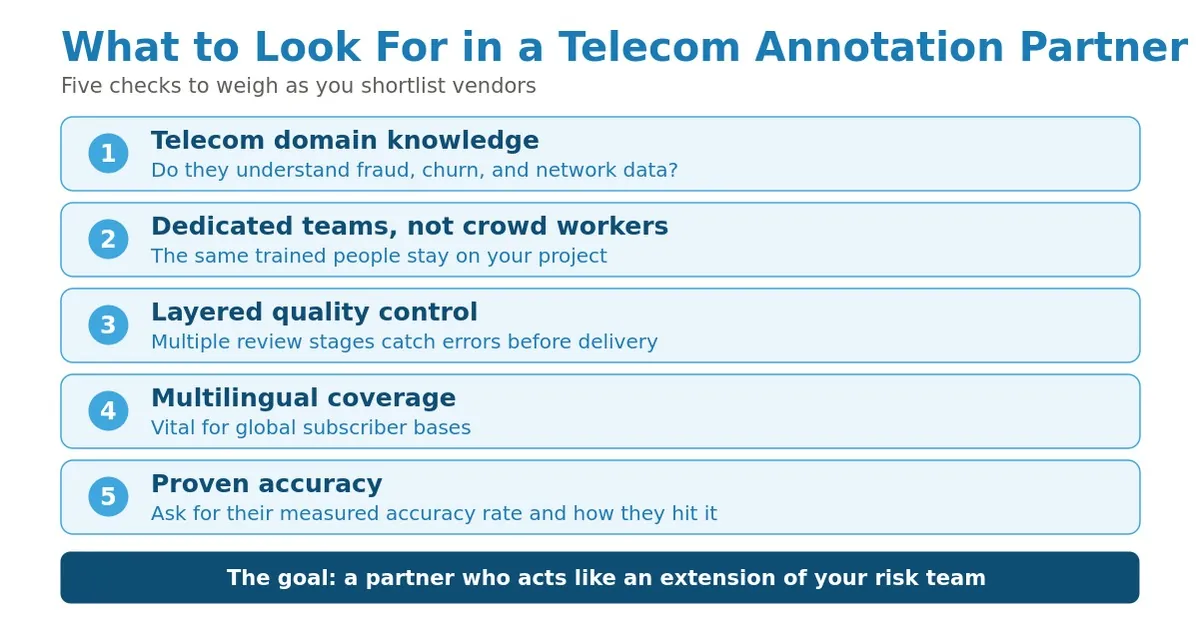
What to Look For in a Telecom Annotation Partner
Not all vendors are equal. As you shortlist, weigh these points:
- Telecom domain knowledge do they understand fraud, churn, and network data?
- Dedicated teams, not crowd workers the same trained people should stay on your project. Here is why crowdsourced labeling quietly breaks telecom AI models.
- Layered quality control multiple review stages to catch errors before delivery.
- Multilingual coverage vital for global subscriber bases.
- Proven accuracy ask for their measured accuracy rate and how they hit it.
The goal is a partner who acts like an extension of your risk team, not a faceless labeling shop. Our guide to choosing a data annotation partner for telecom AI walks through the seven questions that separate strong vendors from weak ones.
The Bottom Line
The telecom fraud fight is only getting harder, and the fraud management market is growing fast to keep up. Your risk models need clean, accurate, telecom-aware training data to stand a chance. Outsourcing data annotation for telecom risk management lets you get that data faster, cheaper, and more securely than building it all in-house, while keeping your best people focused on the models themselves.
Give Your Risk Models the Clean Data They Need
Sequential Tech’s outsourced data annotation is built for telecom fraud, churn, and credit-risk teams. As part of the Fusion CX Group, we run live customer-experience operations for carriers and MVNOs, so our labeling reflects real subscriber and fraud behavior, not guesswork. Our services span fraud and risk data labeling, text and audio annotation, RLHF, and multilingual support across 28+ languages, all delivered by dedicated trained teams with layered QA and security aligned to telecom regulatory standards.