
Ten practical telecom fraud prevention strategies for 2026, from MFA and identity checks to AI detection, PBX security, SIM swap alerts, and 24/7 fraud monitoring.
A customer wakes up to a phone with no signal. By noon, a fraudster has used their number to reset bank passwords and drain an account. Meanwhile, a small business finds a $40,000 bill for calls to premium numbers it never dialed. Stories like these add up fast. Telecom fraud cost operators $41.82 billion worldwide in 2025, according to the Communications Fraud Control Association (CFCA). This guide shares 10 practical telecom fraud prevention strategies that operators, broadband providers, and MVNOs can use in 2026.
The best telecom fraud prevention strategies combine strong identity checks, multi-factor authentication, real-time traffic monitoring, AI-powered fraud detection, PBX and network security, and a trained team that responds to alerts around the clock.
Common Types of Telecom Fraud in 2026
Fraudsters target telecoms because phone numbers, devices, and network access are easy to turn into cash. As a result, the threats keep growing. The most common types include:
- Subscription fraud: Signing up with stolen or fake identities to get phones and service without paying.
- SIM swap and account takeover: Taking over a customer’s number to steal codes and access other accounts.
- International Revenue Share Fraud (IRSF): Pumping calls to high-cost international numbers to collect a share of the fees.
- PBX and SIP hacking: Breaking into business phone systems to make costly calls.
- Social engineering: Tricking agents or customers into sharing data or approving changes.
Subscription fraud alone caused $5.31 billion in losses in 2025, while account takeover added $4.73 billion, according to the CFCA survey. A strong fraud and risk management program needs to cover all of these threats.
10 Strategies to Prevent Telecom Fraud
The strategies below work best together. The graphic shows how they build layers of protection, from the first sign-up to ongoing monitoring.
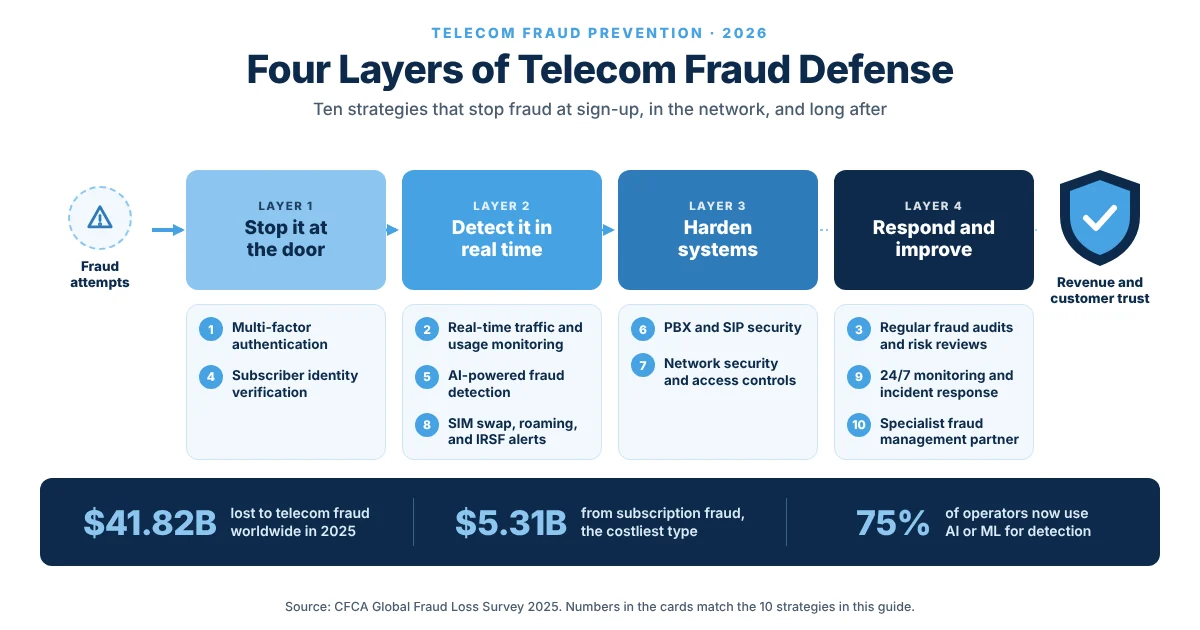 Ten telecom fraud prevention strategies are grouped into four layers of defence.
1. Implement Multi-Factor Authentication (MFA)
Passwords and security questions are easy to steal. So require a second factor, such as an app prompt or a one-time code, for logins and account changes. Also, avoid relying only on text message codes for high-risk actions, because a swapped SIM can catch them.
2. Monitor Telecom Traffic and Usage in Real Time
Real-time fraud detection in telecom starts with watching traffic as it happens. Set alerts for sudden spikes, calls to high-risk countries, and odd data use. Then block or pause risky traffic within minutes, not after the monthly bill.
3. Conduct Regular Fraud Audits and Risk Assessments
Fraud tactics change every few months. Therefore, review your controls, rate plans, and sales channels at least once a quarter. For example, look for weak spots, such as promo offers that fraudsters can abuse or stores with high device-fraud rates.
4. Strengthen Subscriber Identity Verification
Strong telecom identity verification stops fraud at the door. Check ID documents, match them to selfies, and check addresses and payment details before you turn on service or ship devices. In addition, apply extra checks to online orders, which have become a major source of device fraud.
5. Use AI-Powered Fraud Detection
AI-powered telecom fraud detection spots patterns that rules can miss. It scores each event by risk. It also learns from new attacks. In fact, 75% of operators now use machine learning or AI for fraud detection, up from 38% in 2023, according to a TNS summary of the CFCA survey. Modern AI solutions also help agents spot risky requests during live calls.
6. Secure PBX Systems and SIP Infrastructure
PBX fraud prevention starts with the basics. Change default passwords, close unused ports, and block international calling where you do not need it. Also, use session border controllers and set call limits so a breach cannot run up huge bills overnight. Our guide to VoIP fraud prevention covers more steps.
7. Strengthen Network Security and Access Controls
First, limit who can access billing, CRM, and network systems. Then give staff only the access they need, and log every change. Zero trust controls and regular access reviews also protect against insider threats.
8. Detect SIM Swap, Roaming, and IRSF Fraud
SIM swap fraud prevention needs both tools and trained agents. First, flag recent SIM changes, port-out requests, and password resets on the same account. At the same time, watch roaming and international traffic for IRSF patterns. Our guides to SIM swap fraud prevention and IRSF detection explain the warning signs.
9. Build Continuous Fraud Monitoring and Incident Response
Fraud does not keep office hours. So monitor alerts 24/7 and keep a clear playbook for each type of attack. When fraud occurs, act fast, tell affected customers, and close the gap. Close links with billing support and collections and recovery teams also help you reverse charges and recover losses.
10. Partner With a Specialized Telecom Fraud Management Provider
Most fraud teams have too much work and too few people. A specialist partner adds trained analysts, proven tools, and round-the-clock coverage. It can also support your customer care team with fraud-aware call handling.
Telecom Fraud Types and the Strategies That Stop Them
The table below matches each major fraud type with its warning signs and the best prevention steps.
| Fraud type | Warning signs | Top prevention strategies |
|---|---|---|
| Subscription fraud | New accounts ordering many devices | Identity verification, AI risk scoring |
| SIM swap and account takeover | SIM change followed by password resets | MFA, SIM swap alerts, agent training |
| IRSF | Call spikes to high-cost countries | Real-time traffic monitoring, call limits |
| PBX and SIP hacking | After-hours international calls | PBX security, session border controllers |
| Social engineering | Urgent, pushy requests to agents | Agent training, step-up authentication |
| Insider fraud | Unusual access to customer records | Access controls, activity logs |
Why Many Telecoms Outsource Fraud Management
Fraud management is hard to run in-house. Tactics change fast, and skilled analysts are hard to hire. Also, attacks often happen at night or on weekends. In fact, fraud staff hold an average of 2.5 extra roles beyond fraud work, according to the CFCA survey.
Outsourced telecom fraud management services help close these gaps. A partner gives you trained analysts, 24/7 monitoring, and proven playbooks. It can also review alerts, verify identities, and handle fraud-related customer calls. As a result, your in-house team can focus on strategy, while the partner handles daily detection and response.
Protect Revenue and Customers With Expert Fraud Support
Telecom fraud keeps changing, but the right mix of tools, processes, and people can stay ahead of it. Sequential Tech helps US carriers, MVNOs, and broadband providers prevent and respond to fraud with trained risk analysts, identity verification support, AI-assisted monitoring, and fraud-aware customer care. Our teams also support billing, collections, and recovery, so you can protect both revenue and customer trust. Talk to our fraud and risk management experts to find and close the gaps in your fraud defenses.
Frequently Asked Questions
What is telecom fraud prevention?
Telecom fraud prevention is the set of tools, processes, and people that stop criminals from abusing phone and internet services. It includes identity checks, multi-factor authentication, real-time traffic monitoring, AI-powered fraud detection, and fast incident response.
What are the most common types of telecom fraud?
The most common types of telecom fraud include subscription fraud, SIM swap and account takeover, International Revenue Share Fraud (IRSF), PBX and SIP hacking, and social engineering scams. Subscription fraud caused the largest losses in the CFCA’s 2025 survey.
How does AI help detect telecom fraud?
AI helps detect telecom fraud by scanning calls, data use, orders, and account changes in real time. It scores each event by risk and flags unusual patterns that fixed rules can miss. It also learns from new attacks, so detection improves over time.
How can carriers prevent SIM swap fraud?
Carriers can prevent SIM swap fraud by requiring strong identity checks before any SIM change or port-out. They should also use multi-factor authentication, alert customers about SIM changes, and train agents to spot social engineering. Flagging accounts with recent SIM changes adds another layer of protection.
Should telecom companies outsource fraud management?
Many telecom companies outsource fraud management to gain trained analysts, 24/7 monitoring, and proven tools without hiring a large in-house team. Outsourcing works best when the partner has telecom experience, strong data security, and clear reporting.