
Learn what telecom ASR and LSR orders are, how they move from order to install, why carriers reject them, and how rejects delay enterprise circuits.
A logistics company is moving into a new office on Monday. The staff are ready, and the provider promised the dedicated internet line for Friday. On Thursday, the provider calls. A week ago, the other carrier rejected the circuit order over one wrong location code. The new install date is two weeks away, and nobody told the customer until now.
That delay started with a single form. In business telecom, most circuits and local lines depend on two order types: the ASR and the LSR. When either one goes wrong, the customer feels it long before anyone explains why. This guide explains telecom ASR and LSR orders, why carriers reject them, and how each reject pushes back an enterprise install.
An ASR (access service request) is a standard order one carrier sends another to buy access circuits, such as Ethernet or dedicated internet links. An LSR (local service request) orders local lines and number ports. When either order has errors, the other carrier rejects it, and the install date moves.
What Is an ASR in Telecom?
An access service request, or ASR, is the form carriers use to buy access and transport circuits from each other. Say a provider sells dedicated internet to a business. It often needs the last-mile circuit from the local carrier that owns the lines, so it sends an ASR to order it.
ASRs cover dedicated internet, Ethernet circuits, private lines, and trunks that link two networks. The format follows the Access Service Ordering Guidelines (ASOG), set by the ATIS Ordering and Billing Forum.
Each ASR carries a purchase order number (PON) and location codes, such as CLLI codes, that pinpoint the exact buildings and equipment. Getting these details right is core telecom order management work. It matters most for enterprise connectivity providers, whose customers run on dedicated circuits.
What Is an LSR in Telecom?
A local service request, or LSR, is the form a carrier uses to buy or change local phone service from another carrier. Competitive carriers send LSRs to order local loops, resale lines, and, most often, number ports. The format follows the Local Service Ordering Guidelines (LSOG), also from ATIS.
Before sending an LSR, the carrier usually pulls the customer service record (CSR) from the current carrier. The CSR shows the account name, address, and lines on the account. The LSR must then match that record exactly. Even an old suite number can stop a port. Our MVNO porting support guide covers the consumer side.
ASR vs LSR: Key Differences
Both orders move between carriers, but they buy different things. Here is how telecom ASR and LSR orders compare.
| Feature | ASR (Access Service Request) | LSR (Local Service Request) |
|---|---|---|
| What it orders | Access and transport circuits: dedicated internet, Ethernet, private lines, trunks | Local lines, local loops, resale lines, and number ports |
| Who usually sends it | Providers buying circuits from another carrier, such as an ISP or enterprise network provider | Competitive local carriers and service providers |
| Standard it follows | ASOG (Access Service Ordering Guidelines) | LSOG (Local Service Ordering Guidelines) |
| Key details | PON, location codes (CLLI), circuit and facility details | CSR details: account name, address, account number, PIN |
| Common reject causes | Wrong location codes, duplicate PON, address errors | CSR mismatch, wrong PIN, missing customer approval |
| Impact on the customer | A new site goes live late | A number port stalls, or the switch to new service happens late |
How an ASR or LSR Moves From Order to Install
Every order follows the same path. First, the provider creates the order and gives it a PON. Next, it submits the ASR or LSR to the other carrier, which checks every field.
If the order passes, the carrier sends a firm order commitment, or FOC. The FOC confirms the order and sets a due date. After that, the carrier designs, installs, and tests the circuit. Finally, the provider confirms the circuit is live, and billing starts.
However, if the order fails the check, the carrier sends it back for clarification. The provider must fix the error and send a corrected version, called a supplement. Only then does the clock start again. Enterprise telecom provisioning support covers what happens after the FOC.
Why ASR and LSR Orders Get Rejected
Most rejects come from a short list of mistakes. The same causes show up again and again:
- Wrong location codes: someone mistypes a CLLI code, or it doesn’t match the facility on file.
- Address errors: the service address is missing, outdated, or different from the carrier’s records.
- CSR mismatches on ports: the name, address, account number, or PIN doesn’t match the current carrier’s record.
- Duplicate or wrong PONs: a new order reuses an old PON, or a fix goes out as a new order instead of a supplement.
- Pending work on the circuit: another order is already open on the same circuit.
- Missing letter of authorization (LOA): the provider can’t prove the customer approved the change.
Most of these are data problems, not network problems. The good news: teams can prevent them.
How Rejects Delay Enterprise Circuits
A reject rarely costs just one day. The provider has to spot it, find the cause, fix the order, and resubmit. Then the other carrier checks it again before a new FOC. If the fix misses something, the cycle repeats.
Meanwhile, the enterprise customer waits. Their new site can’t open on time, or they pay their old provider longer than planned. Soon they start calling to ask when the circuit will be live. If the order desk has no clear answer, the anger lands on the account team. See our telecom vendor escalation workflows for handling those cases.
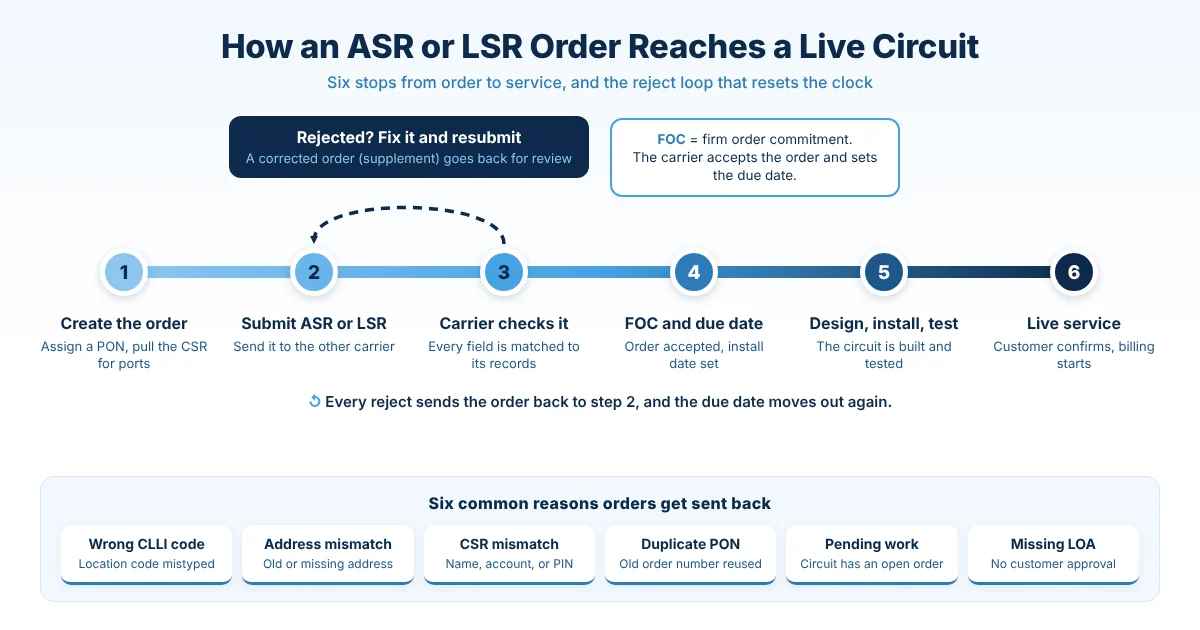 How an ASR or LSR moves from order to live service, and where rejects send it back.
The rules also change over time. In March 2026, ATIS said it had tentatively moved the next ASOG release, Version 71, to September 2026. Carriers would then adopt it in March 2027. Each new version can change fields, so order teams must keep their checklists current.
How Providers Reduce ASR and LSR Rejects
The best order desks catch errors first. They focus on five habits.
- Check every order before it goes out. Use a checklist built on the current ASOG or LSOG version. Confirm location codes, addresses, and PON rules first.
- Pull the CSR before every LSR. Then copy the name, address, and account details exactly as the current carrier shows them.
- Keep location data clean. Store checked CLLI codes and building addresses in one shared place, so every order uses the same data.
- Track FOCs and jeopardy notices every day. A missed FOC or a jeopardy notice is an early warning, so act on it the same day.
- Give each order one owner. One person should own the order from start to finish and update the customer before they ask.
To measure progress, track the first-pass acceptance rate, reject rate, time to FOC, and days lost to clarifications.
Keep Enterprise Orders Moving
ASR and LSR rejects are small errors with big costs. One wrong code can delay a site opening by weeks. Sequential Tech’s order management teams handle ASR and LSR management, circuit provisioning, and MACD work for US carriers, ISPs, and enterprise connectivity providers. Our agents check orders before they go out, track FOCs, fix clarifications fast, and keep business customers updated. Talk to our telecom order management experts to cut your reject rate and get circuits live on time.
Frequently Asked Questions
What is the difference between ASR and LSR?
An ASR (access service request) orders access and transport circuits, such as dedicated internet, Ethernet, and private lines. An LSR (local service request) orders local phone service, such as local loops, resale lines, and number ports. ASRs follow the ASOG guidelines, while LSRs follow the LSOG guidelines from ATIS.
What is an FOC in telecom?
An FOC, or firm order commitment, is the notice a carrier sends after it accepts an ASR or LSR. It confirms the order and commits to a due date. If the order has errors, the carrier sends a reject or clarification request instead.
Why was my LSR rejected?
Carriers reject most LSRs because the details don’t match the current carrier’s customer service record. Common causes include a different account name, an old address, a wrong account number, or a wrong PIN. Missing customer approval and open orders on the same lines also cause rejects.
What is ASOG?
ASOG stands for Access Service Ordering Guidelines. It is the industry standard that sets the fields and rules for ASRs. ATIS’s Ordering and Billing Forum maintains it. In March 2026, ATIS tentatively set the next release, Version 71, for September 2026.
How do you reduce ASR rejects?
You reduce ASR rejects by checking every order against the current ASOG rules before you submit it. Keep checked location codes and addresses in one shared place. Track FOCs and jeopardy notices daily, and give each order one owner who fixes clarifications fast and keeps the customer informed.