

Here is the uncomfortable truth about fraud detection AI: a model can hit 99% accuracy and still be useless. When fraud makes up less than 1% of traffic, a model that flags nothing at all scores 99%. Meanwhile, the model that does fire keeps stopping legitimate customers at the worst possible moment. The CFCA put global telecom fraud losses at $41.82 billion in 2025, up nearly $3 billion in two years, and generative AI is making voice and text scams harder to spot. So why do so many detection models underperform? Usually because nobody taught them what fraud looks like. That teaching is data annotation for telecom fraud detection.
Why Fraud Models Fail Without Labeled Data
Fraud detection is a pattern recognition problem, and patterns have to be shown, not assumed. A model learns what fraud looks like only from examples a human confirmed as fraud. Without those confirmed examples, the model guesses from statistical oddities, and plenty of odd behavior is perfectly innocent. Telecom makes this harder than most industries. A subscriber who suddenly calls six countries in one night might be running IRSF or might have family overseas. A burst of SIM change requests might be an attack or a corporate device refresh. Only labeled history tells the difference. Class imbalance turns the screw further. Published fraud research routinely works with datasets where fraud sits below 1% of records, and one 2025 benchmark saw a random forest model catch just 36% of actual fraud cases. Rare events need precisely labeled examples, because the model has so few chances to learn.What Annotated Data Teaches a Telecom Fraud Mode
Different fraud types need different labeled inputs. This table maps the main ones.| Fraud Type | Data the Model Reads | What Annotation Adds |
|---|---|---|
| SIM swap and account takeover | Support call audio, chat logs, account change records | Tags social engineering language and pretext patterns agents actually hear |
| Subscription fraud | Application records, device and identity signals | Labels confirmed fraud applications versus messy but legitimate ones |
| IRSF and traffic pumping | Call detail records, destination and duration data | Marks confirmed fraud routes and separates them from normal high-cost calls |
| Smishing and SMS phishing | Message text, sender IDs, embedded links | Classifies scam intent across languages and slang, not just keywords |
| Robocalls and voice cloning | Voice audio, call metadata, spectral features | Flags synthetic speech markers and repeat caller behavior |
| Wangiri callback fraud | Missed call patterns, premium number logs | Identifies bait-call signatures against genuine missed calls |
3 Ways Annotation Improves Fraud Detection Accuracy
Here is how careful labeling changes model behavior in practice.1. Precise Labels Cut False Positives
A model trained on vaguely labeled data learns vague rules. When annotators mark not only confirmed fraud but also the legitimate cases that look suspicious, the model learns the boundary between them. Adding richer context to fraud decisions reduced false positives by 42% in 2025 industry benchmarking. That means fewer blocked subscribers for the same fraud caught.2. Edge Case Labeling Handles Rare Fraud
Rare attack types are exactly where models fail. Therefore, annotators deliberately label edge cases: the unusual routing, the odd port request, the one-off pattern. Trained annotators flag these for review instead of skipping them, so the model sees rare fraud often enough to learn it. As a result, the rare attacks that slip past thin training data start getting caught.3. Continuous Relabeling Keeps Pace With Attackers
Fraud detection is not a one-time training job. As tactics change, fresh examples have to be labeled and fed back into the model. Regular relabeling cycles keep accuracy from decaying, while a static training set slowly goes blind to new attacks. Consequently, the model that gets relabeled monthly stays sharp long after a fixed one has drifted.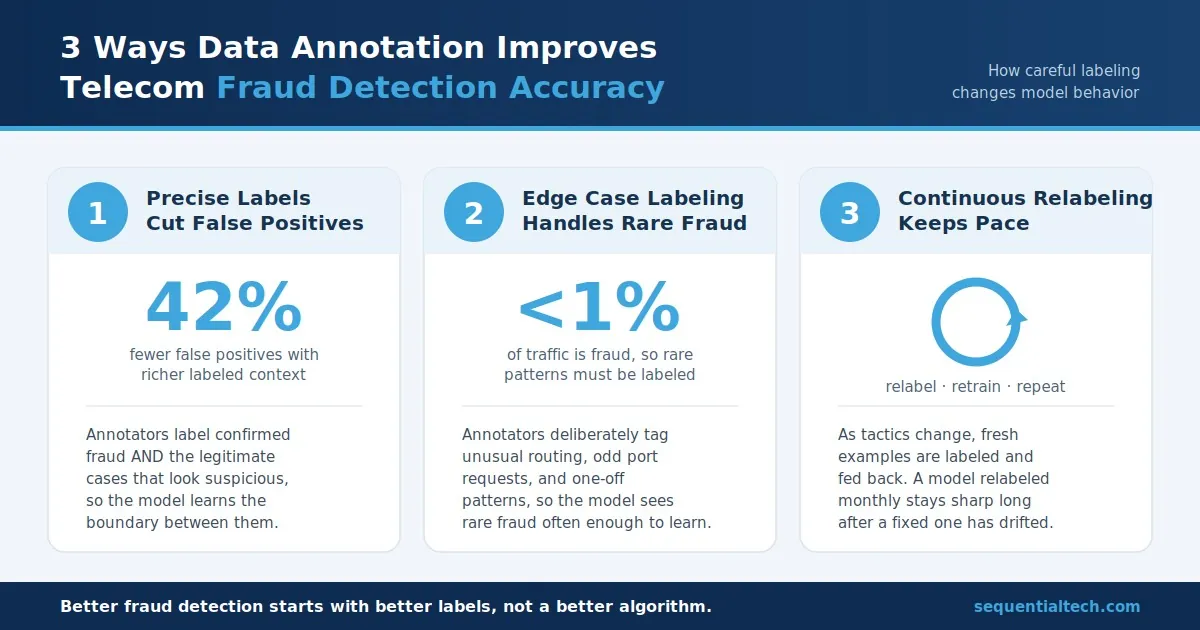
The Real Pain: False Positives Cost More Than Missed Fraud
Most operators focus on the fraud they miss. However, the bigger operational cost usually sits on the other side of the ledger:- Every false positive punishes a paying customer. This is the biggest pain point. Financial-sector analysis finds 10 to 20 false positives generated for every fraud case caught, and in telecom, each one is a blocked activation, a declined payment, or a frozen account belonging to someone who did nothing wrong.
- Fraud teams drown in review queues. Analysts spend their days clearing alerts that were never fraud, so real cases wait.
- Trust erodes quietly. Industry survey data shows 76% of carriers believe fraudulent calls and texts have already reduced subscriber confidence in their brand.
- Fraud tactics shift faster than models. AI-generated voice cloning and smishing evolve monthly, so last year’s labels stop matching this year’s attacks.
- Raw data alone teaches nothing. Operators hold billions of call records with no confirmed fraud labels attached to any of them.
Where Annotation Quality Actually Comes From
Fraud labeling is not generic work, so accuracy depends on three things. First, annotators who understand telecom fraud patterns rather than clicking through unfamiliar records, the case for dedicated annotation teams over crowdsourcing. Second, clear guidelines defining exactly what counts as each fraud type, because inconsistent labels teach the model contradictions. Third, layered review with agreement tracking, so errors get caught before they ever reach training. Security matters just as much. Fraud datasets contain call records, billing details, and personal identifiers, so annotation has to run inside controlled, compliant workflows rather than on an open crowd platform. That choice between building labeling in-house and outsourcing it to a specialist team shapes both cost and accuracy.The Bottom Line
Better fraud detection rarely starts with a better algorithm. It starts with better labels. Precise annotation cuts false positives, teaches rare attack patterns, and keeps the model accurate as fraudsters change tactics. So before rebuilding your model, look at what you trained it on. If nobody confirmed which records were fraud, the model never had a chance to learn. And if you’re weighing outside help, our guide to choosing a data annotation partner for telecom AI covers what to check.TRAIN FRAUD MODELS ON DATA THAT ACTUALLY TEACHES THEM
Sequential Tech delivers telecom data annotation services built for fraud and risk AI. Our trained annotators label call audio and transcripts, SMS and smishing text, call detail records, social engineering patterns in support conversations, and robocall and fraud-call signatures, with support across 28+ languages. Every project runs on dedicated teams instead of crowdsourcing, with layered QA delivering 99%+ accuracy and secure workflows built for regulated telecom data. As part of the Fusion CX Group, we also run live fraud and risk operations, so our labels come from people who handle these cases every day. Talk to Our Data Annotation Team →For the technical backdrop, see how AI training data powers SIM swap fraud detection.