
Learn how order management in telecom billing shapes a subscriber’s first bill, the 7 order errors behind billing mistakes, and how providers catch them early.
Maria signed up for fiber internet at $55 a month. The install went smoothly, and the Wi-Fi was fast. Then her first bill arrived, and it said $95. The promo credit was missing. The bill also charged the partial month twice and added a $15 fee for a router she had already returned. She called support that afternoon. By the evening, she was comparing other providers.
Nothing was wrong with her service. Everything was wrong with her order. That is the hidden link between order management and telecom billing. Every field in an order becomes a line on a bill. So when an order is wrong, the first bill is where the mistake shows up.
Order management in telecom billing is the process that turns a customer’s order into correct billing data. It sets the plan, price, discounts, billing start date, and taxes for each account. When an order detail is wrong, that error flows straight into the customer’s first bill.
What Is Order Management in Telecom Billing?
Order management is how a telecom provider captures, checks, and completes a customer order. In most companies, it runs inside the BSS (business support systems), right next to billing. Order management decides what the customer bought. The billing system then decides what the customer pays, and billing support explains the charges.
To do that, the order hands these details to the billing account:
- Plan and product codes, which set the monthly rate
- Promotions and discounts, with their start and end dates
- The billing start date, which should match the day service goes live
- The service address, which sets local taxes and fees
- Equipment, such as routers, modems, or phones
If any of these details are wrong, billing still runs. It just runs on bad data. That is why so many billing complaints are really order problems in disguise. For the support side, see our telecom billing support best practices.
How an Order Becomes a Bill
Most providers follow a path called order to activation, then order to cash. First, a sales agent or the website captures the plan, offers, address, and equipment. Next, systems validate the address, credit, and product rules. After that, the network team activates the service, and a technician may install it. Billing should start on the day the service goes live. Finally, the billing system rates the charges and creates the first invoice.
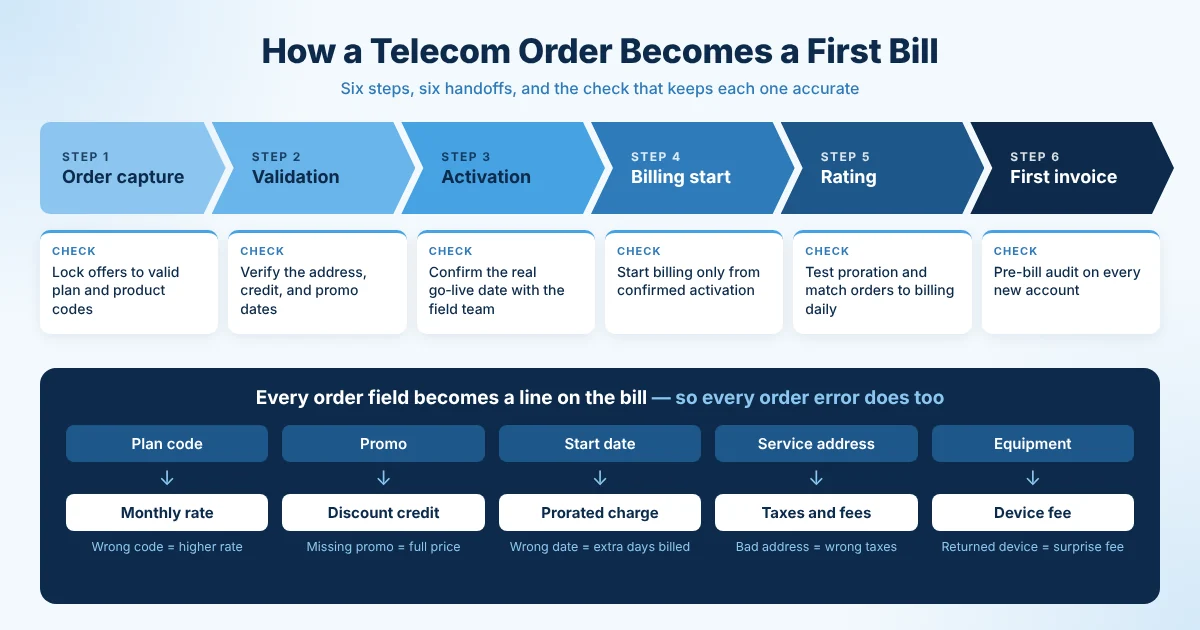 How a telecom order becomes a first bill and the checks that keep each step accurate.
The weak spot is the handoff between steps. Each step often runs in a different system, owned by a different team. For example, a technician may change the install date in the field system, but billing never hears about it. Then the customer pays for days without service.
7 Places Where First Bills Go Wrong
The table below shows the seven order errors behind most first-bill problems, and the fix for each.
| Order error | What the customer sees | Root cause | Fix |
|---|---|---|---|
| 1. Wrong plan or product code | A higher monthly rate than quoted | Sales picked a similar code, or the catalog changed | Allow only valid, current codes at order capture |
| 2. Promo or discount not attached | Full price, with no promised credit | Someone added the offer late or set the wrong end date | Check every promo against the order before activation |
| 3. Billing starts at the wrong time | Charges for days without service | Billing used the order date, not the activation date | Start billing only from a confirmed activation |
| 4. Proration mistakes | Partial-month charges that don’t add up | The system counted a mid-cycle start or plan change twice | Test proration rules and review partial-month bills |
| 5. Wrong service address | Wrong taxes, fees, or surcharges | A typo, or nobody verified the address | Validate the address against a standard database |
| 6. Equipment charges | A fee for a device the customer returned or never got | Nobody logged the return or shipment in billing | Link device tracking to the billing account |
| 7. MACD order not processed | Double billing, or a ported-out line that keeps billing | A move, add, change, or disconnect is stuck between systems | Match MACD orders against billing every day |
Two Errors That Need Extra Care
The first is the billing start date. If billing starts too early, the customer pays for service they don’t have. If it starts too late, the provider gives away service for free. That second problem is a revenue issue, covered in our post on revenue leaks in telecom order management.
The second is MACD orders, which cover moves, adds, changes, and disconnects. These orders change an account that already bills. As a result, a stuck disconnect can keep charging a customer who left weeks ago. A ported-out phone line that keeps billing is one of the fastest ways to earn a formal complaint.
What First-Bill Errors Cost Providers
Billing problems get loud quickly. A 2026 analysis by CompareInternet.com reviewed 1,020 public posts from US customers of major internet providers. As Cord Cutters News reported, 12% of those posts mentioned billing problems. Nearly half of the billing complaints, 47%, were about charges customers said they had already paid or did not owe. They included surprise fees, equipment charges, and billing after cancellation.
For providers, the costs stack up fast:
- More calls: One wrong bill often leads to several contacts before anyone fixes it.
- Credits and disputes: Each fix costs money, and unclear charges turn into slow formal disputes.
- Early churn: New customers have the least loyalty, so a bad first bill can end the relationship early.
Above all, the first bill is a trust test. Our post on transparent billing in broadband shows how clear bills build that trust.
How Providers Catch Errors Before the First Bill
Providers can catch most of these errors before the bill goes out. Strong teams check five points.
Validate the order at the start. Lock offers to valid product codes, verify the service address, and confirm promo dates while the customer is still on the call.
Match order records to billing records. Compare activated orders with billing accounts every day. Then send any mismatch to a team for review.
Run a pre-bill audit on new accounts. Review first invoices before they go out. Focus on partial months, promos, equipment, and recent MACD orders, since most errors hide there.
Explain the first bill before it arrives. Send a short message that explains prorated charges and one-time fees. A bill that matches expectations rarely turns into a call.
Prepare billing support for disputes. Give agents the full order history, so they can compare what the customer bought with what billing charged. Also, send every confirmed error back to the order team, so it doesn’t repeat.
To see if these checks work, track four metrics:
- First-bill accuracy rate
- Billing call rate in the first 60 days
- Credits issued per new account
- Days from activation to billing start
Get Every First Bill Right
A first bill should confirm what the provider promised, not surprise the customer. That takes clean orders, tight order-to-billing checks, and people who fix problems on the first call. Sequential Tech supports US carriers, MVNOs, ISPs, and fiber providers with order management, provisioning, and billing support teams. Our agents validate orders, reconcile accounts, and resolve billing disputes before they turn into churn. Talk to our billing and order management experts to find out where your first bills are going wrong.
Frequently Asked Questions
What is order management in telecom billing?
Order management in telecom billing turns a customer’s order into accurate billing data. It sets the plan, price, discounts, billing start date, taxes, and equipment charges for each account. When an order detail is wrong, the error carries into the bill, starting with the first one.
Why are first telecom bills often wrong?
First telecom bills are often wrong because they include one-time charges, partial-month proration, and new promos. Each of these depends on accurate order data. If a promo is missing, the activation date is wrong, or nobody logs a returned device, the first bill shows the mistake.
What is order to cash in telecom?
Order to cash in telecom is the full process from a customer’s order to the provider’s payment. It covers order capture, validation, activation, billing start, invoicing, and payment. Errors early in the process usually show up later as billing disputes or delayed revenue.
What is a pre-bill audit?
A pre-bill audit is a review of invoices before they go out to customers. Providers often run it on new and recently changed accounts. The audit checks prorated charges, promos, taxes, and equipment fees, so the team can fix errors before the customer sees them.
How can telecom providers reduce billing errors?
Telecom providers can reduce billing errors by validating orders at capture and matching order records to billing records every day. Pre-bill audits on new accounts catch most of the rest. Trained billing support then fixes what remains and sends root causes back to the order team.