
Older adults are a fast-growing telecom customer group. See what they call about, what frustrates them, and seven ways care teams can serve them better.
Margaret is 74. Her landline has worked for decades, and now a letter says it is going away. She calls her provider and hears a menu with nine options. None of them fits. After 20 minutes, she reaches an agent who talks fast and uses words like “VoIP” and “port.” She hangs up more confused than before.
Stories like Margaret’s play out every day. Older adults are a large and growing group of telecom customers in the US, and their needs are shifting fast. Copper lines are shutting down, scam losses are climbing, and phone menus keep getting longer. This guide explains what good telecom customer care for older adults looks like, and how care teams can deliver it.
Telecom customer care for older adults is support built around how older customers reach out, learn, and decide. In practice, it means an easy path to a live agent, plain language, and unhurried calls. It also means scam-aware security and accessible options for hearing or vision loss.
Why Older Customers Need a Different Kind of Care
The numbers alone make the case. In 2024, 61.2 million Americans were 65 or older, up 13% since 2020, according to the US Census Bureau. Older adults now outnumber children in 11 states.
Most older adults are connected, but not in the same way as younger groups. A 2025 Pew Research Center survey found that 70% of adults 65 and older have home broadband, and 78% own a smartphone. The smartphone rate is the lowest of any age group. In addition, 17% rely on a smartphone with no home broadband at all.
AARP’s 2025 survey found that 90% of adults 50 and older own a smartphone, up from 55% in 2016. Still, three in five say technology isn’t designed with their age in mind.
That gap lands on your telecom customer care and technical support teams. When a device, bill, or menu doesn’t make sense, the phone rings. This matters most for MVNO brands aimed at customers 55 and older. It also matters for broadband and fixed-line providers with long-time landline users. For them, good elderly customer service is a core skill.
What Older Customers Call About Most
Older customers call about the same things as everyone else. However, a few topics come up often, and each needs a slightly different approach. The table below shows six common call reasons.
| Call reason | What often goes wrong | What good care looks like |
|---|---|---|
| New phone or device setup | Rushed steps and app-only instructions | Step-by-step help at the customer’s pace |
| Billing questions | Jargon, unclear fees, and partial-month charges | A line-by-line walk-through in plain words |
| Landline or DSL shutdown | Confusing letters and fear of losing 911 | Clear dates and help setting up the new service |
| Scam calls and texts | The customer is unsure who to trust | Calm guidance and account checks |
| Hearing or vision needs | Fast talk, small print, and menus with no way out | Clear speech, relay options, and large-print bills |
| Plan changes | Pushy upsells and too many choices | Two or three options that fit their needs |
Landline shutdowns deserve special attention right now. In January 2026, the FCC approved AT&T’s request to retire copper service in areas serving about 90,000 customers across 18 states. Shutdowns can begin as early as November 15, 2026. Expect many of these calls from older, long-time landline customers. Our guide to copper retirement strategy covers the network side of that shift.
7 Ways to Improve Care for Older Adults
These seven changes help older callers, and everyone else too.
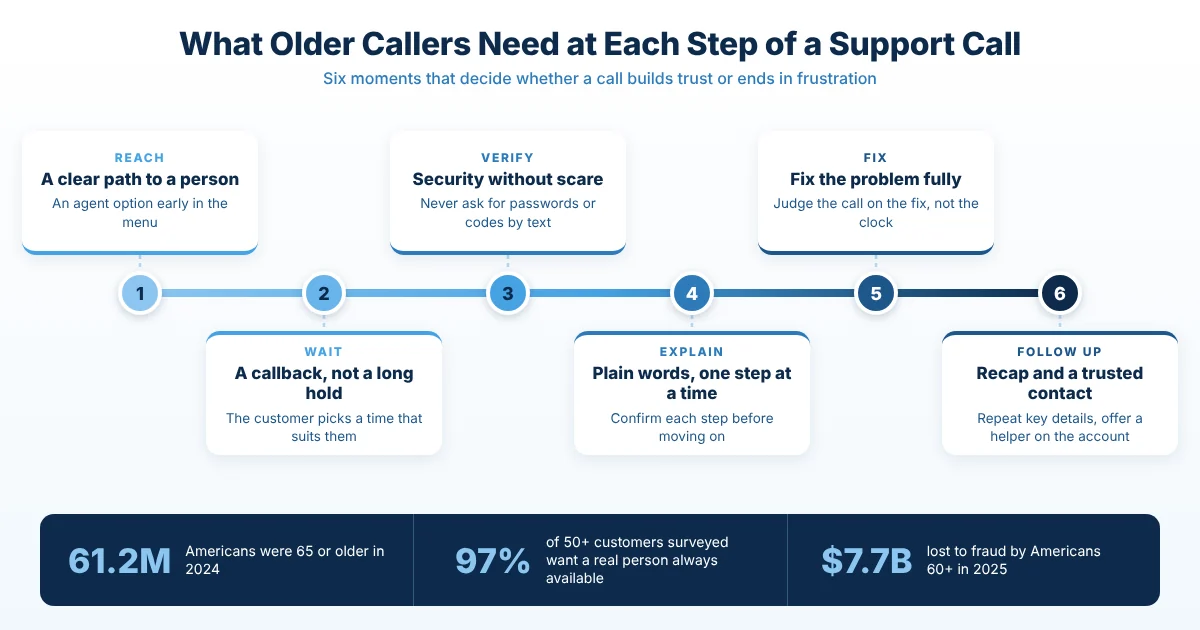 Older adults deserve clear, accessible, and personalized telecom support.
1. Make It Easy to Reach a Human
Older callers often want a person, not a menu. Put a “speak to an agent” option early in the phone menu, and never hide it. If a chatbot can’t solve the issue, pass the customer and the full history to an agent.
2. Offer Callbacks Instead of Long Holds
Long holds are hard for anyone, and harder still for someone with hearing or hand problems. A scheduled callback lets the customer pick a good time. As a result, they come to the call calm and ready.
3. Use Plain Language
Swap jargon for everyday words. For example, say “your number moves to the new line,” not “we’ll port your number.” Confirm each step, and repeat the key details at the end.
4. Judge Agents on Fixes, Not Call Length
Strict average handle time (AHT) targets push agents to rush. For older callers, a slightly longer call that fixes the problem beats a quick call that leads to three more. So track first contact resolution (FCR) alongside handle time, and give agents room to slow down.
5. Build Scam-Aware Security
Scammers target older adults hard. In 2025, Americans 60 and older lost more than $7.7 billion to fraud, according to the FBI. Phishing and spoofing were the most reported types, with over 48,000 complaints from older adults.
Agents should know the warning signs of account takeover. They should also remind customers that the provider will never ask for a password or code by text. See our SIM swap fraud prevention guide for more.
6. Offer Accessible Options
Hearing and vision loss become more common with age. Offer relay service options for callers with hearing loss, large-print and audio bills, and agents trained to speak clearly. Agents should also know which phones work with hearing aids. Under an FCC order adopted in 2024, all new mobile phones must eventually be hearing aid compatible, including over Bluetooth.
7. Set Up a Trusted Contact
Many older customers get help from an adult child or caregiver. Offer a simple way to add a trusted contact to the account, with clear limits on what that person can change. This protects the customer and saves time on future calls.
Where AI Helps, and Where It Doesn’t
AI can shorten waits and answer simple questions. However, older customers want a clear way out. In a 2026 study of 482 adults 50 and older, 87% of current customers said they would consider leaving if they couldn’t reach a human. Moreover, 97% said companies should always offer a real person.
Consumer Cellular, a carrier focused on older customers, paid for that study, so treat it as a signal. The lesson still holds: use AI to route calls and help agents, but keep a human one step away.
How to Measure Progress
You can’t improve what you don’t track. Where customers share their age, or where an account notes accessibility needs, review these numbers for that group:
- Repeat calls within seven days
- Transfers per call
- Complaints, including FCC complaints
- Scam and fraud reports
- Callbacks completed on time
Compare them with your overall averages. A gap shows where to train agents or fix a process.
Care That Works for Every Generation
Older adults expect patience, clear answers, and a real person when it counts. Meeting that need takes trained agents, simple processes, and the right metrics. Sequential Tech’s telecom customer care teams support US carriers, MVNOs, and broadband providers. Our US-based and bilingual agents follow fraud-aware workflows and quality programs that reward fixes over speed. Talk to our telecom customer care experts to build support your older customers will trust.
Frequently Asked Questions
How can telecom providers improve customer service for seniors?
Telecom providers can improve customer service for seniors by offering an easy path to a live agent, scheduled callbacks, and plain language. Agents should confirm each step before moving on. Scam-aware security, accessible options such as relay services and large-print bills, and a trusted contact on the account also help.
Why do older adults prefer talking to a live agent?
Many older adults prefer a live agent because a person can listen, adjust, and explain. Phone menus and chatbots often fail on complex issues. In a 2026 study of adults 50 and older, 97% of current customers said companies should always offer a real person.
What should older customers do when their landline is retired?
When a landline is retired, older customers should read the provider’s notice, note the shutdown date, and ask about replacement options. These usually include home phone service over broadband or a mobile line. They should also confirm that 911 will still work on the new service.
How can older adults avoid phone and text scams?
Older adults can avoid phone and text scams by never sharing passwords or codes and by hanging up on unexpected calls. They should call the provider back on the number printed on their bill. In 2025, Americans 60 and older lost more than $7.7 billion to fraud, according to the FBI.
What are hearing aid compatible phones?
Hearing aid compatible phones are designed to work with hearing aids with less buzzing and interference. Under an FCC order adopted in 2024, all new mobile phones sold in the US must eventually meet hearing aid compatibility rules. The rules also cover Bluetooth connections to hearing aids.