eSIM should be instant. Yet it quietly floods your queues with tickets. Here is where the friction starts and how eSIM customer support outsourcing fixes it in 2026.
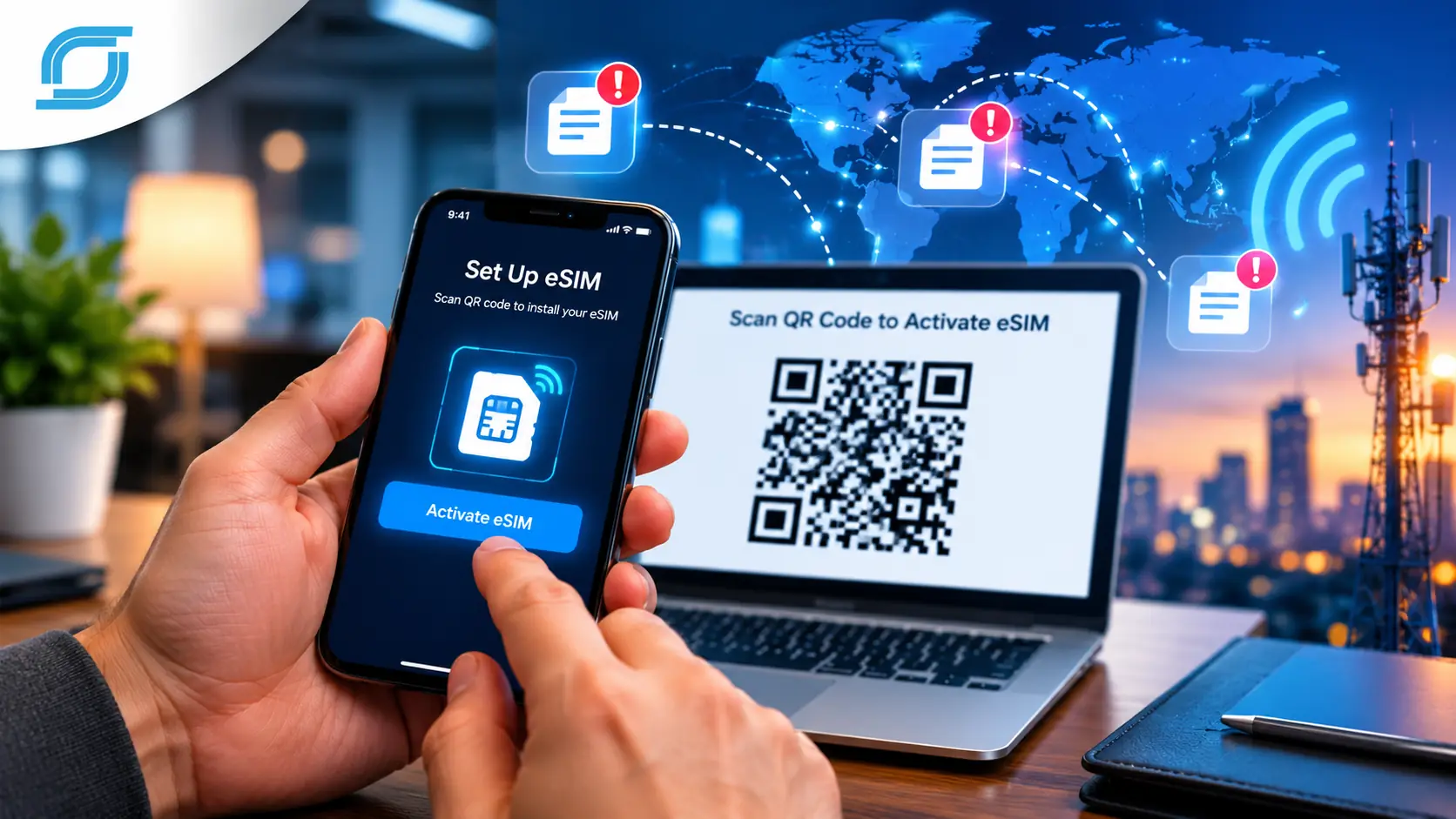
An eSIM promised a simple dream. No plastic, no store visit, just scan and go. But the reality is messier. A customer scans a QR code, and nothing happens. Another loses service after a phone upgrade. A third sees two SIMs and picks the wrong one. Each small stumble becomes a support ticket. And these tickets add up fast. This is the hidden cost of eSIM growth. The good news is simple. Smart eSIM customer support outsourcing can turn this friction into a smooth first experience. Let us look at where the tickets really come from.
The Real Problem: eSIM Friction Is a Silent Ticket Machine
eSIM adoption is booming, and so is the ticket load. The activation looks simple on the surface. But many small failures happen behind the scenes. Here is where eSIM tickets pile up:
- QR code fails. The code will not scan, or it expires before use.
- Profile download stalls. The eSIM profile hangs or errors out.
- Device confusion. The phone does not support the eSIM, or the settings hide.
- Transfer breaks. A device upgrade drops the eSIM, and service stops.
- Dual-SIM mix-ups. The customer sets the wrong line for data or calls.
- Port-in trouble. The number transfer stalls mid-activation.
Each issue feels minor to the customer. But each one still becomes a call or a chat. Worse, these tickets often hit at the worst moment, right at the first use. A new customer cannot even get online yet. That first bad impression drives early churn. And it turns a low-cost digital sale into a costly support case.
Why eSIM Tickets Are Not Physical SIM Tickets
An eSIM is not just a SIM without the plastic. The support journey is different. With a physical SIM, the fix is often a swap or a reseat. With an eSIM, the problem is digital. It lives in the EID, the profile, and the network handshake. So agents need new skills and new tools. They must read an EID, check an IMEI, and trace a profile download. They must know device quirks across many phone models. In short, this is a digital provisioning problem, not a card problem. That is why generic activation scripts fall short here.
Where eSIM Support Tickets Really Come From
So where does the friction start? Six points drive most eSIM tickets.
I. EID and IMEI validation: The wrong EID or IMEI blocks activation. Agents must verify both before anything else works.
II. QR code and profile delivery: A broken or expired QR code stops the download. Agents must resend or push the profile another way.
III. Profile download failure: The profile may stall or fail on the network side. This needs a trace, not a script.
IV. Device compatibility: Not every phone supports every eSIM. Agents must confirm the model and its settings.
V. Transfer and dual-SIM confusion: A device upgrade or a second line trips people up. Agents guide the transfer and set the right default line.
VI. Port-in and authentication: The number port must line up with the eSIM. Agents handle sequencing, identity checks, and fraud flags.
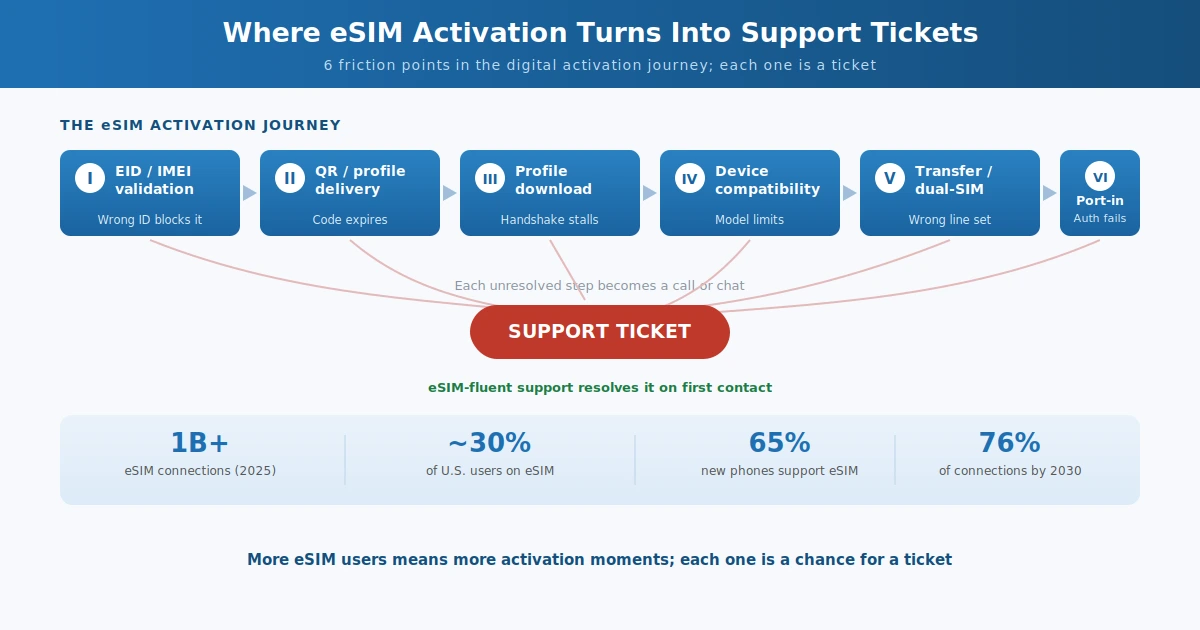 Six eSIM activation friction points that can increase telecom support tickets.
eSIM Friction Points and the Support Fix
Where should you focus first? The table below maps each friction point to its cause and fix.
| eSIM Friction Point | Why It Happens | The Support Fix |
|---|---|---|
| QR code will not scan | Expired or damaged code | Resend or push profile remotely |
| Profile download stalls | Network or RSP handshake gap | Trace and re-provision the profile |
| EID or IMEI rejected | Wrong or mistyped identifier | Verify EID and IMEI at first contact |
| Device not supported | Model or setting limits | Confirm compatibility, guide settings |
| Service lost after upgrade | Transfer not completed | Walk through device-to-device transfer |
| Wrong line for data or calls | Dual-SIM misconfiguration | Set primary and secondary lines |
| Port-in stuck | Sequencing or auth failure | Fix sequence, verify identity, escalate |
What the 2026 Data Shows
The eSIM wave is real, and it is accelerating. Here is where things stand:
- Adoption is surging. eSIM smartphone connections passed 1 billion in 2025, up from 598 million in 2024.
- The U.S. leads. About 30% of U.S. consumers now use an eSIM, the highest rate worldwide.
- Devices are ready. Around 65% of new smartphones launched in 2024 support eSIM.
- Growth keeps climbing. By 2030, eSIM could power about 76% of smartphone connections.
- Transfer is a top pain. Moving a profile between devices is a leading barrier and a major ticket source.
More eSIM users means more activation moments. And each moment is a chance for a ticket. So the volume only grows from here.
How to Reduce eSIM Support Tickets
You cannot stop eSIM growth. But you can cut the tickets it creates. The goal is a smooth first activation. A simple plan works best:
- Train for digital, not plastic. Teach agents EID, IMEI, and profile tracing.
- Fix delivery first. Make QR and profile push fast and reliable.
- Build a device playbook. Keep model-by-model steps ready for agents.
- Master the transfer flow. Guide device-to-device moves step by step.
- Set clean handoffs. Escalate deep faults to carrier or platform teams fast.
Do this, and first-contact resolution climbs. Repeat calls fall. And a smoother eSIM start builds loyalty from day one, the same way strong customer onboarding protects lifetime value.
What This Means for Telecom Operators
For an MNO or MVNO, the message is clear. eSIM is not just a tech upgrade. It is a new support workload. And it needs specialist skills to keep costs down. The right partner cuts ticket volume and lifts CX at once. They resolve more on the first contact. They escalate the rest cleanly, with full context.
The key is a partner who knows eSIM, not just SIM. You need agents fluent in profiles, EIDs, and device quirks. You need clean handoffs to carrier and platform teams. You also need fraud checks built into the port-in flow. And you need it tuned for MVNO eSIM onboarding, where small teams feel the load most. That fit turns eSIM friction into a fast, quiet activation.
Turn eSIM Friction Into a Frictionless Start
The eSIM future is here, and it is growing fast. But growth without support is just more tickets. Operators who master eSIM support win twice. They cut cost, and they keep customers happy from the first scan. So the question is not whether eSIM matters. It is whether your support is ready for it.
Ready to Reduce eSIM Support Tickets Before They Overwhelm Your Team?
eSIM activation issues can quickly add pressure to telecom support teams, especially when customers struggle with QR codes, profile downloads, device transfers, dual-SIM settings, or port-ins. Sequential Tech provides telecom customer care, technical support, and activation services with teams experienced in eSIM support and carrier handoffs. Talk to our expert about building an eSIM support model around your activation journey. Give customers faster help while reducing the operational pressure created by activation-related tickets.