
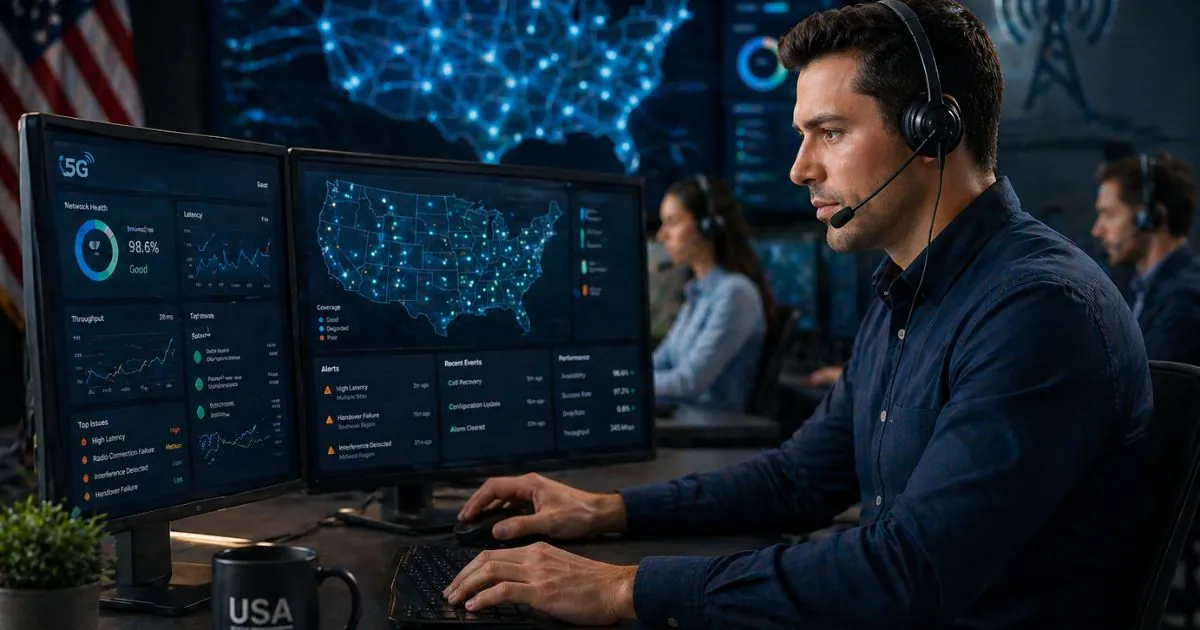
Subscribers calling about 5G battery drain, VoNR call drops, and slice mismatches do not get help from legacy 4G scripts. 5G standalone QoE troubleshooting needs a new generation of trained contact center agents and Sequential Tech builds them.
5G standalone QoE troubleshooting is the process of diagnosing subscriber-experience issues unique to 5G SA networks. It covers battery drain from signal hunting, VoNR call drops, and network slice mismatches. Trained Tier 1 agents resolve most of these issues remotely. By contrast, legacy 4G scripts cannot.
Subscribers calling about 5G battery drain do not get help from a 4G script. They hang up frustrated. Then they call again. Eventually, they churn.
Standalone 5G networks deliver new speed. However, they also deliver new failure modes. Battery drain, dropped voice calls, and slice mismatches now top the support queue. Legacy scripts still tell users to restart the phone. The restart fixes nothing.
5G standalone QoE troubleshooting closes this gap. Trained Tier 1 agents diagnose the real cause in under two minutes. As a result, first-call resolution rates climb. Meanwhile, escalations to Tier 2 fall sharply.
The numbers explain why this matters. According to Ookla 2026 data, T-Mobile delivers a median 309.41 Mbps on 5G. But speed brings new questions. Therefore, agents need new diagnostic skills.
Quality-of-experience work connects to the wider support roadmap — the road to 6G support readiness, how AI improves first-contact resolution, and the quiet advantage of specialized tech support.
Why 5G SA breaks legacy support scripts
The most common 5G complaint is battery drain. Ookla research shows 5G consumes 6 to 11 percent more power than 4G LTE. In patchy coverage, the drain rises further. The phone hunts for SA signals. Then it switches between SA and NSA modes. Each switch costs power.
Untrained agents miss this pattern. Instead, they recommend a phone restart. The restart does nothing because the cause sits in the network mode setting. By contrast, a trained agent spots the issue in seconds.
5G calls drop for a different reason. VoNR is the native voice service for SA networks. However, handoff between VoNR and VoLTE often fails. The user moves between SA and NSA coverage. Suddenly, the call drops mid-sentence.
Video buffering on 5G has yet another cause. Network slicing assigns QoS based on subscription tier. Sometimes the slice mismatches the entitlement. As a result, video stalls even on a strong 5G signal.
Five common complaints and how trained agents resolve them
The table below shows the most common 5G SA tickets. Each row maps the complaint to its real cause. It also shows the legacy script answer next to the trained agent fix.
| Subscriber complaint | 5G SA root cause | Legacy script response | Trained agent fix |
|---|---|---|---|
| “My battery dies by 2 PM” | SA signal hunting in mixed-coverage areas | “Restart your phone” | Switch device to SA-preferred or 5G Auto mode; verify coverage map. |
| “Calls keep dropping” | VoNR handoff failure between SA and NSA | “We will check the network” | Check VoNR vs. VoLTE fallback setting; document for Tier 2. |
| “5G feels slower than my 4G” | Device on NSA in SA-optimized area | “Speed varies by location” | Confirm SA capability; verify APN; check provisioning. |
| “My phone runs hot” | Thermal throttling from continuous SA radio | “Close background apps” | Recommend network mode optimization; explain SA radio behavior. |
| “Video keeps buffering on 5G” | QoS policy mismatch on network slice | “Check your data plan” | Verify slice assignment and QoS entitlement; escalate to Tier 2. |
How Sequential Tech trains agents for 5G SA support
Sequential Tech builds agent skills in three layers. First comes conceptual literacy. Agents learn how SA differs from NSA. They learn why signal hunting happens. Then they learn what slicing means for the subscriber.
Second comes diagnostic skill. Agents learn to read device settings. They interpret network mode indicators. They use carrier diagnostic tools to spot real causes.
Third comes communication skills. Agents explain technical concepts in plain words. They never sound dismissive. As a result, subscribers stay calm even during complex calls.
Tiered support design for 5G SA complexity
Sequential Tech splits 5G SA support across three tiers. Tier 1 handles device-side fixes. They adjust network mode settings. They check APN and VoNR preferences. Most calls end here without escalation.
Tier 2 specialists run network-side investigations. For example, they check slice assignments. They review QoS policy. They coordinate with carrier engineering when the device is not the cause.
Finally, Tier 3 manages chronic incidents. These need network engineering action. Each escalation arrives with full call notes. The subscriber never repeats the story.
Staff your 5G support team with agents who know 5G
Sequential Tech’s 5G SA-trained contact center agents deliver first-contact resolution for the issues legacy scripts cannot handle.