How ISPs Can Build Trust Through Transparent Billing and Usage Visibility
Trust defines success in the broadband market, and transparency now sits at the heart of customer experience for broadband providers. Subscribers want clarity on every billing event, usage detail, and connection behaviour. They compare each ISP experience with the frictionless journeys of digital-native brands, fintech apps, and OTT platforms. As expectations rise, broadband operators must raise transparency to build trust, cut disputes, and deliver more consistent service.
This topic spans operational, technical, and experience-driven insights. The sections below walk through each layer of the transformation.
The first section covers why transparency now defines competitive strength in broadband and fixed-line markets, and how it shapes trust more than traditional service metrics.
Transparent billing is part of a joined-up experience — clear converged billing for triple-play, ending repetition with context sync, and cross-channel context that cuts repetition.
Why Transparency Has Become a Strategic Priority for Broadband and Fixed-Line Providers
The broadband industry faces rising expectations. Customers now depend on digital experiences every day. They manage payments, work remotely, stream entertainment, and run IoT devices on home internet. Because they rely on it so heavily, they expect clarity on usage, speed, and billing. Providers therefore need stronger experience frameworks. Visible, proactive communication builds trust and strengthens the customer experience for broadband providers.
The Evolving Trust Gap in the Broadband Industry
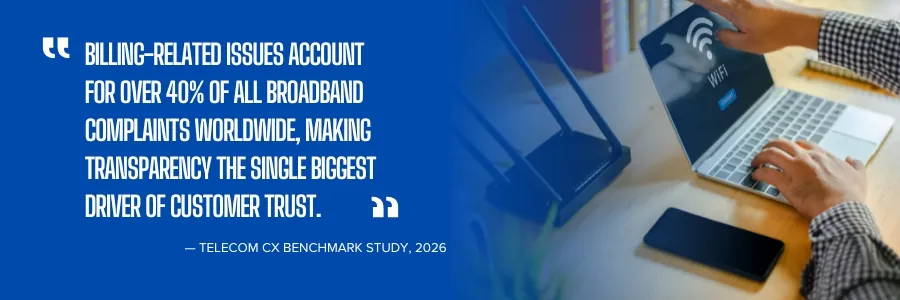
Small billing ambiguities erode confidence fast. Recent global studies show that nearly 42 percent of customer complaints come from unclear billing or unexpected charges. That makes it the single largest driver of dissatisfaction in home internet. Many subscribers see charges with no context. Common culprits are add-ons, tax adjustments, router deposits, pro-rated amounts, and bundled OTT services. Unclear items feel like hidden fees. Customers read that as deliberate opacity.
Because these issues repeat, customers contact support several times in one billing cycle. The Broadband Mapping Project found that 1 in 3 users raises a billing query every quarter. That adds heavy operational load. Each repeat contact lowers CSAT, raises AHT, and strains digital and voice teams. The trust gap widens, because customers blame confusion on deliberate complexity rather than workflow limits.
How Digitization Shifted Modern Expectations
Digital-first customers benchmark their ISP against platforms that deliver instant clarity. Fintech apps, ride-sharing, and OTT services give full visibility into every transaction. That shapes how broadband customers judge transparency today.
A McKinsey study on personalization backs this up. It reports that 71 percent of consumers expect personalized, relevant interactions, and 76 percent feel frustrated when they do not. The study spans many industries, but the insight fits broadband directly. Customers who want personalized clarity also expect transparent billing, usage visibility, and proactive communication. Because they crave control and context, transparency is now a defining part of customer experience for broadband providers. It shapes loyalty and long-term trust.
What Causes Billing and Usage Dissatisfaction Among Broadband and Fixed-Line Customers
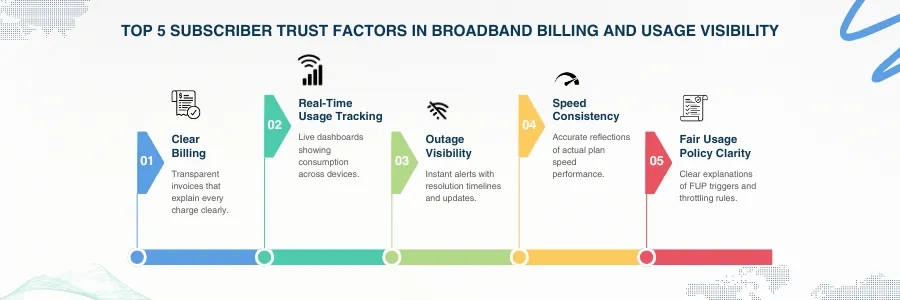
Billing and usage confusion usually comes from fragmented systems and outdated communication. When customers cannot see their usage, speed, and consumption triggers, they contact support more often.
Billing Ambiguity and Unexpected Line Items
Customers dislike unclear charges with no quick explanation. Common culprits are router fees, installation charges, tax components, and OTT bundle renewals. Clear line items cut confusion and prevent escalations across home internet care teams.
Insufficient Real-Time Usage and Speed Visibility
Many ISP dashboards show stale usage numbers. Customers then read speed drops as service failures, not FUP effects. Without a view of consumption across devices, confusion grows.
Unclear Fair Usage Policies (FUP)
A misunderstood FUP triggers frustration. Customers need clear throttling points, consumption thresholds, and restoration rules. Better FUP visibility cuts dissatisfaction and improves fiber broadband support.
Poor Outage Visibility and Communication Delays
Customers expect fast, accurate communication during outages. Many ISPs still send delayed messages. When service drops without warning, anxiety rises and trust falls.
The Influence of Transparent Billing on Trust and Operator Performance
Transparency now shapes sentiment more than price or speed. Billing and usage clarity lifts confidence and cuts frustration right away. When subscribers understand their charges and consumption, they see the provider as fair and reliable. Clarity also lowers inbound support load and improves efficiency across billing support teams. Agents spend less time explaining bills and more time solving technical problems.
How Billing Clarity Reduces Disputes and Operational Overheads
Customers get frustrated whenever they see a charge they cannot read. Clear invoices remove that uncertainty and cut support dependency. When every fee, tax, discount, or pro-rated amount is easy to follow, trust grows.
Greater billing clarity delivers:
30–40% fewer dispute-driven contacts, based on industry benchmarks.
Better resolution prioritization, so agents focus on technical and network issues.
Lower AHT, because agents skip long bill explanations.
More efficient broadband customer service outsourcing, from less repetitive volume.
Structured transparency also drives internal efficiency. Clear bill components help teams respond faster, cut follow-up loops, and improve first-contact accuracy.
Why Usage Visibility Strengthens Customer Experience for Broadband Providers
Real-time usage visibility shows subscribers how they consume data through the day. When dashboards are accurate and timely, customers feel in control, not uncertain. They see the direct link between their behaviour, plan limits, and any throttling or speed changes.
Clear views of consumption, connected devices, peak hours, and Wi-Fi strength help customers self-diagnose. They stop calling for common usage questions. That cuts unnecessary contacts and strengthens CX frameworks for broadband and fixed-line networks. Informed subscribers see fewer surprises and feel less frustration.
How Transparency Influences ARPU Growth
Transparency cuts friction and also opens revenue. When customers understand their own usage, they judge upgrade suggestions more rationally. Because recommendations feel contextual, not sales-driven, acceptance rises.
Operators can offer plan upgrades, booster packs, mesh Wi-Fi, or premium fiber support tiers. Customers accept these more willingly when they see why the offer fits their usage. As trust grows, ARPU rises through informed adoption, not hard selling.
Modern Transparency Tools Transforming Broadband and Fixed-Line Providers
As expectations rise, static billing portals are not enough. Subscribers expect real-time clarity, proactive communication, and simple explanations at every step. To meet that, providers now use modern transparency tools. These unify billing data, network insights, CRM records, and device telemetry. The integrated base lets operators answer faster, cut confusion, and support customers with timely, accurate, easy-to-read information.
Real-Time Usage Dashboards and Predictive Analytics
Live dashboards show speeds, device usage, and FUP thresholds. Customers understand consumption instantly, which cuts repeat queries.
Proactive Billing Alerts and Predictive Notifications
Alerts about usage limits, due dates, and throttling points prevent surprises. They build trust and reduce support contacts.
AI-Assisted Bill Explanation for Dispute Prevention
AI bill tools turn complex charges into plain language. Disputes fall and support teams work more efficiently.
Together, these tools shift operators from reactive support to proactive clarity. That is the base for the next generation of broadband CX.
New CX Models Centered on Transparency for Broadband and Fixed-Line Providers
Modern CX models unify customer, billing, and network data for seamless journeys. These frameworks help operators decide faster, cut friction, and build trust across the subscriber lifecycle.
Proactive Engagement Based on Usage Behaviour
Usage insights reveal consumption spikes, device patterns, speed shifts, and FUP trends. Operators send timely notifications that fix issues before they escalate.
Personalization Through Data-driven Billing Insights
Machine learning finds the right plans and add-ons for each household from real usage. These recommendations feel relevant and transparent, so acceptance rises.
Network, Billing, and CRM Integration for Cohesive Experiences
Integrated systems give customers consistent, accurate information on every channel. Agents work from one dataset, which removes friction and confusion.
These models move operators from reactive support to intelligent, transparency-driven experiences that feel predictable and built around subscriber needs.
How Sequential Tech Helps Broadband and Fixed-Line Providers Strengthen Trust
Sequential Tech brings deep domain expertise and telecom-trained skills to broadband operators. The broadband ecosystem involves varied device behaviours and shifting network conditions. Providers need telecom-grade CX teams that understand these interactions well.
Telecom-Trained CX Specialists Focused on Billing and Usage Clarity
Our specialists know device patterns, router setups, Wi-Fi coverage issues, and billing rules. That expertise reduces friction, so customers get faster, clearer answers.
Proactive CX Models Built for Broadband and Fixed-line Providers
We design workflows for proactive FUP alerts, usage notifications, outage messages, and consumption triggers. These workflows cut inbound calls and lift satisfaction.
Technology-enabled Support Ecosystems
We integrate omnichannel communication, AI-driven billing interpretation, proactive usage alerts, and predictive analytics. These systems support seamless transparency across home internet customer care solutions.
Trust-building Outcomes Broadband and Fixed-Line Providers Can Achieve
Transparency improves sentiment and reshapes the whole service relationship. When customers understand their billing, usage, and service commitments, they trust the provider’s intent and reliability. Clarity cuts confusion, prevents repeat inquiries, and signals respect for the customer’s time. So transparency becomes a direct driver of trust, satisfaction, and loyalty.
The table below shows where transparency delivers measurable value:
Outcome Area
Impact Delivered
Business Benefit
Billing accuracy
Fewer disputes
Higher trust
Usage visibility
Lower complaints
Greater satisfaction
Proactive communication
Faster response
Reduced churn
Transparent FUP
Fewer escalations
Better retention
These outcomes compound over time. They create a more stable, predictable customer experience. Customers feel informed, because information is clear. They feel respected, because the provider communicates proactively. And they feel supported, because issues are anticipated before they escalate.
Sequential Tech works as a strategic CX partner, not a cost unit. We help operators build clarity-driven journeys that reduce strain and raise customer value. Our focus is stabilizing the broadband lifecycle, strengthening trust at every interaction, and helping operators deliver consistent, transparent experiences that retain customers and improve long-term performance.
Conclusion: Building the Future of Broadband Through Transparent and Intelligent Experiences
Broadband leadership now depends on transparency plus predictive intelligence. Operators need CX architectures that unify data, speed up support, and deliver proactive, trust-building communication at every touchpoint. As digital adoption rises, transparency frameworks will define the next decade of competitiveness.
Ready to raise trust and give customers full clarity? Connect with Sequential Tech to discuss your goals, schedule a consultation, and get a tailored transparency blueprint for broadband and fixed-line providers.
With over 20 years of enterprise strategy and AI transformation experience, Manish Jain writes on the strategic dimensions of AI data at Annotera — exploring how organizations can build scalable annotation pipelines, make sound training data investments, and position data quality as a competitive advantage in their AI development roadmap.
Contact
Have Questions? Talk to Our Telecom Experts
Reach out to our team for tailored guidance, project support, or outsourcing recommendations. We’ll get back to you with insights aligned to your telecom and digital CX needs.
Please fill in the information below
insights
Explore More Insights and Resources
Discover our latest blogs, case studies, whitepapers, and industry analysis covering telecom innovation, CX transformation, network modernization, and global outsourcing trends.