
Starlink has topped 10 million subscribers, and Amazon Leo is close behind. Both now target the rural homes your network serves. So this guide reframes the satellite threat as a support and retention challenge. Then it shows what a battle-ready ISP team does to win customers first.
A farmer in Iowa just canceled your service. She did not move. Nor did she lose her job. Instead, a dish arrived in the mail. She clipped it to her roof, and she was online in an hour. So this is the new rural broadband story in 2026. Satellite is no longer a last resort. For many rural homes, it is now the first choice. Therefore, the real question for regional ISPs and fixed-line providers is simple. When that dish shows up, is your support team ready to fight for the customer?
Why is satellite now a real threat?
Satellite broadband used to be slow and pricey. Not anymore. Starlink passed 10 million subscribers worldwide in early 2026, with about 2.6 million in the U.S. alone. It now runs more than 10,000 satellites in low orbit. Real-world speeds sit near 105 Mbps down, with latency close to 45 ms. That is fast enough for video calls, streaming, and gaming. In other words, the old excuses no longer hold.
And Starlink is not the only player now. Amazon Leo (formerly Project Kuiper) is scaling up fast, too. For instance, it had around 241 satellites in orbit by April 2026. Moreover, it plans a full U.S. launch by mid-year. Amazon also advertises speeds up to 1 Gbps. Its long-term goal is nearly 7,700 satellites. So you can see how quickly the satellite field is filling up. In short, two deep-pocketed giants now chase the same rural homes you serve. Both have huge marketing budgets. Besides, both can wait years to turn a profit.
The math is stark. About 28% of rural Americans still lack solid fixed broadband. Roughly 6 million addresses remain fully unserved by ground providers. Many of these are BEAD-funded rural broadband markets you may be building into right now. Those are the exact customers satellite wants. Many of them are yours today. Therefore, the threat is not far off. It is already knocking on doors in your service area.
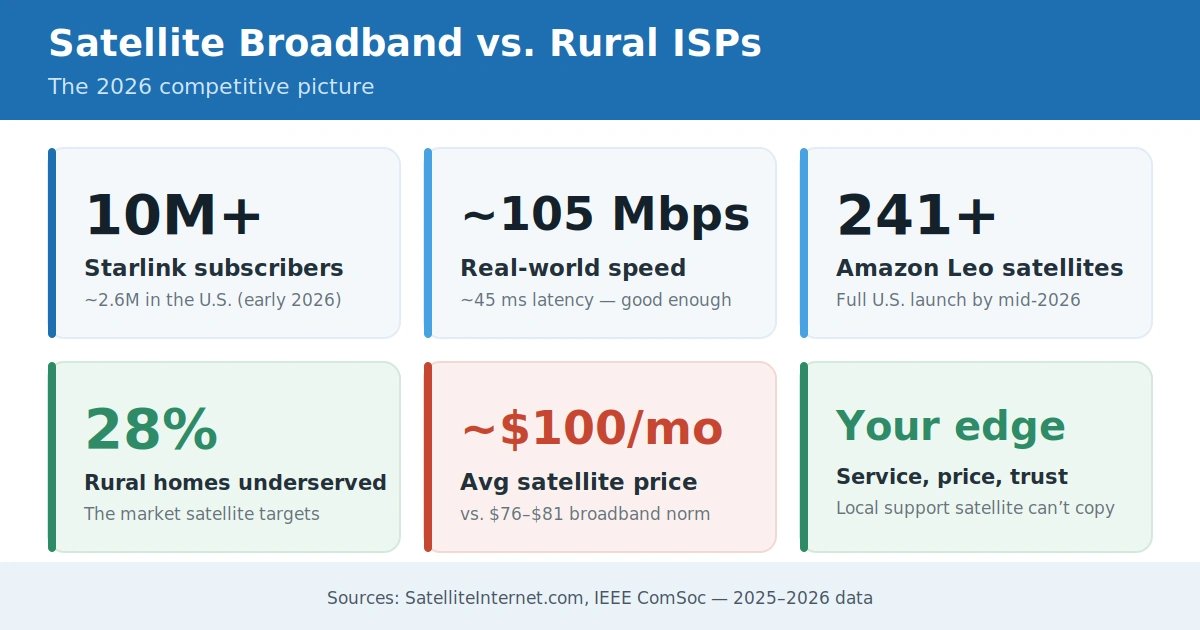 Satellite broadband vs. rural ISPs – the 2026 competitive picture.
Where satellite still leaves a gap
Here is the good news. Satellite still has real weak spots. And every weak spot is a chance for you to win a customer back. So let us look at four.
- Price. Satellite costs about $100 a month on average. That is well above the $76–$81 national broadband norm. Many rural budgets feel that gap fast.
- Weather. Heavy rain, snow, and thick tree cover can slow or drop a satellite signal. Fixed lines do not blink at a storm.
- Self-install pain. A dish sounds easy. In practice, people struggle with aiming, mounting, and app setup. That is a support moment you can own.
- Faceless service. Big satellite brands lean on chatbots and forums. There is no local team who knows the area or the weather.
That last point matters most. Satellite giants scale with automation, not empathy. So your edge is not the network alone. In fact, your edge is the human on the other end of the line. A fast, warm, local support team is the one thing a satellite mega-brand cannot copy overnight. Yes, machines can move data. Still, they cannot calm a worried customer at 9 p.m.
Satellite vs. your service: the support view
Look at the fight through a support lens, not just a speed chart. Speed is only one part of the choice. Price, trust, and service shape the rest. The table below shows where each side is strong and weak.
| Factor | Satellite (Starlink / Amazon Leo) | Regional ISP / FWA |
|---|---|---|
| Monthly price | Higher (~$100 avg) | Often lower, local plans |
| Weather reliability | Can drop in storms | Steady on fixed lines |
| Install experience | Mostly self-serve | Can offer guided, local help |
| Human support | Chatbots, forums | Real agents who know the area |
| Local trust | Low, national brand | High, community roots |
Still, the pattern is clear. You will rarely beat satellite on raw reach. But you can beat it on service, price, and trust. So that is a support and operations game, not a hardware race. Moreover, it is a game you can start winning this quarter, with no new towers or fiber.
Why the switching moment is a support moment
Most rural customers do not switch on a whim. Instead, they switch after a bad experience. Maybe a long outage. Then a slow fix. Or a rude call. Soon a Starlink ad appears, and the timing feels right. So churn is rarely about the satellite dish. As we cover in why broadband subscribers churn faster than any other segment, it is really about the moment your service lets someone down.
This is why support sits at the center of the fight. Because each weak interaction pushes a customer one step closer to that dish. But each strong one pulls them back. Meanwhile, satellite brands are spending heavily to catch people at their lowest moment. So if your team is slow or hard to reach, you hand them the win.
Reliability tells the same story. Of course, rural customers accept that storms happen. Yet what they cannot forgive is silence. For example, a proactive text about an outage builds trust. Likewise, a quick, clear repair keeps them loyal. In short, good support turns a bad day into a reason to stay.
What “ready” support actually looks like
So what does a battle-ready rural ISP support team do? It moves fast at the moments that decide loyalty. Three moments matter most.
First, onboarding. A smooth install and activation builds trust on day one. If your team makes fixed-line setup easier than a satellite self-install, you win the first impression. And first impressions stick.
Second, problem-solving speed. When the internet drops, patience is thin. So quick, clear technical support keeps a frustrated customer from browsing satellite deals that night. But slow help does the opposite.
Third,the save moment. When a subscriber calls to cancel for Starlink, that call is not lost yet. A trained save-desk and win-back agent can offer a better plan, fix the real issue, and keep the customer. Miss that call, and the dish wins by default.
Here is the catch, though. Many regional ISPs run lean. So they do not have staff to cover nights, weekends, or sudden call spikes. Then satellite marketing drives a wave of “should I switch?” calls, and the phone rings out. Callers wait on hold. Some hang up and order a dish instead. Therefore, that gap is where subscribers quietly slip away.
Staffing for that gap is hard, too. After all, call volume is spiky, not steady. For instance, a storm or a new satellite ad can double your calls overnight. And hiring full-time agents for peaks you cannot predict is costly. Yet under-staffing costs even more in lost customers. So it is a tough balance for a small team.
Turning the threat into a plan
You cannot stop satellite from launching. But you can control how ready your team is when it lands. So treat support as a competitive weapon, not a cost center. In practice, that means always-on coverage, trained agents, and strong save-desk skills. And you get all of it without hiring a huge in-house team. It also means clean data. As a result, you spot at-risk customers before they call to quit.
This is exactly where the right partner helps. Sequential Tech supports rural and regional broadband providers with the operations that keep subscribers loyal. For example, our teams cover 24/7 customer care, technical and install support, plus retention and win-back. So they can answer the “should I switch to satellite?” moment before it becomes a cancellation. Moreover, our telecom-trained agents work across onshore, nearshore, and offshore sites. As a result, you get coverage and scale without the overhead.
So if a satellite is moving into your territory, let’s get your support team ready first. Book a free consultation, and turn the satellite threat into your next retention win.