
BEAD money is flowing to rural broadband. But building the network is only half the job. Serving new subscribers well is the next big test, and many small ISPs are not ready.
The checks have cleared, and the fiber is going in the ground. For many rural internet providers, this is a huge moment. Years of planning are finally becoming real service. But here is the part few people talk about. Once the network is live, the real work begins. New subscribers will call, chat, and email from day one. They will need installs, logins, billing help, and fixes. And they will expect it fast. This is the quiet challenge behind BEAD-funded ISP customer support. So let us look at why readiness matters now, not later.
The Shift From Deployment to “Non-Deployment”
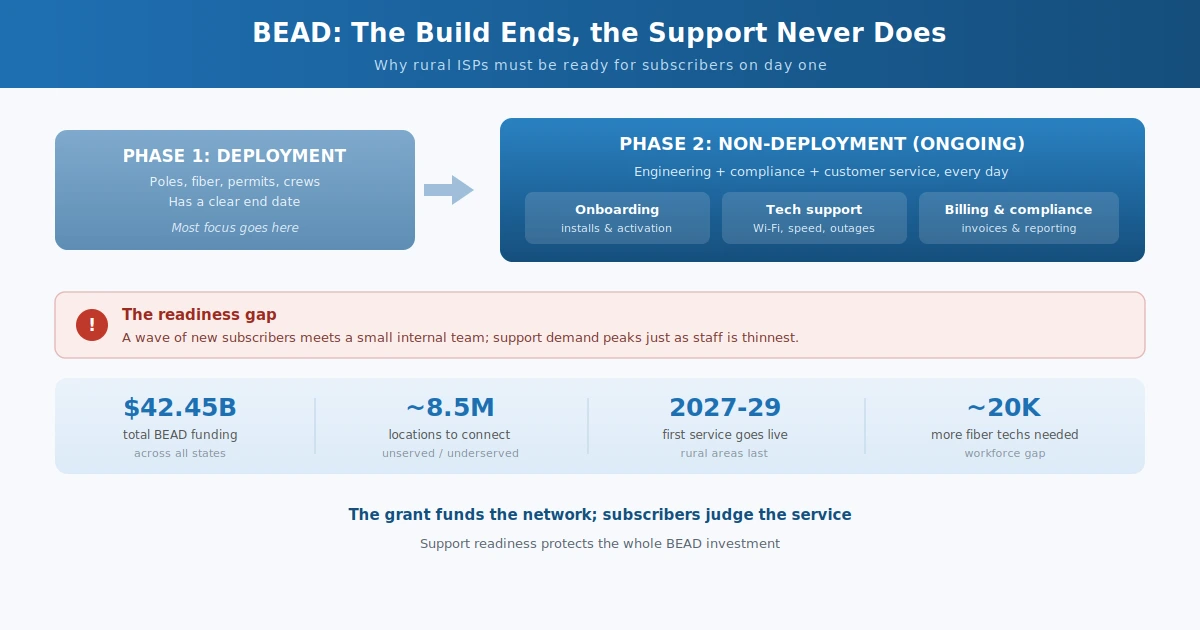
For years, the BEAD story was about deployment. It was about poles, fiber, permits, and crews. That phase is vital, but it has an end date. After the build comes a longer phase, and it never really stops. Industry voices now call it the “non-deployment” side. In short, once the network is built, the daily job changes. Suddenly, an ISP must run engineering, compliance, and customer service at the same time. And it must do all of this with a small internal team. That shift catches many rural providers off guard. During the build, the pressure sits with construction crews and vendors. After the build, it moves to the front line that talks to subscribers. Yet that front line is often the least staffed part of a small ISP. So the very moment demand peaks is the moment many teams feel stretched.
The Real Challenge: Serving Subscribers With a Small Team
Most rural ISPs are lean by design. A handful of people may cover many roles. That works fine during a slow, steady build. But a BEAD rollout is not slow or steady. It brings a wave of new subscribers in a short window. And each new subscriber brings new support needs. The gaps show up fast in areas like these:
- Installation and onboarding. New users need setup help and clear first steps.
- Tier 1 technical support. Wi-Fi, speed, and connection issues arrive daily.
- Billing questions. First bills and plan changes drive many calls.
- Outage response. A single fiber cut can flood the phone lines.
- Compliance and reporting. BEAD grants carry ongoing rules and paperwork.
- After-hours coverage. Subscribers expect help at night and on weekends.
Each gap is manageable alone. Together, though, they can overwhelm a small team. For example, one bad storm can trigger an outage and a call spike on the same day. Meanwhile, routine installs and billing questions still need answers. Worse, a poor first experience can sink trust quickly. In rural markets, word travels fast, so reputation matters even more. And once a new subscriber loses faith, winning them back is hard.
Why Support Now Shapes the Whole BEAD Investment
It is easy to treat support as an afterthought. After all, the grant funds the build, not the call center. However, the build only creates the pipe. Subscribers judge the service, not the fiber. So a great network with poor support still feels like a bad product. Moreover, churn early in a rollout is expensive. Every lost subscriber weakens the business case behind the grant. In other words, support readiness protects the whole BEAD investment. It is not a side task; it is part of the return.
Where Support Demand Comes From After Buildout
New demand does not arrive evenly. Instead, it clusters around a few key moments. First comes activation, when many users connect for the first time. Then comes the learning curve, as people test speeds and set up devices. Many of these callers are new to home broadband, so even basic questions take longer. Billing questions follow soon after, once the first invoice lands. Outages create their own sharp spikes, often all at once. On top of this, BEAD programs add reporting and compliance duties. So the support load is both larger and more uneven than many expect. As a result, average staffing plans rarely hold up during these peaks.
 Customer support readiness for BEAD-funded rural broadband providers in 2026
A Simple Support Readiness View
Where should a rural ISP focus first? The table below maps each support area to the BEAD-era demand and a simple way to prepare.
| Support Area | The BEAD-Era Demand | How to Get Ready |
|---|---|---|
| Installation and onboarding | A surge of new activations at once | Plan for peak volume, not average |
| Tier 1 technical support | Daily Wi-Fi, speed, and setup issues | Train agents on your network and devices |
| Billing and account help | First-bill confusion and plan changes | Prepare clear scripts and self-service |
| Outage and network events | Sharp, sudden call spikes | Build surge capacity and status updates |
| After-hours coverage | Nights and weekends demand | Add 24/7 support without full-time hires |
| Compliance and reporting | Ongoing grant obligations | Track and log subscriber interactions |
What the 2026 BEAD Data Shows
The scale of BEAD explains the urgency. Here is where things stand now. The program directs about $42.45 billion to expand high-speed internet, and every state and territory has an allocation. Together, these plans target roughly 8.5 million unserved and underserved locations. As of early 2026, most states have moved past planning and into deployment or coverage checks. First service is expected to reach many subscribers in 2027 and 2028, with the hardest rural areas stretching to 2029. Meanwhile, the industry still needs about 20,000 more fiber technicians, and build costs have risen 15% to 20%. So budgets are already tight before support even begins. In that setting, an efficient support plan is not a luxury. It is a way to protect thin margins while service scales.
How Rural ISPs Can Prepare Their Support
There is no single right answer here. Instead, most rural ISPs weigh three broad paths. The first is to build support fully in-house. This gives control, but it is slow and costly to staff and train. The second is to partner with a support provider that already knows broadband technical support. This adds trained agents and 24/7 coverage without a hiring sprint. The third is a hybrid, where the ISP keeps core roles and shares the overflow. Many rural providers favor this mix, since it protects local knowledge while adding scale. Whichever path fits, the goal is the same. It is to be ready for the first wave, not to scramble after it. Therefore, it helps to plan support early, right alongside the build schedule. Strong customer onboarding from day one also lifts retention across the whole rollout.
Getting BEAD-Era Support Right
BEAD is a rare chance to close the rural digital divide. But the grant only pays for the network, not the years of service that follow. So the providers who plan for support now will protect both their subscribers and their investment. If your team is preparing for a wave of new users, Sequential Tech can help. Our telecom-trained teams handle customer care and technical support with 24/7 coverage and fast, flexible scaling. To map your support readiness before your first subscribers connect, book a free consultation today.