
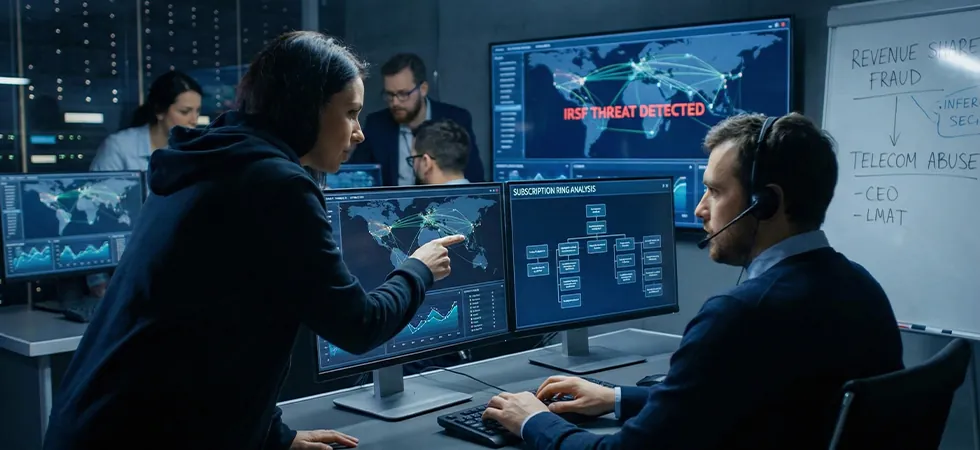
How international revenue share fraud detection depends on trained fraud analysts who monitor traffic patterns, investigate suspicious call volumes, and coordinate blocking actions before losses accumulate.
International Revenue Share Fraud (IRSF) is the most financially damaging fraud type in telecom, costing the industry an estimated $6.69 billion annually. The scheme is simple: fraudsters generate high volumes of calls to premium-rate numbers in countries where they control the revenue share, pocketing the per-minute payments while the originating carrier absorbs the charges. The calls are often generated through SIM boxes, hacked PBX systems, or subscription fraud rings that open accounts solely to generate fraudulent traffic.
International revenue share fraud detection requires trained fraud analysts who monitor traffic patterns 24/7, investigate anomalies that automated systems flag, and make the judgment calls about blocking suspicious traffic before losses accumulate into six-figure exposures. Sequential Tech provides the fraud analyst teams who serve as the carrier’s operational defense against IRSF; the people who interpret alerts, investigate patterns, and take action.
Revenue-share fraud connects to the wider threat landscape — stopping VoIP fraud at the source, detecting synthetic voice in high-value calls, and zero-trust controls for agent data access.
What Fraud Analysts Monitor and Investigate
IRSF Detection: Analyst Monitoring and Response Workflow
| Fraud Signal | How It Appears in Traffic Data | Analyst Investigation | Blocking Action |
|---|---|---|---|
| Sudden spike to premium-rate destinations | New account generates 500+ minutes to high-cost country in first 48 hours | Verify account legitimacy, check subscription details, review activation channel | Suspend international calling on account, escalate for investigation |
| SIM box traffic pattern | Multiple SIMs showing identical call patterns to same destinations from same cell tower | Correlate IMEI/IMSI data, map device cluster to single location | Block device cluster, report to regulatory authority |
| Wangiri (one-ring) callbacks | Missed calls from premium-rate numbers triggering subscriber callbacks | Identify originating number ranges, assess subscriber exposure volume | Block inbound from flagged ranges, notify affected subscribers |
| PBX compromise traffic | Enterprise PBX generating unusual overnight international calls | Contact enterprise client to verify, check for known PBX vulnerability patterns | Restrict enterprise international access pending client confirmation |
| Subscription fraud ring | Cluster of new activations with similar identity patterns generating IRSF traffic | Analyze activation data: same store, similar ID documents, sequential device IMEIs | Suspend ring accounts, flag activation channel for review, generate prosecution referral |
The Speed Imperative: Analyst Response Time vs. Loss Accumulation
International revenue share fraud detection is a race against the clock. IRSF losses accumulate at $50–$500 per minute depending on the destination. A fraud analyst who detects and blocks a SIM box generating traffic to a premium destination within 30 minutes limits exposure to $1,500–$15,000. The same fraud operating for 24 hours generates $72,000–$720,000 in losses. Every hour of analyst response delay translates directly into financial exposure.
Sequential Tech’s fraud analysts operate on aggressive response SLAs: initial alert review within 5 minutes, investigation initiated within 15 minutes, and blocking action executed within 30 minutes of confirmed fraud. This human response speed, combined with automated blocking for the highest-confidence alerts, limits carrier exposure to minutes of loss rather than hours.
“IRSF fraud does not wait for business hours. The fraud analyst who reviews an alert at 3 AM and blocks a SIM box by 3:30 AM has saved the carrier more money in 30 minutes than most cost-cutting initiatives save in a quarter. 24/7 analyst coverage is not optional for IRSF defense. It is financial protection.” — Telecom Fraud Economics Report, 2026
Post-Incident Analysis: Building the Intelligence Library
After every confirmed IRSF event, Sequential Tech’s analysts document the fraud pattern, the detection signals that identified it, the response timeline, and the total financial exposure. This documentation builds a continuously growing intelligence library that improves detection speed for future events. Analysts trained on past patterns recognize new variants faster, and the intelligence is shared across the analyst team to ensure every shift benefits from collective experience.
DEFEND YOUR REVENUE WITH FRAUD ANALYSTS WHO RESPOND IN MINUTES
Sequential Tech’s IRSF fraud analysts monitor traffic 24/7, investigate anomalies, and execute blocking actions within 30 minutes — limiting exposure from hours to minutes.