
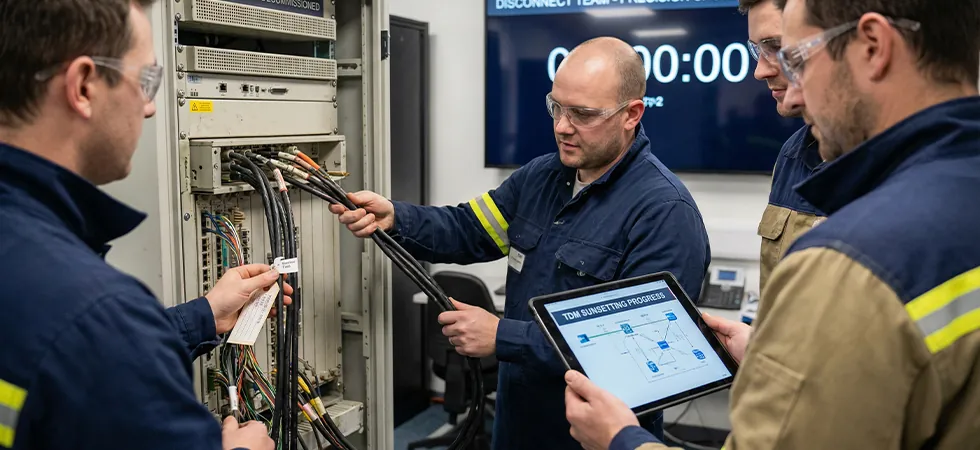
How a legacy copper TDM sunset strategy depends on trained disconnect analysts who verify circuit dependencies, coordinate with field teams, and process structured decommissioning records that prevent accidental service impact.
TDM sunsetting is not a switch that gets flipped. It is a circuit-by-circuit, record-by-record operation executed by analysts who verify each circuit’s status before any disconnect order is issued. Automated tools can flag candidates for disconnection, but the decision to disconnect and the verification that no active service will be impacted; requires human judgment applied to each individual circuit.
An analyst reviews the billing record, checks the network management system, contacts the customer if status is ambiguous, and only then submits the disconnect order. A well-executed legacy copper TDM sunset strategy at scale requires hundreds of these verification-and-disconnect cycles executed daily across a project spanning 12–24 months. Sequential Tech provides the trained disconnect analyst teams who perform this precision work, operating within the carrier’s systems and compliance requirements.
TDM sunsetting relies on tight operational discipline — coordinating secure facility access, change control for every shutdown, and compliance documentation that stays current.
What Disconnect Analysts Do Every Day
Daily Workflow of a TDM Disconnect Analyst
Each analyst handles a structured workload that spans five core task categories. Together, these tasks form the human execution layer of any serious legacy copper TDM sunset strategy.
| Task | Daily Volume | Skills Required | Why It Cannot Be Automated |
|---|---|---|---|
| Circuit status verification | 20–35 circuits reviewed | Navigate billing, NMS, and provisioning systems simultaneously | Conflicting records across systems require human interpretation |
| Customer contact for ambiguous circuits | 5–12 outbound calls | Professional communication; ability to explain technical status simply | Customer confirmation of service usage requires conversation |
| Dependency check with field operations | 3–8 coordination contacts | Understanding of physical plant relationships, alarm circuits, inter-carrier trunks | Shadow circuits and undocumented dependencies found only through human inquiry |
| Disconnect order submission | 10–20 orders processed | Disconnect workflow compliance, proper approval routing | Each order requires confirmed verification status before submission |
| Documentation and audit trail | All actions logged per circuit | Accurate record-keeping, resolution codes, exception notes | Complex cases need narrative explanation for regulatory audit |
The Customer Contact Challenge in TDM Disconnects
Sensitive Conversations That Protect Service Continuity
A legacy copper TDM sunset strategy requires analysts who can handle sensitive customer conversations. When an analyst calls an enterprise customer to verify whether a legacy TDM circuit is still in use, the conversation must be handled with care. The customer may not know what a TDM circuit is. They may panic at the suggestion that a service might be disconnected. They may have a critical application running on a circuit nobody in their organization documented.
The analyst must navigate these conversations professionally; gathering the information needed to make a safe disconnect decision without creating unnecessary alarm or compliance risk.
“Every TDM circuit has a story. Some are carrying critical traffic that nobody documented. Some were abandoned years ago but never formally disconnected. The analyst’s job is to uncover each story, verify the facts, and make the right call. There is no automated substitute for that judgment.” — Network Decommissioning Operations Report, 2026
Scaling Disconnect Operations with BPO Teams
Project-Based Analyst Staffing Across the Volume Curve
TDM sunset projects generate enormous volumes of disconnect work that peak during the active decommissioning phase and wind down as the project completes. Sequential Tech provides project-based disconnect analyst teams that scale to match the volume curve ramping up to dozens of analysts during peak execution and scaling down as the remaining circuit count decreases.
The carrier gets the operational capacity the project demands without building permanent headcount for temporary work. This flexible staffing model is central to any cost-effective legacy copper TDM sunset strategy at enterprise scale.
Key Performance Benchmarks for TDM Sunset Operations
Metrics That Define a Successful Decommissioning Program
- Circuit verification accuracy rate: 99%+ required for audit compliance
- Customer contact resolution rate: 85–95% of ambiguous circuits resolved within 5 business days
- Disconnect order accuracy: Zero re-orders due to analyst error
- Documentation completeness: 100% of orders accompanied by audit-trail notation
- Project cycle time: 12–24 months for enterprise-scale copper sunset programs
EXECUTE YOUR TDM SUNSET WITH PRECISION ANALYST TEAMS
Sequential Tech’s disconnect analysts verify every circuit, contact every ambiguous customer, and process every decommissioning order with the care and documentation your sunset project demands.