

This guide compares the top 5 satellite internet providers in the USA for 2026, covering real prices, speeds, latency, and current provider risks for homes.
Need fast internet but live far from a city? You are not alone. Millions of US homes sit outside cable and fiber lines. Satellite internet providers solve this problem. They send internet signals from space straight to your home. This makes them a lifeline for rural areas.
However, not all providers work the same way. Some are fast. Some are cheap. One is even shutting down parts of its service this year. Therefore, picking the right plan takes real research. This guide breaks down the top 5 satellite internet providers in the USA for 2026. You will learn the actual prices, real speeds, and key pain points to watch.
This guide covers only satellite options. We skip cable and fixed wireless entirely. That way, you get a clear, focused view of the best satellite internet provider choices available right now.
If you’re also comparing mobile connectivity, see our guide to the top 5G network providers in the USA.
Common Pain Points with Satellite Internet
Satellite internet is not perfect. Before you pick a plan, you should know the trade-offs. Otherwise, you may face surprise costs or slow service later.
- High cost: Plans often cost more than cable or fiber internet.
- Data caps: Some plans slow down sharply after you hit a limit.
- Lag time: Older satellites sit farther from Earth. This creates delay, known as latency.
- Weather issues: Heavy rain or snow can weaken your signal.
- Provider risk: Some satellite companies are struggling financially. One major provider filed for bankruptcy in August 2026.
Keep these points in mind as you compare the options below.
How We Picked These Providers
We looked at three factors: speed, price, and current market strength. We used data from late 2025 and 2026. We also checked which providers are actually accepting new customers today. This matters more than usual, since not every well-known provider is a safe long-term pick right now. We pulled figures from provider disclosures, FCC filings, and recent SEC reports.
Top 5 Satellite Internet Providers in the USA (2026)
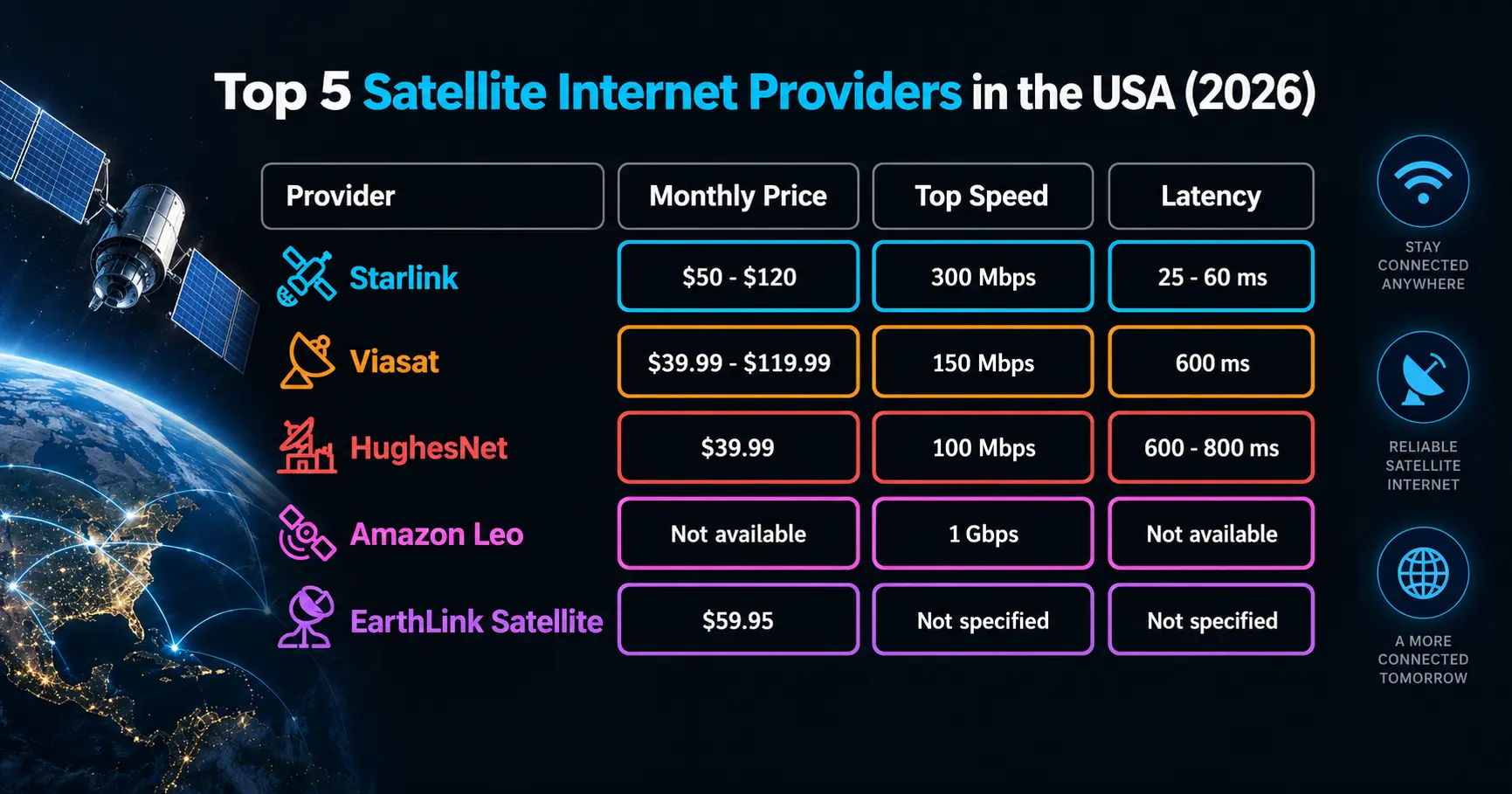 Comparison of the top satellite internet providers in the USA by price, speed, and latency.
1. Starlink — Best Overall Pick
Starlink leads the pack among residential satellite internet providers in 2026. It uses small satellites that orbit close to Earth. This setup is called low Earth orbit, or LEO. Because the satellites sit closer, the connection carries much less lag than older systems.
Starlink plans start at $50 a month for 100 Mbps download speeds. The top residential plan costs $120 a month for up to 300 Mbps. Hardware costs $349 upfront, or about $10 a month to rent instead. Latency runs between 25 and 60 milliseconds, which is fast enough for video calls and most online games.
Starlink now reaches almost every US ZIP code. It also serves more than 4 million subscribers worldwide. As a result, it stands out as the best high speed satellite internet provider for most rural homes today.
2. Viasat — Best for No-Contract Plans
Viasat uses older, high-orbit satellites. This design creates more lag than Starlink, often close to 600 milliseconds. Even so, Viasat still offers real value for many households, especially after its newer ViaSat-3 satellite boosted network capacity.
Plans range from about $39.99 to $119.99 a month. Top speeds reach 150 Mbps on the Unleashed plan. Viasat does not require a long-term contract on this plan. It also skips hard data caps, so your service will not simply shut off after you use your allowance.
Viasat works well if you want flexibility and do not need Starlink-level speed.
3. HughesNet — Proceed with Caution
HughesNet has served rural America since 1996. But 2026 brought major changes. The company filed for Chapter 11 bankruptcy on August 2, 2026. Since then, its parent company has guided many customers toward Starlink instead.
HughesNet still serves about 622,000 customers. Existing plans continue to run as normal. However, new sign-ups are not the safe choice they once were. Prices start near $39.99 a month for speeds up to 100 Mbps. Latency stays high, often between 600 and 800 milliseconds.
If you already use HughesNet, your service should keep working for now. Still, we do not recommend it for new customers in 2026.
4. Amazon Leo (Formerly Project Kuiper) — One to Watch
Amazon Leo is the newest name in the satellite race. Amazon rebranded Project Kuiper as Leo in late 2025. The company then began testing the service with business partners in April 2026, including major airlines and telecom carriers.
Amazon claims Leo could reach speeds up to 1 Gbps. That would beat every other provider on this list. However, full home service is not available yet. Amazon plans a wider consumer rollout in late 2026 or 2027.
Keep an eye on Amazon Leo. It may soon become one of the best satellite internet provider options once it opens to more US homes.
5. EarthLink Satellite — Best for Customer Support
EarthLink does not operate its own satellites. Instead, it partners with existing networks like Viasat. This setup makes EarthLink one of the more flexible internet providers via satellite.
Plans start around $59.95 a month. EarthLink offers unlimited data with no throttling penalties. Most plans do require a 12-month contract, though. On the plus side, EarthLink often scores well in customer service surveys, with ratings that beat several larger competitors.
If good support matters most to you, EarthLink is worth a closer look.
Compare the Top 5 Satellite Internet Providers
| Provider | Monthly Price | Top Speed | Latency | Best For |
|---|---|---|---|---|
| Starlink | $50–$120 | Up to 300 Mbps | 25–60 ms | Speed and low lag |
| Viasat | $39.99–$119.99 | Up to 150 Mbps | ~600 ms | No-contract flexibility |
| HughesNet | $39.99–$70 | Up to 100 Mbps | ~600–800 ms | Existing customers only |
| Amazon Leo | Not yet public | Up to 1 Gbps (planned) | TBD | Future high-speed potential |
| EarthLink Satellite | From $59.95 | Up to 150 Mbps | ~600 ms | Strong customer support |
Which Satellite Internet Provider Should You Choose?
The best satellite internet provider depends on your location, required speeds, latency expectations, pricing, contract preferences, and intended use. Availability and plan options can also vary by address, so checking each provider’s current service details is important before making a decision.
If satellite internet isn’t your only option, you can also compare traditional broadband alternatives in our guide to the top broadband service providers in the USA. This can help you compare different connectivity options based on speed, availability, pricing, and service requirements.
Satellite and Broadband Customer Support Services
Fast-changing markets like satellite internet create real pressure on customer support teams. Sequential Tech helps broadband and satellite providers manage that pressure every day. We handle customer care, technical support, billing support, and retention calls at scale.
Our teams also manage activations and onboarding, so new customers get set up fast and stay happy. If your satellite or broadband business needs a trusted BPO partner.