

The Enterprise Network Has Outgrown Traditional IT Teams
Enterprise IT teams used to manage predictable networks — centralized infrastructure, controlled traffic. Today’s environments span SaaS platforms, cloud regions, remote sites, and edge devices, and the traffic varies wildly. Traditional monitoring tools fall short because they lack the unified visibility and automated response that modern operations demand.The Explosion of Multi-Cloud, SaaS, and Edge Traffic
Digital enterprises now run across multiple clouds, SaaS platforms, and edge locations, which creates diverse, unpredictable traffic. It gets more complex as applications move between cloud regions, remote teams, and distributed devices. Gartner forecasts that nearly 90 percent of organizations will adopt hybrid-cloud strategies by 2027 — a clear sign of how fast the shift toward distributed ecosystems is happening. SaaS adoption is climbing across every industry, which raises the need for real-time, application-aware routing and stable connectivity. Edge workloads keep growing too, as enterprises add smart devices, IoT sensors, and location-specific processing. These shifts overwhelm legacy routing and open up visibility gaps. So enterprises turn to enterprise network management solutions to unify observability, automate routing, and strengthen cloud-ready connectivity. Those capabilities steady performance across SaaS platforms, hybrid environments, and distributed teams.Why Enterprise Network Management Solutions Fill the Gap
Modern ecosystems need real-time visibility, automated response, and unified policy control. Fragmented tools create blind spots that slow troubleshooting and drag down performance. The need for unified intelligence is growing worldwide. Cisco’s 2024 Global Networking Trends Report notes that more than 70 percent of organizations plan to adopt a “network platform approach” for their digital transformation. That reflects a wider move toward integrated architectures — combining routing analytics, performance metrics, transport insights, and security posture in one command layer. Enterprise network management solutions deliver that foundation. They support better decisions, add stability, and enable proactive monitoring that catches issues early. As SD-WAN adoption grows, enterprises lean on SD-WAN and managed services for predictable, secure, cloud-optimized connectivity across sites.
Managed Connectivity Services Bring Order to Network Chaos
Enterprises run across multiple clouds, SaaS platforms, and distributed sites, and the traffic is hard to predict. That complexity fragments the network and makes it tough to control. Managed connectivity simplifies the picture by pulling monitoring, routing, automation, and governance into one coordinated framework. The result: better reliability, faster troubleshooting, and steadier performance everywhere.From Fragmented Monitoring to Unified Intelligence
Legacy networks force teams to juggle separate dashboards for routing, logs, cloud health, and application performance. That slows decisions and creates blind spots. Managed connectivity merges those views into one observability layer, so teams see clearly and act faster. Single-source visibility helps enterprises catch issues sooner, coordinate responses, and stay connected even at peak demand.Three Personas Driving Modern Enterprise Connectivity
Think of modern enterprise connectivity as three personas working quietly inside the network. Each one is a layer of intelligence for performance, stability, and security.- The Watchtower — watches every packet and spots unusual patterns early. It predicts capacity issues and powers proactive network monitoring services that stop disruptions before they hit operations.
- The Traffic Conductor — allocates bandwidth smartly and picks the best routing paths. Through SD-WAN and managed services, it keeps performance stable across clouds, branch sites, and edge workloads.
- The Guardian Layer — enforces zero-trust security on every route. It analyzes traffic, blocks threats instantly, and protects distributed environments with unified policies.
The True Value of Managed Connectivity — Predictability Over Performance
Enterprises no longer judge connectivity on raw speed. They want predictable performance, stable application delivery, and uninterrupted access everywhere. Predictability drives operational continuity, revenue stability, and customer experience. So modern strategies focus on consistency, resilience, and governance — not peak throughput.Predictability as a Strategic Business Metric
Predictable networks cut friction and let workflows run cleanly. Stable connectivity keeps sales, engineering, logistics, finance, support, and digital operations performing consistently. That reliability improves coordination, lifts productivity, and supports better decisions across the business.Enterprise Network Management Solutions and the Cost-of-Downtime Equation
Downtime does real financial and operational damage. A simple baseline shows the impact: Cost = Minutes of Outage × Impacted Processes × Revenue Dependency Managed connectivity cuts both how often outages happen and how long they last, using automation, intelligence, and early intervention. Enterprises get stronger continuity, steadier performance, and more control over mission-critical work.Inside the Modern Managed Connectivity Stack
Modern enterprise networks rely on a structured connectivity stack that brings automation, visibility, routing intelligence, and security together. This layered model helps enterprises hold predictable performance, build resilience, and support complex workloads across many clouds.Layer 1 – Transport Intelligence
This layer manages MPLS, broadband, and 5G paths with precision. It gives critical applications stable throughput, low latency, and minimal packet loss, and it fails over fast to hold performance at peak demand.Layer 2 – Routing Autonomy
AI-driven engines track link health and pick the best path automatically. When congestion hits, they reroute instantly, keeping applications stable across clouds, edge sites, and remote locations.Layer 3 – Security Fusion
Security fusion combines SASE frameworks, zero-trust controls, and unified threat visibility in one protective layer. It secures users, workloads, and devices with consistent policies and real-time threat analysis across distributed environments.Layer 4 – Observability Mesh
The observability mesh pulls telemetry, logs, device insights, and performance analytics into a single diagnostic view. It speeds troubleshooting, sharpens detection, and helps teams read network behavior clearly.Layer 5 – Experience Orchestration
Experience orchestration uses QoE intelligence to manage bandwidth and prioritize the applications that matter. It keeps collaboration tools, cloud workloads, and enterprise systems responsive through real-time adjustments.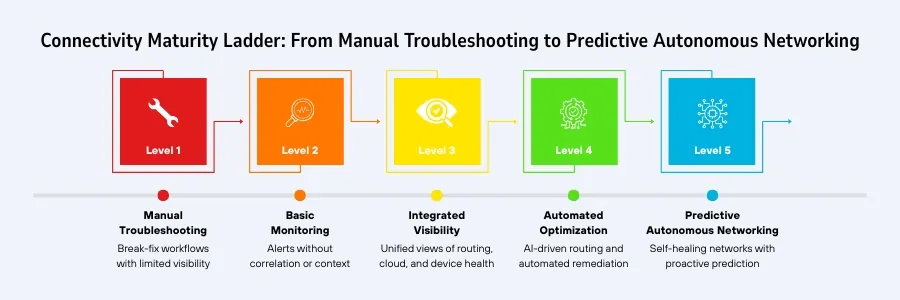
What Enterprises Gain from Managed Connectivity Services
Managed connectivity strengthens performance by improving reliability, tightening security, and adding operational agility across distributed environments. That helps enterprises keep operations steady, support heavy workflows, and deliver predictable results across every function.Uptime Becomes a Business Capability
Always-on connectivity supports operations that depend on constant access to cloud platforms and critical applications. Stable networks reduce interruptions and lift productivity across distributed teams. Enterprises get stronger continuity because users stay connected even at peak times. Key uptime advantages include:- Fewer operational delays during high-traffic demand
- Consistent performance across remote and on-site teams
- Better customer experiences across digital channels
Operations Transform from Reactive to Autonomous
Automated remediation replaces manual troubleshooting, so response cycles get faster. Predictive alerts catch faults early and guide fixes before disruptions land. That sharpens decisions and lightens the load on internal teams. Autonomous operations support:- Faster fault isolation across cloud and edge environments
- Less dependence on manual network intervention
- Better service reliability during unpredictable traffic shifts
Network Scaling Becomes Instant Instead of Incremental
Managed connectivity speeds expansion into new offices, warehouses, and cloud regions. Automated configuration activates sites fast, with no complex provisioning. Central orchestration supports real-time adjustments and instant scaling worldwide. Scalability benefits include:- Faster deployment for new facilities and project teams
- Simpler configuration for multi-region expansion
- Consistent performance through every growth phase
How Sequential Tech Helps Build the Modern Connected Enterprise
Sequential Tech strengthens enterprise connectivity through a co-managed model that improves reliability and performance across distributed environments. We deploy enterprise network management solutions that unify network intelligence, streamline routing, and remove blind spots. Our approach includes:- Digital enterprise connectivity support for multi-cloud workloads, global teams, and high-density edge deployments.
- SD-WAN and managed services that deliver encrypted transport, intelligent failover, and performance-based routing.
- Proactive network monitoring that catches anomalies early and cuts downtime risk.
- Cloud-ready connectivity models built for hybrid environments, SaaS ecosystems, and mission-critical workloads.
- A co-managed framework that empowers your IT team while handing complex engineering to our specialists.
- Continuous optimization that refines throughput, cuts latency, secures distributed access, and improves SLA outcomes.
WINNER · BEST B2B CX
A 15-year partnership grown to 76 live programs and $60M+ in annual revenue.
Mission-critical B2B telecom CX across nine sites — Gold, Best B2B CX, 2026.
Read the case study →