
A 2026 comparison of cost, speed, and staffing to help telecom operators pick the right 5G support model.
A single unfilled 5G engineering role can delay a network launch by months, and in 2025 that shortage hit roughly two out of every three telecom operators. So before you staff up an internal team, it is worth asking a sharper question: build 5G support yourself, or lean on managed 5G support services that already have the bench ready?
This guide compares both paths head-to-head, using current 2025-2026 data on cost, speed, and staffing, so you can pick the model that actually fits your network.
What Is Managed 5G Support, Exactly?
Managed 5G support services hand network monitoring, technical support, and customer care to an outside partner instead of an internal team. The partner brings trained staff, AI-assisted tools, and contractual service level agreements. In-house operations, on the other hand, keep every function inside the company, from hiring to tooling to daily monitoring. Both models aim for the same result: a stable, fast, well-supported 5G network. However, they reach that result in very different ways.
Why This Decision Matters More in 2026
Two forces are pushing this choice higher up the priority list.
First, the three biggest US carriers alone have invested more than $150 billion in 5G deployment since 2018, and North America’s 5G connections are on track to reach 867 million by 2030. Most of that growth needs specialized engineering and support talent behind it.
Second, that talent is scarce. In 2025, the Global mobile Suppliers Association found that 68% of telecom operators struggled to hire workers with the right 5G skills, especially for network slicing, RAN, and edge roles. As 5G-Advanced and cloud-native cores roll out, this gap is likely to widen, not close. As a result, more operators now treat the build-versus-outsource decision as a real strategic question instead of a formality.
Managed 5G Support Services vs In-House Operations: The Core Differences
Here is how the two models stack up across the factors that matter most to telecom operators.
| Factor | In-House Operations | Managed 5G Support Services |
|---|---|---|
| Setup cost | High upfront: hiring, tools, facility | Low upfront, pay-as-you-scale |
| Hiring 5G-skilled staff | Difficult — 68% of operators report shortages (GSA, 2025) | Handled by the partner’s existing bench |
| Time to launch a new market | Months (recruit, hire, train) | Weeks, using already-trained staff |
| Peak-period scaling | Requires overstaffing or risks missed SLAs | Elastic capacity, no idle headcount |
| AI tools & monitoring | Separate technology investment required | Bundled into the service (AI QMS, automated triage) |
| SLA accountability | Internal team only, no financial backing | Contractual SLA with financial terms |
| Best fit | Large carriers with an existing NOC | Growing operators, MVNOs, new market launches |
The pattern is clear: in-house operations demand more upfront investment and carry more staffing risk, while managed support trades some internal control for speed and cost predictability.
When In-House Still Makes Sense
Managed support is not the right fit for every operator. In-house operations still make sense in a few specific situations:
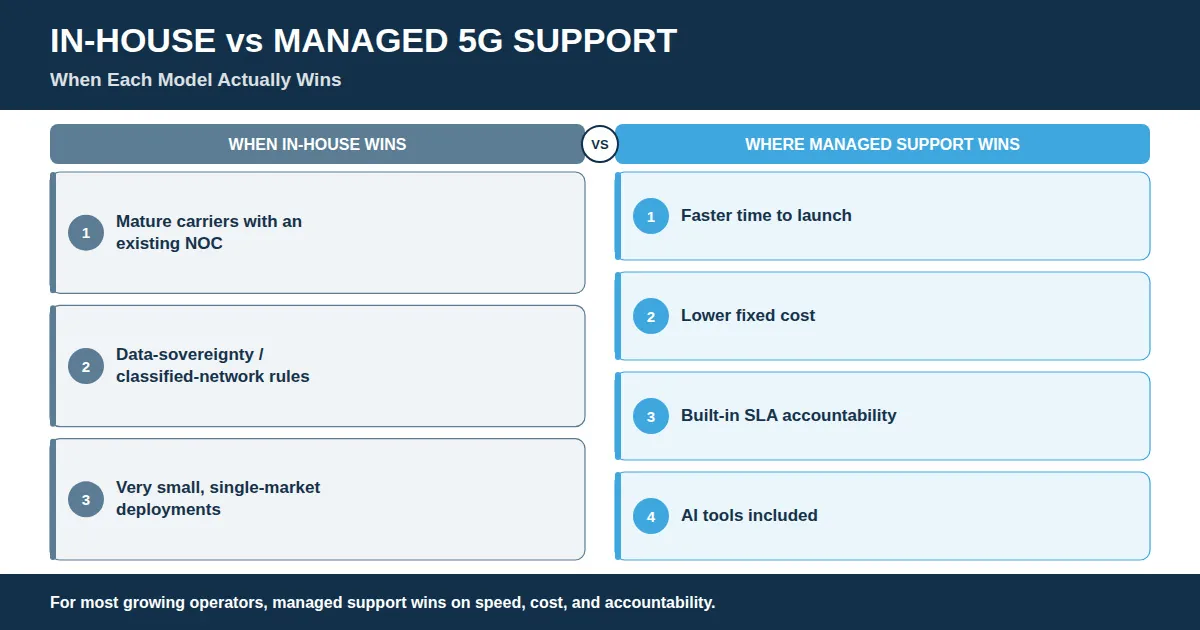
I. Mature carriers with an existing NOC: large operators with a fully staffed Network Operations Center already have the infrastructure, so adding managed support may just duplicate what already works.
II. Data-sovereignty or classified-network rules: some government or defense-adjacent networks require every operator to be an internal employee, which rules outsourcing out entirely.
III. Very small, single-market deployments: a carrier serving one small region may not generate enough support volume to justify a managed contract, so in-house handling can stay cost-effective at that scale.
Where Managed 5G Support Services Have the Clear Advantage
For most growing and mid-size operators, the advantage tips firmly toward managed support:
1. Faster time to launch: a managed partner already has a trained bench of 5G-skilled agents, so new markets or products can go live in weeks instead of months.
2. Lower fixed cost: staffing scales with support volume instead of headcount, so there is no need to carry idle capacity between deployment waves.
3. Built-in SLA accountability: a managed contract ties performance targets to real financial terms, which is harder to enforce on an internal team alone.
4. AI tools included: quality monitoring, automated triage, and real-time coaching come bundled into the service instead of requiring a separate technology budget.
Worth a Read — Managed 5G BPO Support Services: Reduce Costs & Improve SLAs
So, Which Is Better?
The honest answer depends on scale. Large, mature carriers with a fully staffed Network Operations Center often keep support in-house, since the infrastructure already exists. However, for growing operators, MVNOs, and any carrier entering a new market or launching 5G-Advanced services, managed 5G support services typically win on speed, cost predictability, and staffing risk. In practice, many operators land on a blended model: core network control stays in-house, while day-to-day private 5G enterprise support and monitoring shift to a managed partner.
The Pain Points of Running 5G Support In-House
Even well-funded telecom operators run into the same recurring problems when they keep 5G support entirely internal:
- A shrinking pool of 5G-skilled talent: in 2025, 68% of telecom operators reported trouble hiring workers with the right 5G skills, and the shortage is worst for network slicing, RAN, and edge roles.
- Contractor premiums keep climbing: when full-time hiring stalls, operators pay contractor rates instead, and those premiums add up fast during a 5G-Advanced rollout.
- Peak periods force a hard choice: mass IoT activations and 5G standalone migrations create sudden spikes in support volume, forcing teams to either overstaff year-round or risk missed SLAs.
- Tooling adds hidden cost: AI-assisted monitoring, quality management systems, and automated triage all require separate investment when built in-house.
- Slower time to market: recruiting, hiring, and training a 5G-ready team takes months, and that delay can push back a new market launch or product rollout.
Powering The CX Behind America’s 5G Operators
Growing 5G and IoT deployments bring growing support demand, especially during network slicing rollouts, mass device activations, and 5G-Advanced migrations. Sequential Tech helps telecom and 5G operators manage exactly this kind of volume. Our teams handle customer care, technical support, service assurance, and activations and onboarding, all backed by AI-powered quality monitoring across onshore, nearshore, and offshore delivery. If your 5G support needs are outpacing your internal capacity, talk to our telecom BPO experts today.