
A SIM swap model is only as sharp as the examples it learned from. Here is why labeled training data, not the algorithm, decides whether your AI catches the attack or waves it through.
A SIM swap takes minutes, and the victim often has no idea until their phone goes dark. By then the attacker has already reset a password, caught the one-time code by text, and started draining accounts.
The FBI’s Internet Crime Complaint Center (IC3) tracked $25,983,946 in reported U.S. SIM swapping losses across 982 complaints in 2024, putting the average reported loss per victim at approximately $26,460 (with broader overall cybercrime averages distinct at lower amounts).
Carriers keep buying smarter detection AI to stop it. Yet many models still miss the attack, because nobody showed them what one looks like. That teaching material is AI training data for SIM swap fraud detection, the labeled examples that turn a raw model into one that actually catches the swap.
Why SIM Swap Is So Hard for AI to Catch
A SIM swap hides inside normal activity. Legitimate customers change SIMs every day when they upgrade phones, break a device, or switch networks. The fraudulent swap uses the same process as the honest one, so the raw signal looks almost identical.
That is the core problem. A model cannot separate a real attack from a routine upgrade unless it has seen thousands of confirmed examples of each. Without labeled history, it either misses the fraud or blocks paying customers who did nothing wrong. Neither outcome is acceptable to a US carrier.
The attack is also fast and rare. Because confirmed SIM swap fraud is a tiny fraction of all SIM changes, the model gets very few chances to learn the pattern. Rare events demand precise labeling, or the signal disappears into the noise.
What Labeled Data Teaches a SIM Swap Model
SIM swap is one case of a wider truth about how labeled data improves telecom fraud detection. Good training data marks the difference between an attack and an ordinary upgrade across several signals. This table shows what the model learns to read.
| Signal the Model Watches | Looks Like Fraud | Looks Legitimate |
|---|---|---|
| SIM change request | New device and location, minutes after a password reset | Routine upgrade at a store the customer has used before |
| Support call before the swap | Caller pressures the agent and dodges verification | Customer answers security checks calmly and correctly |
| Account activity after the swap | Instant login attempts on banking and email | Normal calls and texts resume as usual |
| Recent profile edits | Email and address changed hours earlier | No recent changes on the account |
| Port-out timing | Odd hours, far from the customer’s usual pattern | Daytime request matching past behavior |
Notice the pattern. Every signal already exists in carrier systems. What turns it into a detection model is the human label that says which pattern was fraud and which was a normal customer.
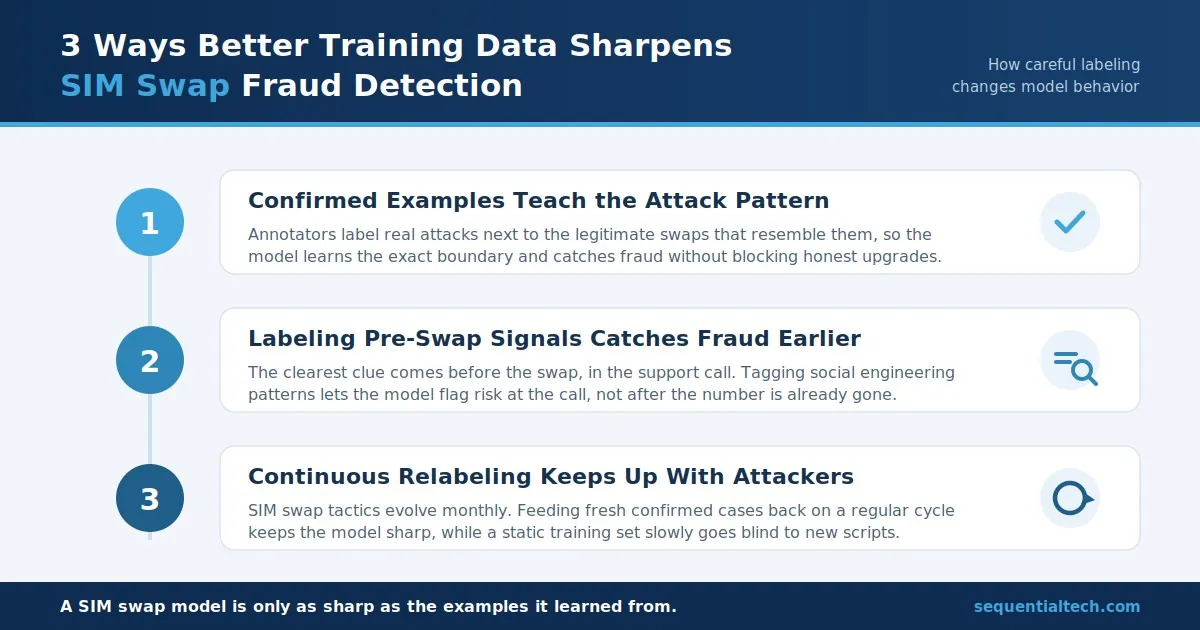
3 Ways Better Training Data Sharpens Detection
Here is how careful labeling changes the way a SIM swap model performs.
1. Confirmed Examples Teach the Attack Pattern
A model learns SIM swap fraud only from swaps a human confirmed as fraud. When annotators label real attacks alongside the legitimate swaps that resemble them, the model learns the exact boundary between the two. As a result, it catches more real attacks while waving through honest upgrades.
2. Labeling Pre-Swap Signals Catches Fraud Earlier
The strongest clue often comes before the swap, in the support call where an attacker pressures an agent or dodges verification. Therefore, annotators tag these social engineering patterns from real call recordings. The model then learns to flag risk at the call, not after the number is already gone.
3. Continuous Relabeling Keeps Up With Attackers
SIM swap tactics evolve fast, so a fixed training set goes stale within months. Consequently, fresh confirmed cases have to be labeled and fed back on a regular cycle. A model retrained on current examples keeps pace with new social engineering scripts, while a static one slowly goes blind.
Where SIM Swap Training Data Actually Comes From
This is not generic labeling work. Accurate SIM swap detection data depends on three things. First, annotators who understand how the attack unfolds, so they label the right signals rather than guessing. Second, clear rules for what counts as confirmed fraud versus a suspicious-but-legitimate swap, because inconsistent labels teach the model to contradict itself. Third, layered review, so labeling errors get caught before they ever reach training.
Security is non-negotiable here. This data includes call recordings, account records, and personal identifiers, so labeling has to run inside controlled, compliant workflows rather than on an open crowd platform. It is one reason outsourcing annotation for telecom risk management works best with a partner built for regulated data.
The Real Pain: The Model Learns the Wrong Lesson Without Good Labels
Most teams blame the algorithm when detection fails. However, the problem usually sits in the training data:
- The model never saw enough confirmed swaps. This is the biggest pain point. With SIM swap fraud so rare, a thin set of labeled attacks leaves the model guessing, and it guesses wrong on the cases that matter most.
- Legitimate swaps get labeled as fraud. Sloppy labeling teaches the model to distrust normal upgrades, which floods agents with false alarms.
- Attack tactics change monthly. Social engineering scripts shift constantly, so last quarter’s labels stop matching this quarter’s attacks.
- The pre-swap warning signs go unlabeled. The suspicious support call before the swap is often the clearest signal, yet it rarely gets tagged as training data.
- Raw carrier logs teach nothing alone. Operators hold millions of SIM change records with no label marking which ones were actually fraud.
The Bottom Line
Stopping SIM swap fraud rarely starts with a better algorithm. It starts with better labeled examples. Confirmed attack data teaches the pattern, labeled pre-swap calls catch fraud earlier, and continuous relabeling keeps the model current as tactics shift.
So before your team rebuilds its detection model, look hard at the data behind it. If nobody confirmed which SIM changes were fraud, the model never learned to tell the difference.
BUILD SIM SWAP DETECTION ON DATA THAT TEACHES YOUR MODEL
Sequential Tech delivers telecom data annotation services built for fraud and risk AI. Our trained annotators label SIM change records, pre-swap support call audio, social engineering patterns, account takeover signals, and post-swap activity, with support across 28+ languages. Every project runs on dedicated teams instead of crowdsourcing, with layered QA delivering 99%+ accuracy and secure workflows built for regulated telecom data. As part of the Fusion CX Group, we also run live fraud and risk operations, so our labels come from people who handle these attacks every day.