
Order fallout quietly drains telecom revenue. Here is how to prevent provisioning errors at the source, before stuck orders cost you activations, SLAs, and customers.
A telecom order rarely fails with a bang. It fails quietly. An address is wrong. A field detail is missing. A circuit sits half-built for weeks. The customer waits, and the revenue never starts. This is order fallout, and it is expensive. Worse, most of the cost hides below the surface. Yet most advice focuses on recovering stuck orders. This guide takes a different path. It shows how to prevent provisioning errors before they cost you revenue. That is the heart of smart telecom order fallout management.
The Real Problem: A Silent Revenue Leak
Order fallout is sneaky. The failure hides inside the workflow. So nobody notices until the numbers slip. By then, the damage is done. Here is what a single stuck order really triggers:
- Delayed revenue. Billing cannot start until the service is live.
- Rework and repeat handling. Staff touch the same order again and again.
- Pointless truck rolls. A failed field visit costs $150 to $500 or more.
- Missed SLAs. Late activations breach enterprise contracts.
- Customer churn. Frustrated customers leave before service even starts.
- Diverted staff. Teams fix orders instead of growing the business.
Each item drains margin. Together, they add up fast.
Why Provisioning Errors Cost More Than You Think
Here is the number that surprises finance teams. Back-end order fallout costs about $1 million for every percentage point of failure. And that is just direct remediation. Add churn, SLA penalties, and fines, and the real cost climbs much higher.
The volume adds up, too. Industry benchmarks show 10% to 20% of telecom orders fall out of automated workflows. Picture 10,000 orders a month at a 6% fallout rate. That is 600 stuck orders, every single month.
So fallout is not a rare glitch. It is a steady, hidden tax on your revenue.
Warning Signs Your Fallout Is Too High
How do you know fallout is hurting you? Watch for these signs:
- Orders that sit “pending” for days or weeks.
- Repeat truck rolls for the same install.
- A growing backlog in the provisioning queue.
- Billing that starts weeks after activation.
- Agents spending more time on fixes than on sales.
- The same error type appearing again and again.
A fallout rate above 10% is a clear red flag. It points to a system problem, not a one-off glitch.
Where Fallout Really Starts
To prevent fallout, you must find its root. And the root is usually not the technology. In one operator study, nearly 90% of provisioning escalations traced back to bad upstream data. Think stale addresses, duplicate records, and siloed systems.
A single broadband order can touch four systems: CRM, inventory, provisioning, and billing. These were rarely built to talk to each other. So one bad field early on breaks everything downstream. That is why fixing errors at capture beats fixing them later. In fact, standardized validation at capture is what separates a 5% fallout rate from a 15% one.
The True Cost of an Error, Stage by Stage
The later you catch an error, the more it costs. The table below shows why prevention wins.
| Stage | Typical Error | Cost to Fix | Why It Hurts |
|---|---|---|---|
| Order capture | Wrong address or data | $3–$10, minutes | Cheapest to fix here |
| Validation | Serviceability or inventory mismatch | Low, if caught | Stops downstream fallout |
| Provisioning | VLAN conflict or config error | Hours of rework | Order stalls in the queue |
| Field / truck roll | Missed visit or wrong CPE | $150–$500+ | 1 to 3 week delay |
| Post-activation | Billing never started | ~$1M per fallout point | Silent revenue leak |
The pattern is clear. An error caught at capture costs a few dollars. The same error caught after activation can cost a fortune.
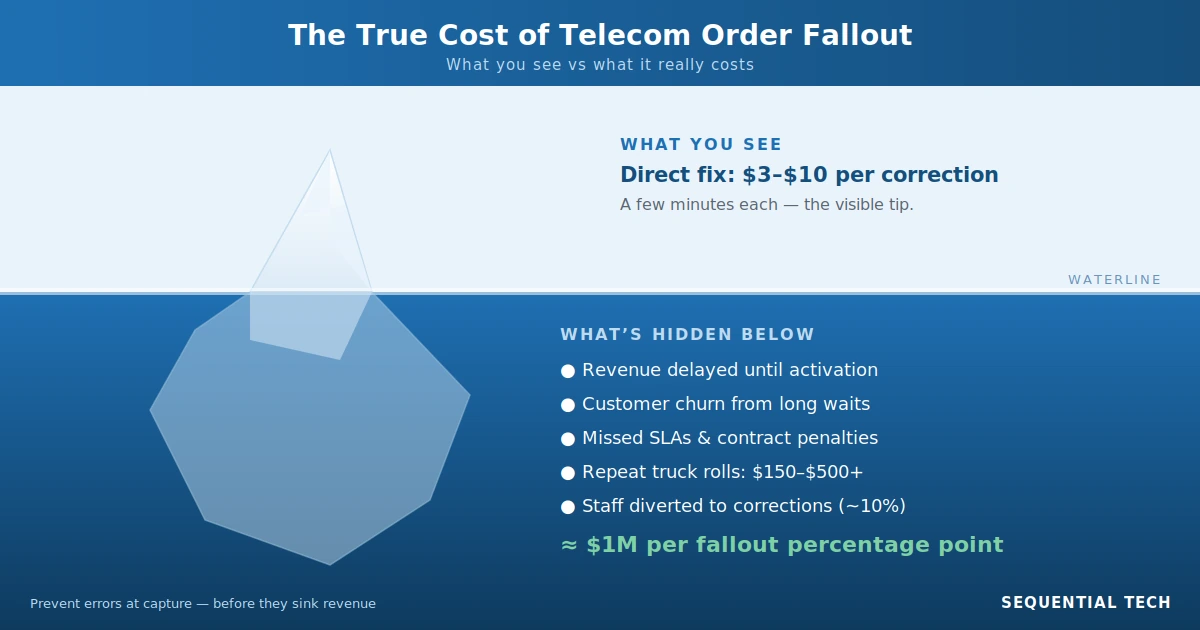 The visible fix is small, but hidden fallout costs much more.
How to Prevent Fallout Before It Costs Revenue
Prevention is a process, not a patch. Five moves make the biggest difference.
I. Validate at capture. Check serviceability, inventory, and address data at intake. Catch the error before it enters the pipeline.
II. Clean your upstream data. Since 90% of fallout is bad data, fix the source. Sync your CRM, inventory, and provisioning records. Clean data at the source prevents most fallout.
III. Give every order one owner. End-to-end ownership stops orders from falling between teams.
IV. Automate exception detection. Flag and route fallout by root cause, with full context, so fixes are fast.
V. Close the loop. When a pattern repeats, fix the system. Feed the fix back so the same error never returns.
Together, these five moves shift you from cleanup to prevention. And prevention is where the savings live.
Set a Target and Measure It
You cannot fix what you do not measure. So track your fallout rate every week. Break it down by cause, product, and stage. Then set a clear target. Best-in-class operators keep fallout under 2%. Above 10% is a warning sign. With the right process, most operators can cut their rate in half. The key is simple: measure, act, and repeat.
The 2025–2026 Data Leaders Should Know
The pressure is rising, and so is the investment. Here is where telecom sits today:
- Fallout is common. 10% to 20% of orders fall out of automation, per industry benchmarks.
- It is costly. Back-end fallout runs about $1 million per percentage point.
- Field visits hurt. Each failed truck roll costs $150 to $500 or more.
- Data is the culprit. Nearly 90% of escalations trace to bad upstream data.
- Silos slow you down. In PwC’s 2025 survey, 49% of telecom leaders cite siloed structures as a top barrier.
- Investment is growing. The order management market rises from $5.40 billion in 2025 to $6.14 billion in 2026.
The takeaway is clear. Prevention now pays off fast.
What This Means for Telecom Operators
For a NOC or service-delivery leader, fallout is a controllable risk. Most of it starts with data, not technology. So the fix is process and ownership, not just new tools.
A specialized telecom BPO partner can help. It can validate at capture, own the thread end-to-end, and close the loop on repeat errors. That is how leading operators push fallout down and keep it there. It is also how they protect provisioning quality at scale.
Fix Fallout at the Source
Order fallout is not fate. It is a data and process problem. Fix it at capture, and the savings compound. Ignore it, and the leak keeps draining revenue. So the smart move is prevention, not just recovery. Catch it early, and it never becomes a crisis.
Stop Paying for Orders that Never Activate.
Sequential Tech, runs telecom order management, provisioning, and fallout prevention, validating orders at capture, owning them end-to-end, and driving fallout below 2%, alongside activations and field coordination.