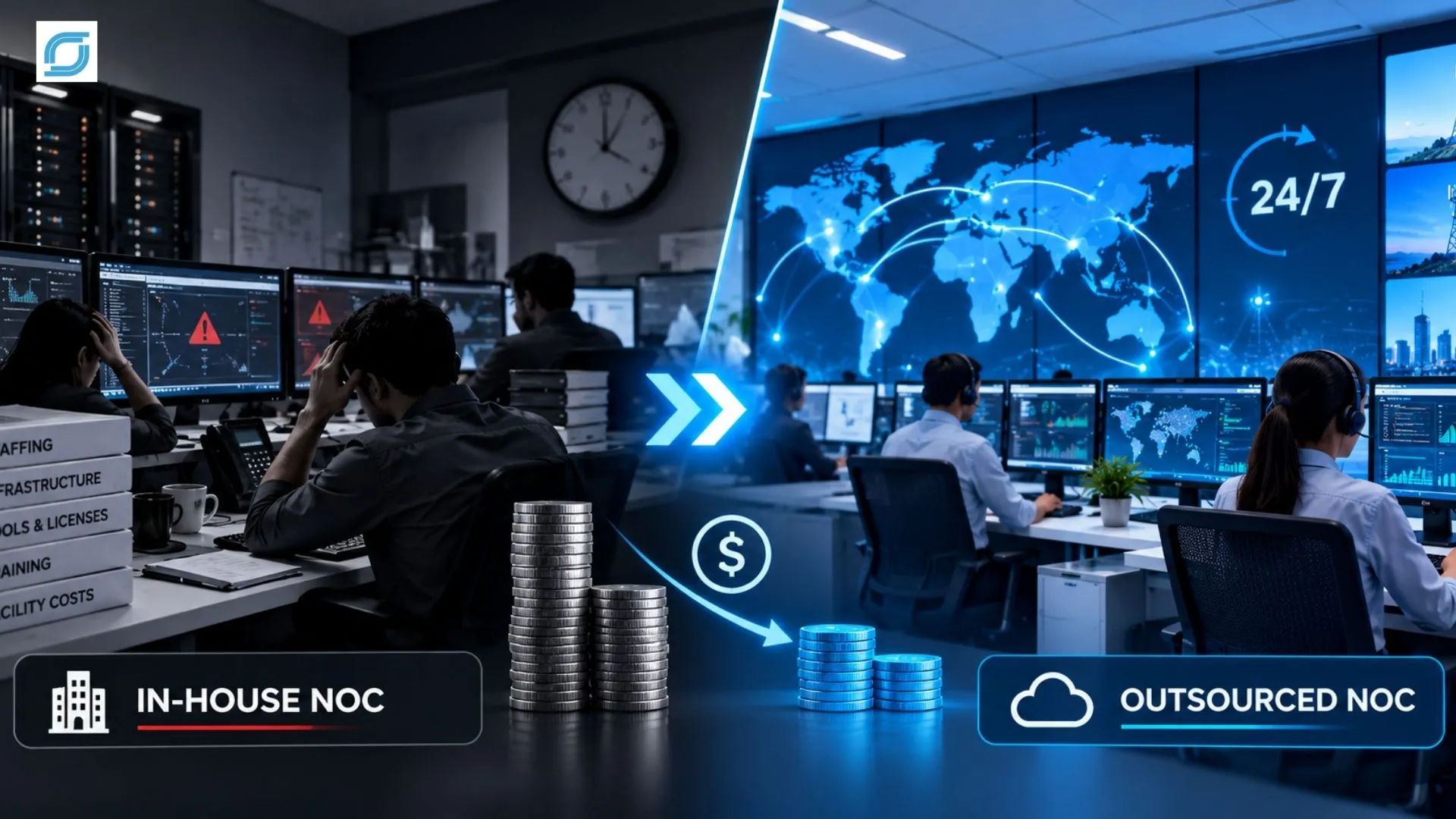
A clear cost breakdown of running an in-house telecom NOC versus outsourcing, the real total cost of ownership, and the point where telecom network operations outsourcing pays off.
Ask a telecom leader what their network operations center costs, and most name a salary figure. That number is only the tip of the iceberg. A 24/7 NOC costs far more than the people on the screens. There are tools, training, turnover, real estate, and the constant risk of downtime. Add it all up, and the true bill can shock a finance team. So the real question is not “what does a NOC cost?” It is “when does telecom network operations outsourcing make more financial sense?” This guide breaks down the math.
The Real Problem: The Hidden Cost of an In-House NOC
Most budgets only capture the obvious costs. Yet the biggest costs often hide below the surface. Here is what an in-house telecom NOC really includes:
- 24/7 staffing. A round-the-clock NOC needs at least two engineers on shift at all times. That means many hires, not a few.
- Fully loaded pay. Benefits push each engineer’s real cost to 1.25 to 1.4 times their base salary.
- Tools and licenses. Monitoring platforms, ticketing, and AIOps carry steep yearly fees.
- Turnover and burnout. Night shifts drive churn, and each exit means new hiring and training.
- Setup time. Standing up a basic NOC takes 16 to 24 weeks before it even runs.
- Downtime risk. Every hour of outage drains revenue and trust.
Each item adds up fast. Together, they turn a “simple” cost into a major line item.
What an In-House Telecom NOC Actually Costs
Let us put real numbers on it. Industry data for 2025–2026 gives a clear range. A fully staffed, 24/7 in-house NOC costs about $300,000 to $750,000 a year. Larger, complex telecom networks run higher. Network operations are a big slice of the budget, too. In fact, they make up over a quarter of total telecom OPEX, per Omdia.
The staffing math explains why. A true 24/7 desk needs coverage across four or five shifts. Salaries alone for a full team can reach $780,000 a year. And that figure does not include benefits, tools, or real estate. So the “loaded” cost climbs even further.
There is also the clock. It takes 16 to 24 weeks to build a basic NOC. During that time, you pay to build while you still carry the risk. That is a slow, expensive start.
In-House vs Outsourced: The Cost Comparison
The gap becomes clear when you line them up side by side. The table below uses common 2025–2026 figures for a mid-sized telecom network.
| Cost Factor | In-House NOC | Outsourced NOC (Telecom BPO) |
|---|---|---|
| Annual cost | $300K to $750K+ | About 30% lower OPEX |
| Staffing | You hire 8 to 12+ engineers | Shared expert team, no hires |
| Setup time | 16 to 24 weeks | Live in weeks |
| Tools and platforms | You buy and maintain | Included in the service |
| Turnover risk | High (night shifts) | Carried by the partner |
| Scaling | Slow and costly | Fast and flexible |
| Coverage | Hard to staff 24/7 | 24/7, follow-the-sun |
The pattern is simple. Outsourcing spreads fixed costs across many clients. So you pay for coverage, not for idle time at 3 a.m.
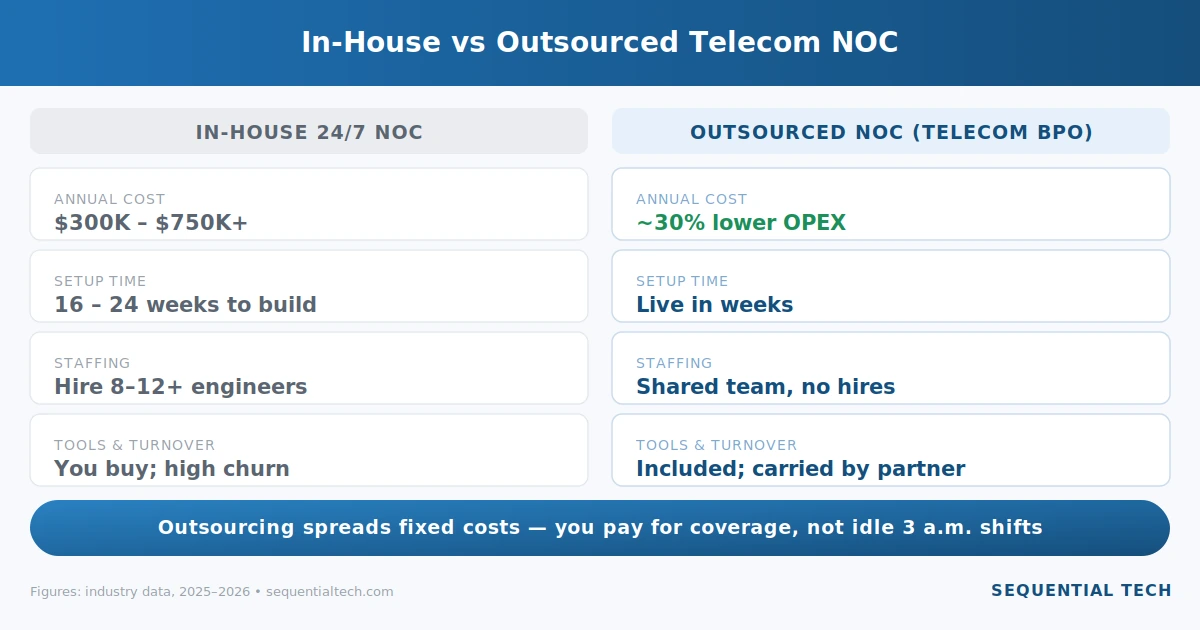 In-house vs outsourced telecom NOC — cost, setup, staffing, and coverage compared.
Why Outsourcing Changes the Math
An outsourced model works because of scale. One partner runs a single NOC for many operators. So the cost of each shift is shared. You are not paying an engineer to sit idle on a quiet night.
The savings are real. Telecom operators typically cut network OPEX by 15% to 35% with outsourcing, often around 30%. In some cases, the drop reaches much higher, since you skip the year-one build entirely. You also skip the hiring risk and the tool projects. There is more than cost, too. A mature partner brings ready processes, trained staff, and proven tools. So you get faster incident response from day one. That means less downtime and better SLA compliance.
When Does Outsourcing Make Financial Sense?
Outsourcing is not always the answer. But four signals point clearly toward it. Watch for these:
I. You cannot staff 24/7. If night and weekend coverage is a struggle, the math already favors a partner.
II. Setup time is too long. If you need coverage now, a 16 to 24 week build is too slow.
III. Costs keep climbing. If tools, turnover, and overtime keep rising, fixed monthly pricing brings control.
IV. The network is growing. If you are scaling fast, a flexible partner beats constant re-hiring.
If two or more of these fit, outsourcing likely wins on cost and speed.
When In-House Still Makes Sense
To be fair, in-house is not always wrong. Some operators have good reasons to keep it. A very large carrier may already have scale. A highly sensitive network may need direct control. And a stable, slow-growth network may not need extra flexibility. So weigh your own case. The goal is the best total cost of ownership, not a one-size answer.
Build Your Own TCO Model
You can run this math for your own network. Total cost of ownership takes six inputs. Pull these first:
1. Staffing. Fully loaded pay for every shift, not just base salary.
2. Tools. Monitoring, ticketing, and AIOps license fees.
3. Facilities. Real estate, power, and backup for the NOC.
4. Turnover. Hiring and training costs for each exit.
5. Setup. The one-time cost to build and integrate.
6. Downtime. Lost revenue during outages.
Add these up for a true yearly figure. Then compare it to a fixed outsourced quote. The gap is usually wider than a salary-only view suggests.
How to Move to a Partner Without Disruption
Switching does not have to be risky. Instead, phase it. First, let the partner shadow your team and learn the network. Next, hand over monitoring, with your team as a safety net. Then move Tier 1 and Tier 2 incidents. Finally, shift full 24/7 ownership once the metrics hold. A mature partner can be live in weeks, not months. So you gain coverage fast, without a risky “big bang” cutover.
What This Means for Telecom Operators and BPOs
For most mid-sized telecom operators, the numbers favor a partner. A 24/7 in-house NOC is expensive, slow to build, and hard to staff. A telecom BPO with a managed NOC removes those burdens. It also pairs well with telecom call centers and customer care, so network and customer issues connect smoothly.
That combined model matters. When the NOC and the contact center work together, faults get fixed and customers get told faster. That is where outsourcing pays off twice, on cost and on experience.
Run the Numbers on Your NOC
The true cost of an in-house NOC is bigger than the salary line. Tools, turnover, setup, and downtime all add up. In 2026, a managed partner often delivers the same coverage for far less. So before you build, run the full total cost of ownership.
Stop Paying Full Price For Idle 3 A.M. Coverage
Sequential Tech, a Fusion CX company, runs 24/7 telecom network operations, service assurance, and technical support, alongside customer care, billing, and activations, with SLA-backed coverage and global delivery. Want to see your real numbers?